Listen to a sample
This album is included in the following sets:
Overview
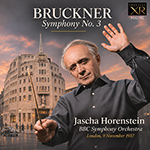
BRUCKNER Symphony No. 3 in D minor
Oeser edition (1877/78 version)
BBC broadcast, London, 9 November 1957
Ambient Stereo · Total duration: 58:36
BBC Symphony Orchestra
conducted by Jascha Horenstein
Audio presentation: Ambient Stereo
This set contains the following albums:
Jascha Horenstein’s name is inseparable from Bruckner, yet his path to the composer was oddly intermittent. He first encountered Bruckner at the age of fourteen, in June 1912, when he heard Artur Nikisch conduct the Ninth Symphony in Vienna. Horenstein later described the experience as a turning point, and admitted that when he conducted Bruckner he could never entirely escape the impression Nikisch had made on him. During the Weimar years his performances of the Ninth helped establish his reputation, and in 1928 he made with the Berlin Philharmonic the first electrical recording of a complete Bruckner symphony, the Seventh. Yet after a public performance of the Ninth in Leningrad in April 1932, Bruckner disappeared from his concert programmes for a quarter of a century.
It was only in 1957 that Horenstein returned to the composer in public, and he did so with a work new to him: the Third Symphony. The first of these performances was given in Caracas on 8 February 1957, the Venezuelan première, using the late Schalk/Rättig revision. Nine months later he turned to the work again in London, now with the BBC Symphony Orchestra, for a broadcast on 9 November. This second encounter is the present recording. It catches Horenstein at a revealing moment: a conductor already steeped in Bruckner’s language, but still discovering the particular shape and argument of the Third.
That work had had one of the most difficult births in nineteenth-century symphonic history. In 1873 Bruckner travelled to Bayreuth and offered both his Second and Third Symphonies to Wagner, asking him to choose which should bear the dedication. Wagner selected the Third, and Bruckner completed the original version later that year. Substantial revision followed. By the time the symphony was first heard in Vienna on 16 December 1877, its form had been tightened and its scoring reconsidered. Fate intervened cruelly: Johann Herbeck, who had arranged the performance, died before it could take place, leaving the composer to conduct it himself. The result was a notorious fiasco, with much of the audience leaving before the end. Even so, admirers remained, among them the young Gustav Mahler, who later helped prepare a piano-duet arrangement with Rudolf Krzyzanowski.
The Third exists in several significantly different forms, and the choice of text matters. For his Caracas performance Horenstein had used the familiar late revision. For the BBC he was asked to conduct Fritz Oeser’s edition of the earlier score, generally referred to as the 1877/78 version. Horenstein was not immediately convinced. In a letter to the BBC dated 25 October 1957 he complained, “I do not trust Oeser, and his edition is not convincing as far as I am concerned,” arguing that the mere restoration of cuts did not by itself prove the composer’s intention. The BBC turned to Robert Simpson, composer, broadcaster and one of Britain’s finest Bruckner advocates, to persuade him. After their correspondence on the subject, Horenstein eventually cabled: “AM SURRENDERING UNCONDITIONALLY TO THE SUPREME BRUCKNER AUTHORITY”. Beneath it, Simpson scribbled a single word: “Phew!” That exchange is more than an anecdote. It reminds us that Horenstein’s Bruckner was never routine. He approached the score with reverence, certainly, but also with a sceptical, independent musical intelligence.
Those qualities were ideally suited to this symphony, perhaps the most enigmatic of Bruckner’s mature works. The opening trumpet call, suspended above murmuring strings, sets an unmistakable seal on the whole structure. From there the music moves between solemnity and rustic vitality, mystery and proclamation. The Adagio unfolds in spacious paragraphs of grave lyricism; the Scherzo has the tread of an earthy dance; the Finale can seem almost wilfully elusive, its ideas juxtaposed with a freedom that challenges both conductor and listener. Horenstein’s gift was to make such contrasts feel inevitable. He avoids rhetoric for its own sake, keeps the long line in view, and allows the music’s architecture to emerge through patience rather than force.
In that respect this 1957 broadcast stands at the beginning of an important late chapter in Horenstein’s career. After so long an absence, Bruckner quickly reoccupied a central place in his repertory, and the Third became one of his favourites. Later performances would follow, but this London account preserves something unique: the sense of a great interpreter measuring a newly embraced work, and doing so under the stimulus of a newly adopted edition. The result joins experience to discovery. Forty-five years after the young Horenstein heard Nikisch conduct the Ninth in Vienna, Bruckner was still, for him, a living question rather than a settled monument.
BRUCKNER Symphony No. 3 in D minor
Oeser edition (1877/78 version)
01 I. Mehr langsam, misterioso (20:09)
02 II. Adagio, bewegt, quasi Andante (15:20)
03 III. Scherzo. Ziemlich schnell (7:18)
04 IV. Finale. Allegro (15:49)
BBC Symphony Orchestra
conducted by Jascha Horenstein
BBC broadcast, London, 9 November 1957
Digital restoration and remastering by Andrew Rose
Ambient Stereo
© 2026 Pristine Audio
Total duration: 58:36