Listen to a sample
This album is included in the following sets:
Overview
MOZART Symphony No. 40 in G minor, K. 550
HAYDN Symphony No. 88 in G major, Hob. I:88 (finale)
BEETHOVEN Symphony No. 3 in E flat major, Op. 55, “Eroica”
BEETHOVEN Symphony No. 5 in C minor, Op. 67
SIBELIUS Symphony No. 7 in C major, Op. 105
Studio and live recordings, London, 1933–1934
Total duration: 2:11:20 (2 CDs)
Mono
London Philharmonic Orchestra
BBC Symphony Orchestra (Sibelius)
conducted by Serge Koussevitzky
Transferred and restored by Mark Obert-Thorn
This set contains the following albums:
The present release brings together all of the recordings made by Serge Koussevitzky for the Gramophone Company (His Master’s Voice, or HMV) in London. These were his only commercial discs made with an ensemble other than his own Boston Symphony Orchestra, and as such are not included in Sony’s download-only release of his complete BSO recordings for RCA Victor and American Columbia. They are particularly important in that, except for the two Beethoven symphonies, these works were never re-recorded by Koussevitzky.
After his October, 1930 sessions in Boston, Koussevitzky found himself a casualty of the general cessation of Victor’s orchestral recording program due to the ongoing economic depression. As with some fellow Red Seal artists like Heifetz and Kreisler, he was offered a lifeline by Victor’s British affiliate, HMV, which was keen to record him with what were arguably the UK’s two finest orchestras of the time: Boult’s BBC Symphony (founded in 1930) and Beecham’s London Philharmonic (founded 1932).
Koussevitzky’s first session for HMV was held not in a studio, but during a live public performance. On 15 May 1933, he led the BBC forces at Queen’s Hall in a blazing account of Sibelius’s then relatively new Symphony No. 7, a reading which even nine decades on is still regarded as one of the finest versions ever committed to disc. The question as to why Koussevitzky never re-recorded the work with his own Boston Symphony has often puzzled recording aficionados; but his contract with HMV stipulated that in exchange for his royalties on this recording, any remake of the work would require written approval by the label.
Koussevitzky’s next recording would similarly be made during a live performance, this time in Carnegie Hall with the Boston Symphony in February, 1934 for American Columbia. But the resultant album of Roy Harris’s Symphony 1933 was poorly engineered, and proved to be his only effort for the label. Back in London in September of that year, Koussevitzky was welcomed before the HMV microphones again, this time in EMI’s new Abbey Road studios (opened 1931) for a recording program centered on three pillars of the Classical repertoire: Haydn, Mozart and Beethoven.
Although the LPO were very familiar with the idiom from their work with Beecham, some of Koussevitzky’s rhetorical touches may have been a surprise. The Mozart 40th is a strong performance and might stand as one of the most compelling versions of the 78-rpm era, save for the conductor’s odd choice to accelerate when the opening theme switches from minor to major in the first movement. By contrast, the Haydn 88th finale (recorded as the filler for the Beethoven Fifth) is an unalloyed delight, and makes one wish he had recorded the entire symphony.
The Eroica is another solid performance overlaid with such interpretive touches as the pronounced rallentandos during first movement transitions and the deliberate tempos for the opening and closing of the fourth movement. The overall conception is similar to the conductor’s 1945 Boston studio recording, however, demonstrating the consistency of Koussevitzky’s approach.
Noteworthy in his largely unmannered Beethoven Fifth is the broad tempo in the second movement, which required three sides rather than the usual two. The matrix numbers show that these sides, as well as the first side of the third movement, were recorded at the start of Koussevitzky’s first session with the orchestra, with the first movement coming next and the rest following.
HMV were happy enough with the results of the sessions that plans were mooted to record the Beethoven “Pastoral” and Seventh, even though Koussevitzky’s 1928 Boston recording of the former had only recently been issued in the UK. However, four months later in January 1935, RCA began recording the Boston Symphony once more, and Koussevitzky never subsequently made records with any other orchestra or label.
These recordings have been newly transferred and restored using state-of-the-art iZotope RX software and American Victor pre-war “Z” (Beethoven, Haydn and Mozart) and Gold label (Sibelius) pressings, featuring the quietest shellac on which the discs were originally released.
Mark Obert-Thorn
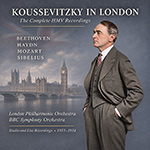
SERGE KOUSSEVITZKY in London: The Complete HMV Recordings
CD 1 (76:31)
MOZART Symphony No. 40 in G minor, K. 550
01 I. Molto allegro (7:25)
02 II. Andante (8:42)
03 III. Menuetto. Allegretto – Trio (3:52)
04 IV. Allegro assai (4:45)
Recorded 4–5 September 1934 · Matrices: 2EA 836-1, 837-1, 834-2, 835-2, 839-1 & 838-1 · First issued on HMV DB 2343/5
HAYDN Symphony No. 88 in G major, Hob. I:88
05 IV. Finale. Allegro con spirito (3:24)
Recorded 4 September 1934 · Matrix: 2EA 833-1 · First issued on HMV DB 2342
BEETHOVEN Symphony No. 3 in E flat major, Op. 55, “Eroica”
06 I. Allegro con brio (14:41)
07 II. Marcia funebre: Adagio assai (15:30)
08 III. Scherzo: Allegro vivace (5:14)
09 IV. Finale: Allegro molto (12:56)
Recorded 7 September 1934 · Matrices: 2EA 840-1A, 841-2A, 842-1A, 843-1, 844-1, 845-1, 846-1, 847-1, 848-1C, 849-1A, 850-2 & 851-2 · First issued on HMV DB 2346/51
CD 2 (54:49)
BEETHOVEN Symphony No. 5 in C minor, Op. 67
10 I. Allegro con brio (8:05)
11 II. Andante con moto (10:50)
12 III. Scherzo: Allegro (5:36)
13 IV. Allegro – Presto (8:56)
Recorded 3–4 September 1934 · Matrices: 2EA 829-2, 830-1, 824-1A, 825-2A, 826-2A, 827-1A, 828-2A, 831-1A & 832-2A · First issued on HMV DB 2338/42
SIBELIUS Symphony No. 7 in C major, Op. 105
14 Adagio (8:04)
15 Un pochettino meno adagio – Vivacissimo – Adagio (4:27)
16 Allegro molto moderato (3:43)
17 Vivace – Presto – Adagio (5:06)
Live recording, 15 May 1933 · Matrices: 2B 3784-1A, 3785-1A, 3786-2, 3787-1A, 3788-1A, 3789-1A · First issued on HMV DB 1984/6
London Philharmonic Orchestra (Mozart, Haydn, Beethoven)
BBC Symphony Orchestra (Sibelius)
conducted by Serge Koussevitzky
Recording venues: Abbey Road Studio No. 1, London (Mozart, Haydn, Beethoven); Queen’s Hall, London (Sibelius)
Producer and Audio Restoration Engineer: Mark Obert-Thorn
© 2026 Pristine Audio
Total duration: 2:11:20