This album is included in the following sets:
This set contains the following albums:
- Producer's Note
- Full Track Listing
- Cover Art
To mark the bicentenary of Beethoven’s death in 2027, Pristine returns to one of the most distinctive achievements of the early stereo era. Between 1957 and 1960, André Cluytens made the Berlin Philharmonic’s first complete recording of Beethoven’s nine symphonies. That honour belonged neither to Furtwängler nor to Karajan, but to a Belgian-born conductor whose reputation is still too often confined to French music.
Cluytens had developed his craft in the opera house, first in Antwerp and subsequently in France. His celebrated affinity with French repertoire was only part of his musical personality: in 1955 he became the first French conductor to appear at Bayreuth, directing Tannhäuser. His Beethoven belongs to that broader experience, bringing a feeling for colour and the singing phrase to an orchestra steeped in the German symphonic tradition.
The sessions took place in Berlin’s Grunewaldkirche. The First Symphony was recorded on 19 December 1958, during the same sequence of sessions that produced the Eroica; the Second followed on 15 and 16 April 1959. The Fidelio Overture was recorded as late as November 1960. These are commercial studio recordings rather than concert performances, made when stereo was opening new possibilities for capturing the colour, balance and spatial relationships of a great orchestra.
These three symphonies encompass an extraordinary transformation. The First, completed in 1800, still works within the classical framework of Haydn and Mozart, though its wit and disruptive accents are unmistakably Beethoven’s. By the Eroica, completed in 1804, the symphony has become a vehicle for drama on a radically enlarged scale.
British listeners encountered the recordings piecemeal. The First and Coriolan appeared on HMV’s Concert Classics label in 1969, before joining the Classics for Pleasure catalogue. Gramophone reviewed the First, Second and Third in April, May and August 1972 respectively, as the budget label assembled the cycle. The critics were not without reservations about Cluytens’s interpretations, but repeatedly recognised the quality of the orchestral playing and the attractions of the recorded sound.
In the First, Cluytens observes the exposition repeats in both outer movements, giving Beethoven’s arguments room to unfold. Robert Layton described the interpretation as “straightforward and unmannered”, while praising the recording’s “weight and sonority and a good spread of sound”. His observation that “The balance and perspective are natural and the tone quality lifelike” neatly identifies an enduring attraction of these performances: orchestral richness without a loss of individual instrumental character.
The Second makes greater demands on both players and conductor. Reviewing it the following month, Trevor Harvey emphasised the orchestra’s virtuosity and the “real excitement in the development section of the first movement”. He welcomed the flowing pace of the Larghetto, and found that the recording had “the great virtue of being extremely clear in every detail of the score”. Those remarks point towards a Beethoven in which energy and lyrical ease are partners rather than opposites.
With the Eroica, the scale changes dramatically, yet Cluytens’s concern for beauty of line remains. Edward Greenfield found his particular strengths most fully realised in the Scherzo: “The staccato is lithe and bright to give leaping energy, and the Berlin horns roar impressively in the Trio.” He also admired the finale’s rhythmic lightness, its exciting coda and the characteristic Berlin oboe tone. His description of the sound as “reverberant and warm in the Berlin manner” captures something essential about the partnership. The orchestra’s personality is not smoothed away; its colours are central to the interpretation.
The three overtures broaden this picture of Beethoven while recalling Cluytens’s theatrical roots. The Creatures of Prometheus provides a buoyant opening and a connection with the Eroica: it was the ballet’s finale, rather than its overture, whose theme Beethoven reused in the symphony. Coriolan introduces a darker dramatic world, and Fidelio offers a contrasting affirmation. Layton heard “splendid weight and authority” in Coriolan. Placed before the symphonies, these overtures serve as curtain-raisers rather than appendices, allowing each disc to reach its conclusion in Beethoven’s larger symphonic architecture.
Together, these performances offer more than a historical first. They preserve an encounter between a great orchestra and a conductor who could draw on its strength without sacrificing grace: an eloquent starting point for an anniversary journey through the nine symphonies.
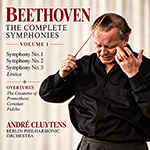
BEETHOVEN The Complete Symphonies, Volume 1
CD 1 (66:16)
BEETHOVEN The Creatures of Prometheus Overture, Op. 43
01. Overture (5:41)
Recorded April 1959
BEETHOVEN Symphony No. 1 in C major, Op. 21
02. I. Adagio molto – Allegro con brio (9:37)
03. II. Andante cantabile con moto (6:10)
04. III. Menuetto: Allegro molto e vivace (3:33)
05. IV. Finale: Adagio – Allegro molto e vivace (6:10)
Recorded 19 December 1958
BEETHOVEN Symphony No. 2 in D major, Op. 36
06. I. Adagio molto – Allegro con brio (12:47)
07. II. Larghetto (11:34)
08. III. Scherzo: Allegro (3:49)
09. IV. Allegro molto (6:55)
Recorded 15–16 April 1959
CD 2 (63:48)
BEETHOVEN Coriolan Overture, Op. 62
01. Overture (8:45)
Recorded April 1959
BEETHOVEN Fidelio Overture, Op. 72
02. Overture (7:14)
Recorded 25 November 1960
BEETHOVEN Symphony No. 3 in E-flat major, Op. 55, “Eroica”
03. I. Allegro con brio (14:33)
04. II. Marcia funebre: Adagio assai (16:13)
05. III. Scherzo: Allegro vivace (5:29)
06. IV. Finale: Allegro molto – Poco andante – Presto (11:34)
Recorded 15–16 and 18–19 December 1958
Berlin Philharmonic Orchestra
conducted by André Cluytens
Stereo studio recordings, Grunewaldkirche, Berlin
XR remastering by Andrew Rose
Copyright © 2026 Pristine Audio
Total duration: 2:10:05