This album is included in the following sets:
This set contains the following albums:
- Producer's Note
- Full Track Listing
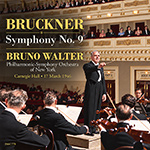
- Cover Art
Bruno Walter's Bruckner Ninth from Carnegie Hall on 17 March 1946 preserves a performance from a time when the symphony's greatness was still a matter of argument. The New York critics had heard him conduct it three days earlier. Their reports offer an unusually vivid setting for the Sunday broadcast, revealing both the resistance Bruckner continued to encounter and the persuasive power of one of his most devoted interpreters. Broadcast by CBS, the Sunday concert carried this interpretation far beyond the Carnegie Hall audience.
The New York Times provided the sharpest dissent. Its reviewer dismissed the Ninth as 'a weak symphony by an exhausted composer', while acknowledging the beauty of the Adagio, the vitality of the Scherzo and Walter's devoted conducting from memory. Robert A. Simon, writing in The New Yorker, reached a strikingly different conclusion about the occasion, describing 'one of his most memorable performances'. Even a listener uncertain of the work's stature could recognise the distinction of Walter's advocacy.
Other witnesses were more enthusiastic still. Louis Biancolli in the World Telegram admired the original score's force. Edward O'Gorman of the New York Post reported a 'spellbound hesitation' before an ovation. Virgil Thomson, in the Herald Tribune, heard Walter make Bruckner into 'live music', and judged the unfinished Ninth 'a master's masterpiece'. Their disagreements make these accounts valuable: the performance was taking place within an active debate over the music's worth.
Walter understood something of the difficulties his listeners faced. In his 1940 essay Bruckner and Mahler, he recalled that his affection for Bruckner's melodies and orchestral language had long coexisted with uncertainty about the music's apparent lack of form. Conducting it transformed his understanding. The expansive dimensions, unexpected turns and interruptions became features of a world in which he felt at home. His advocacy thus rested on an intimacy acquired through performance, with all the practical demands of making these vast structures speak.
The score itself had undergone a comparatively recent transformation in public understanding. Ferdinand Löwe's edition, used for the posthumous premiere, had extensively altered Bruckner's orchestration and other details. Alfred Orel's edition restored the composer's original text; the Philharmonic had introduced it to American audiences under Otto Klemperer in October 1934. Walter's 1946 performances belonged to this continuing reassessment. Only twelve years separated them from that New York introduction, a short interval in the life of a work whose reception had already been shaped by decades of performance in an altered form.
For listeners familiar with Walter's celebrated Columbia Symphony recording of 1959, the broadcast also offers a different perspective on the conductor. The music occupies roughly fifty-two minutes, against almost fifty-nine in the studio account. Such figures cannot convey an interpretation, but they indicate how substantially his conception broadened. Here, swift movement can coexist with pronounced local flexibility: an urgent overall course does not imply an unvarying pulse.
That freedom has divided later critics. Reviewing the Music & Arts issue in 2003, Richard Osborne found particular dramatic force in the opening movement, though he considered the Adagio compromised by the recording's distortion. Michael Tanner admired the performance's expressive flexibility and clarity of orchestral detail. James A. Altena, comparing Walter's surviving accounts a decade later, felt that some first-movement pauses and slowings weakened its continuity. The disagreement concerns a central feature of Walter's approach: how far an individual phrase may expand while remaining part of the symphonic argument.
William Carragan's later analysis supplies two particularly revealing details. Near the end of the first movement, he identifies timpani interventions associated with an older Dutch Bruckner tradition; in the Adagio, he draws attention to a marked acceleration through bars 105-120. These touches connect Walter's interpretation with performing practices that a modern listener might otherwise overlook. His Bruckner emerges as mobile, responsive and shaped by inherited habits as well as by close engagement with the score.
The broadcast belongs to the same March series as those contested performances, but preserves a separate Sunday occasion. It allows us to return to the musical evidence behind the argument: the relationship between urgency and breadth, the shaping of the great paragraphs, and the conviction with which Walter entrusted this still disputed work to his New York players. The contemporary press supplies the setting; the surviving performance gives us the opportunity to form our own response.
About this remastering
New Ambient Stereo XR remastering by Andrew Rose brings fresh clarity and presence to this broadcast. Surface noise has been treated, and the interruption between the first and second movements, while latecomers were seated, has been removed. The opening and closing radio announcements are retained as separate tracks. The online sample presents the complete Scherzo.
BRUCKNER Symphony No. 9 in D minor
1. RADIO Introduction (1:30)
2. 1st movement: Feierlich, misterioso (21:55)
3. 2nd movement: Scherzo: Bewegt, lebhaft; Trio: Schnell (9:59)
4. 3rd movement: Adagio: Langsam, feierlich (19:54)
5. RADIO Conclusion (0:24)
Philharmonic-Symphony Orchestra of New York
conducted by Bruno Walter
Live broadcast from Carnegie Hall, New York, 17 March 1946
XR remastered by Andrew Rose
Ambient Stereo
Copyright 2026 Pristine Audio
Total duration: 53:43