This album is included in the following sets:
This set contains the following albums:
- Producer's Note
- Full Track Listing
- Cover Art
By April 1950 Mahler’s Eighth Symphony was still an event rather than repertory. Forty years had passed since Mahler himself conducted its first performance in Munich, yet the work’s enormous vocal and orchestral demands continued to make every revival a special undertaking. For Leopold Stokowski it carried unusually deep personal associations. He had attended rehearsals and both Munich performances in September 1910, later recalling an impression of awe and immensity, and in March 1916 he persuaded the Philadelphia Orchestra to mount the American premiere with 110 instrumentalists, some 950 singers and eight soloists. The Eighth had been one of the great early landmarks of his career.
His return to it with the Philharmonic-Symphony Orchestra of New York in April 1950 therefore had something of the quality of a homecoming. It was the orchestra’s first performance of the symphony. The forces assembled at Carnegie Hall included the Westminster Choir, prepared by John Finley Williamson, the Schola Cantorum of New York under Hugh Ross, and the Boys’ Chorus of Public School No. 12 under Pauline L. Covner, together with eight soloists and an enlarged orchestra. An additional brass choir was stationed in the dress circle. The surviving recording comes from the Sunday concert of 9 April, broadcast by CBS from Carnegie Hall at 3 p.m.
The first performance of the run, on 6 April, was reviewed the following day in The New York Times by Olin Downes. His reaction captured both the fascination and the unease that Mahler’s Eighth could still provoke. He admired Stokowski’s complete command of the huge choral forces and described the cumulative effect of the massed voices, echo choirs and spatially separated instruments as “overwhelming”. He also called the symphony a “great paean of joy”. Yet Downes was not wholly persuaded by Mahler’s gigantic conception, finding some effects “showy and mysterious” and others “a little hollow”, especially when compared with the Gabrieli ceremonial music Stokowski had placed before it. That ambivalence is a useful reminder that in 1950 Mahler had not yet entered the secure international canon he would occupy a generation later.
Posterity has been kinder to this performance. When the recording appeared on CD, critic Kevin Conklin judged it among the most consistently satisfying accounts of the Eighth and made a strong case for the special electricity of a live performance. Tony Duggan, surveying the symphony’s recorded history, likewise singled out Stokowski’s 1950 reading as a document from an era when Mahler was still comparatively unfamiliar, preserving performing traditions closer to the composer’s lifetime. Its approximately seventy-eight-minute span is notably taut for a work that can easily become monumental in every sense.
There is also an intriguing recording-history footnote. The New York Philharmonic archives preserve correspondence concerning plans for a Columbia recording of the Eighth, including negotiations over royalties, overtime and even the possibility of contributing profits to the orchestra’s pension fund. The project was abandoned because Stokowski was under exclusive contract to RCA Victor. Instead, it is the CBS broadcast of 9 April that became the lasting document. The Paley Center records the transmission, while the New York Public Library catalogue identifies the surviving CBS source as four sixteen-inch acetate discs.
Although Sir Adrian Boult’s BBC broadcast of 1948 predates it, the Stokowski performance remains one of the earliest surviving complete recordings of the symphony. Its historical importance is intensified by the conductor’s direct link back to Mahler’s own 1910 premiere and to the American premiere six years later.
The afternoon ended with an apt ceremonial gesture. Following the symphony, the Bruckner Society of America presented Stokowski with its Mahler Medal. Nearly forty years after he had sat in Munich listening to Mahler conduct the work himself, Stokowski had returned to the Eighth in New York and left behind a vivid document of a time when this now-familiar giant of the repertory could still seem astonishingly new.
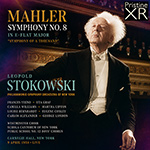
MAHLER Symphony No. 8 in E-flat major
“Symphony of a Thousand”
Part I (22:29)
1. Veni, creator spiritus (1:25)
2. Imple superna gratia (3:26)
3. Infirma nostri corporis I (3:42)
4. Infirma nostri corporis II (3:03)
5. Accende lumen sensibus (4:47)
6. Qui Paraclitus diceris (2:48)
7. Gloria sit Patri Domino (3:18)
Part II (55:21)
8. Poco adagio (4:55)
9. Più mosso. Allegro moderato (2:43)
10. Waldung, sie schwankt heran (2:52)
11. Ewiger Wonnebrand (1:44)
12. Wie Felsenabgrund mir zu Füssen (5:14)
13. Gerettet ist das edle Glied (1:05)
14. Jene Rosen, aus den Händen (2:42)
15. Uns bleibt ein Erdenrest (1:43)
16. Ich spür’ soeben - Höchste Herrscherin der Welt (5:25)
17. Dir, der Unberührbaren (3:02)
18. Bei der Liebe, die den Füssen - Neige, neige, du Ohnegleiche (8:28)
19. Er überwächst uns schon - Komm! hebe dich zu höhern Sphären (4:27)
20. Blicket auf zum Retterblick (5:50)
21. Alles Vergängliche (5:11)
Frances Yeend (soprano) - Magna Peccatrix
Uta Graf (soprano) - Una Poenitentium
Camilla Williams (soprano) - Mater Gloriosa
Martha Lipton (alto) - Mulier Samaritana
Louise Bernhardt (alto) - Maria Aegyptiaca
Eugene Conley (tenor) - Doctor Marianus
Carlos Alexander (baritone) - Pater Ecstaticus
George London (bass) - Pater Profundus
Westminster Choir - John Finley Williamson
Schola Cantorum of New York - Hugh Ross
Public School No. 12 Boys’ Chorus - Pauline L. Covner
Philharmonic-Symphony Orchestra of New York
conducted by Leopold Stokowski
Recorded live at Carnegie Hall, New York
9 April 1950
XR Remastered by Andrew Rose
Total duration: 1hr 17:50