This album is included in the following sets:
This set contains the following albums:
- Producer's Note
- Full Track Listing
- Cover Art
Ataúlfo Argenta’s career was one of the most brilliant and cruelly abbreviated in twentieth-century conducting. Born in Castro Urdiales in 1913, he first established himself as a pianist, studying in Madrid and Liège before further work in Germany brought him into contact with Carl Schuricht, who encouraged him towards the podium. Argenta’s rise was rapid. By 1947 he was sharing the direction of the Orquesta Nacional de España, and from 1950 he appeared regularly with the Orchestre de la Société des Concerts du Conservatoire in Paris. He also built an extensive recorded legacy in zarzuela, helping to preserve a repertory that was then poorly represented on disc. His sudden death in January 1958, aged only forty-four, halted a career that was plainly moving onto the widest international stage.
This collection brings together two complementary portraits of Argenta in Spanish and Spanish-inspired repertoire. The Paris recordings, made in mono in 1953, place him before a French orchestra in music by Albéniz and Turina. The later London sessions, recorded in stereo at Kingsway Hall over New Year 1956-57, show him commanding the London Symphony Orchestra in works by Rimsky-Korsakov, Granados and Moszkowski. Heard together, they move from Spain imagined by Spanish composers to Spain refracted through the colourful imagination of outsiders.
Albéniz composed Iberia between 1905 and 1909 as a cycle of twelve piano pieces, each demanding extraordinary refinement of rhythm, colour and touch. The five selections heard here were orchestrated by Enrique Fernández Arbós, who transformed the piano’s layered sonorities into a glittering orchestral fabric without losing their intricate rhythmic life. Evocación opens in a haze of memory; El Puerto dances with bright coastal energy; El Corpus en Sevilla grows from solemn procession to ecstatic celebration; Triana captures the swagger and pulse of Seville’s famous quarter; and El Albaicín evokes Granada’s old Moorish district with hypnotic, nocturnal intensity. Argenta understands that this music needs both atmosphere and backbone: the perfume never obscures the dance.
Turina’s Danzas fantásticas, written in 1919 and inspired by José Más’s novel La orgía, offers three sharply contrasted visions. Exaltación is founded on the Aragonese jota; Ensueño turns to the asymmetrical sway of the Basque zortziko; and Orgía erupts in an Andalusian farruca, full of heat, brilliance and barely contained abandon. Argenta binds the suite together with a strong dramatic curve, making the final dance feel not merely festive but inevitable.
Rimsky-Korsakov’s Capriccio espagnol is Spain seen through the eyes of a Russian master orchestrator. Its five linked sections set Asturian melodies amid a succession of instrumental solos, flashing percussion, guitar-like string writing and dazzling changes of colour. Argenta’s performance became one of the celebrated early stereo showpieces, valued not only for its spectacular sound but for the conductor’s ability to make virtuoso display feel rhythmically alive rather than merely decorative. Reviewing the original Decca programme, Paul Serotsky called it “a joy from start to finish” and praised its “peerless evocation” of Spanish character.
Granados’s Andaluza provides a more intimate interlude, its supple melody and gently insistent rhythm handled with affectionate simplicity. Moszkowski’s Spanish Dances, originally written for piano duet and later orchestrated by Philipp Scharwenka and Valentin Frank, belong to the nineteenth-century European tradition of imagined Spain. They may be less authentically local than Albéniz or Turina, but their melodic abundance, deft scoring and buoyant rhythms make an irresistible finale.
Across both orchestras and two very different recording environments, Argenta’s signature remains unmistakable: rhythmic lift, vivid colour, elegance without fuss, and excitement that never becomes crude. These performances preserve a conductor working at white heat, with an instinctive command of the music’s accent and gesture. In this new XR remastering, their brilliance, warmth and extraordinary vitality can once again take centre stage.
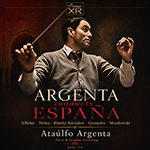
ARGENTA conducts España
Paris recordings (46:14)
ALBÉNIZ Iberia - orchestral excerpts
1. Book 1 No. 1 - Evocación (5:28)
2. Book 1 No. 3 - El Corpus en Sevilla (8:14)
3. Book 2 No. 3 - Triana (4:41)
4. Book 1 No. 2 - El Puerto (4:36)
5. Book 3 No. 1 - El Albaicín (7:18)
Orchestrated by Enrique Fernández Arbós
TURINA Danzas fantásticas, Op. 22
6. I. Exaltación (5:20)
7. II. Ensueño (6:07)
8. III. Orgía (4:29)
Orchestre de la Société des Concerts du Conservatoire
conducted by Ataúlfo Argenta
Recorded at Maison de la Mutualité, Paris
12, 14-17 & 19 October 1953 (mono)
London recordings (32:57)
RIMSKY-KORSAKOV Capriccio espagnol, Op. 34
9. I. Alborada (1:11)
10. II. Variazioni (4:17)
11. III. Alborada (1:13)
12. IV. Scena e canto gitano (4:44)
13. V. Fandango asturiano (3:18)
14. GRANADOS Andaluza - Danza española No. 5 in E minor, Op. 37 (4:08)
MOSZKOWSKI Spanish Dances, Book 1, Op. 12
15. No. 1 in C major (1:42)
16. No. 2 in G minor (4:05)
17. No. 3 in A major (2:45)
18. No. 4 in B flat major (2:31)
19. No. 5 in D major (3:03)
Orchestrated by Valentin Frank (Nos. 1, 3 & 4) and Philipp Scharwenka (Nos. 2 & 5)
London Symphony Orchestra
conducted by Ataúlfo Argenta
Recorded at Kingsway Hall, London
31 December 1956 & 1 January 1957 (stereo)
XR Remastered by Andrew Rose
Total duration: 1hr 19:11