This album is included in the following sets:
This set contains the following albums:
- Producer's Note
- Full Track Listing
- Cover Art
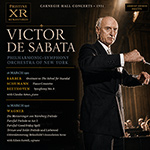
In March 1951 Victor de Sabata appeared at Carnegie Hall as guest conductor of the Philharmonic-Symphony Orchestra of New York, in a group of concerts later drawn upon for CBS broadcast. The dates given here are the concert dates, not the broadcast dates. The broadcasts themselves came later, introduced on air by Jim Fassett, and were edited from the original programmes.
The first concert represented here took place on 18 March 1951, with Claudio Arrau as soloist. The printed programme also included Debussy’s Iberia, but the CBS transcription preserved here gives us Barber’s Overture to The School for Scandal, Op. 5, Schumann’s Piano Concerto in A minor, and Beethoven’s Symphony No. 8 in F major. De Sabata was making his first guest appearance of the season with the orchestra, and contemporary criticism was fascinated, if not entirely persuaded, by his personality on the podium. Olin Downes heard a conductor of strong effects, concerned less with literal textual polish than with atmosphere, colour and dramatic projection.
Barber’s overture was still a relatively modern American score in 1951, composed in 1932 and inspired by Sheridan’s comedy. It is an ideal curtain-raiser: quick-witted, brilliantly scored and full of theatrical sparkle. In this context it also reminds us that De Sabata’s visit was not simply a parade of old-world Austro-German monuments. He could bring his operatic instinct for character and timing to a score whose energy depends on precision, brightness and lift.
Schumann’s Piano Concerto placed De Sabata alongside Claudio Arrau, one of the great serious pianists of the age. Arrau’s playing was sometimes described in terms of intellectual weight and classical restraint, qualities that suit a concerto which resists empty display. Schumann’s soloist is not a conquering hero set against the orchestra, but a poetic presence woven into it. The critic found Arrau a little held back on this occasion, yet the surviving performance allows us to hear the meeting of two large musical temperaments: Arrau’s inward gravity and De Sabata’s taste for colour and expressive surge.
Beethoven’s Eighth Symphony completed the surviving part of the 18 March programme. Compact, energetic and often slyly comic, it is a work whose apparent lightness can deceive. Its wit is structural, rhythmic and dramatic, and in De Sabata’s hands it becomes less a polite Classical interlude than a finely sprung orchestral mechanism, alert to sudden turns and flashes of temperament.
The second concert heard here took place on Easter Sunday afternoon, 25 March 1951, and was devoted to Wagner, with Eileen Farrell as soloist. This concert followed an orchestral-only Wagner programme earlier in the same period, which perhaps explains the slightly tangled trail left by the contemporary reviews. The printed 25 March programme included Forest Murmurs from Siegfried, but the edited CBS transcription heard here centres on the Prelude to Die Meistersinger von Nürnberg, the Prelude to Act I and Good Friday Spell from Parsifal, the Prelude and Liebestod from Tristan und Isolde, and Brünnhilde’s Immolation Scene from Götterdämmerung.
Farrell was warmly received. Her Wagner singing was praised for its fullness, warmth and command, and the source recording captures her with particular success. The Tristan and Götterdämmerung excerpts demand not only power but breadth of line and emotional concentration, and Farrell brings both scale and human warmth to music that can too easily become merely monumental.
The orchestral Wagner reveals De Sabata at his most characteristic: grand, theatrical, sometimes extravagant, but never anonymous. One critic thought him happiest when able to “shake the roof”; another heard vitality even where refinement was not the principal virtue. These performances confirm that impression. De Sabata’s Wagner is not neutral, devotional wallpaper. It is painted in dark colour, strong gesture and high relief.
The original tapes had suffered considerable degradation, but this has been successfully addressed in the present XR remastering. The resulting sound from both concerts is excellent for its age and source, with the vocal material especially vivid. Ambient Stereo has been used to open the acoustic without falsifying the historical character of the recordings: Carnegie Hall, great artists, broadcast microphones, and interpretative risk caught in the act.
DE SABATA New York Broadcasts, 1951
Disc one (71:54)
1. RADIO Introduction (1:45)
2. BARBER Overture, The School for Scandal, Op. 5 (9:51)
SCHUMANN Piano Concerto in A minor, Op. 54
3. 1st mvt. - Allegro affettuoso (16:26)
4. 2nd mvt. - Intermezzo: Andantino grazioso (5:45)
5. 3rd mvt. - Allegro vivace (11:46)
Claudio Arrau, piano
BEETHOVEN Symphony No. 8 in F major, Op. 93
6. 1st mvt. - Allegro vivace e con brio (9:29)
7. 2nd mvt. - Allegretto scherzando (3:47)
8. 3rd mvt. - Tempo di menuetto (4:35)
9. 4th mvt. - Allegro vivace (7:28)
10. RADIO Conclusion (1:02)
Disc two (74:41)
1. RADIO Introduction (1:30)
2. WAGNER Die Meistersinger von Nürnberg - Prelude (9:48)
3. WAGNER Parsifal - Prelude to Act I (12:51)
4. WAGNER Parsifal - Good Friday Spell (13:46)
5. WAGNER Tristan und Isolde - Prelude and Liebestod (17:44)
6. WAGNER Götterdämmerung - Brünnhilde’s Immolation Scene (17:56)
Eileen Farrell, soprano
7. RADIO Conclusion (1:06)
Philharmonic-Symphony Orchestra of New York
conducted by Victor de Sabata
XR Remastered by Andrew Rose
Live CBS recordings made at Carnegie Hall, New York City
Recorded 18 & 25 March 1951
Broadcast 25 March & 1 April 1951
Total duration: 2hr 26:35