

This album is included in the following sets:
This set contains the following albums:
- Producer's Note
- Full Track Listing
- Cover Art
Bruno Walter came only slowly to Bruckner. As he recounted both in his 1944 autobiography Theme and Variations and in his 1956 recorded conversation with Arnold Michaelis, he had always loved Bruckner’s thematic substance, but found his vast symphonic forms loquacious and structurally defective. Then, on a 1927 concert tour in America, he contracted a life-threatening case of double pneumonia, and upon his return to Europe was confined to bed for several weeks. The enforced repose, with lengthy periods for contemplation, provided Walter with his portal to understanding Bruckner. Thereafter he became a champion of the composer, and would become a recipient of the medal of the Bruckner Society of America. He recorded the Te Deum and the Fourth, Seventh, and Ninth Symphonies in the studio; live broadcasts also survive for all of these works, plus the Eighth Symphony (from January 1941, in dim sound).
After recording the Bruckner Ninth (see Pristine Audio PASC 384) in November 1959, Walter turned to the Fourth in February 1960, in what was only the work’s second stereo release (preceded by that of Heinrich Hollreiser from October 1959). This is a reading of great equipoise and balanced proportions, resulting in a total organic unity. Its tempos are moderate throughout; it is unhurried though never dragging or slack, and it manifests its power with unruffled calm rather than anxious agitation. Throughout one marvels at how naturally, without affectation or ostentation, Walter elicits manifold small instrumental details — a woodwind burble here or trumpet chirp here, a supple horn line or undulating string figuration there — with absolute clarity in even the most contrapuntally and harmonically dense passages. A continuous, seamless melodic flow sings serenely even when voicing passionate ardor: every phrase and strand is perfectly dovetailed with its predecessor and successor, and climaxes are powerful but not exaggerated. The finale often is criticized as being somewhat ramshackle in construction; Walter effortlessly puts the lie to any such notion in a manner that might well be described at several points as a delightful romp, though the closing pages are powerfully emphatic.
Walter’s recording of the Bruckner Seventh in March 1961 had three stereo predecessors: those of Hans Rosbaud (December 1957), Franz Konwitschny (June 1958), and Otto Klemperer (November 1960). It was released posthumously after Walter’s death on February 17, 1962, and quickly established itself as a phonograph classic. Here the pacing is somewhat more varied: the first two movements and the other sections of the Scherzo are on the brisker side, while the central trio section of the Scherzo and the finale are relaxed and given breadth. Everything is suffused with a remarkable, genial lyricism. The opening Allegro moderato ascends and descends its peaks and valleys as graded slopes rather than as sheer granitic mountain faces to be scaled; the ensuing Adagio is an elegiac recollection of a long-departed loved one, not a tragic outpouring of grief. The Scherzo, as noted, surprises with the energetic, light-footed spring of its outer sections, for which the intervening trio, as in the Fourth Symphony, provides an idyll of repose in an Alpine meadow. The finale of this work sometimes is criticized as being too short and lacking in requisite weightiness for what has preceded it. Walter refutes this view by giving it a measured tread and endowing the pizzicato strings with unusual heft as a counterpoint to the brass interjections, culminating in the work’s exultant close.
In Walter’s pithy but trenchant observation to Michaelis, “Mahler his whole life through was seeking God; Bruckner had found God. That is the difference, and the connection.” Very few other great artists have bridged this span and illuminated both sides of it equally well.
James A. Altena
Additional note
The original recording and all subsequent issues and reissues of the Fourth Symphony included an edit in the fourth movement which cut a beat at the beginning of the bar at around 8:10. I am grateful to James Altena for not only spotting this for the first time in decades of familiarity with the recording whilst writing his notes, but also for alerting me to it in sufficient time to manufacture a seamless and satisfactory fix for the missing music. It took me about an hour to patch 0.373 seconds of music in such a way as to render it impossible to spot, but it had to be done - once the bad edit (which we assume dates from the master tape editing sessions) was pointed out it could not be un-heard!
For the first time in 65 years this final movement can now be heard as Bruno Walter (and Bruckner) intended, and for that reason it has been chosen as our online sample for this page.
Andrew Rose
WALTER Bruckner Symphonies 4 & 7
disc one (66:30)
BRUCKNER Symphony No. 4 in E-flat major, WAB 104
1. 1st mvt. - Bewegt, nicht zu schnell (18:48)
2. 2nd mvt. - Andante quasi allegretto (15:38)
3. 3rd mvt. - Scherzo. Bewegt; Trio. Nicht zu schnell. Keinesfalls schleppend (11:02)
4. 4th mvt. - Finale. Bewegt, doch nicht zu schnell (21:02)
disc two (65:00)
BRUCKNER Symphony No. 7 in E major, WAB 107
1. 1st mvt. - Allegro moderato (21:00)
2. 2nd mvt. - Adagio. Sehr feierlich und sehr langsam (19:33)
3. 3rd mvt. - Scherzo. Sehr schnell (10:27)
4. 4th mvt. - Finale. Bewegt, doch nicht schnell (14:00)
Columbia Symphony Orchestra
conducted by Bruno Walter
Stereo XR remastering by Andrew Rose
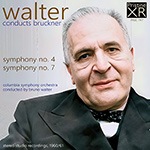
Cover artwork based on a photograph of Bruno Walter
Recorded at the American Legion Hall, Hollywood
Symphony No. 4: 13, 15, 17, 25 February, 1960
Symphony No. 7: 11, 13, 19, 22, 27 March, 1961
Total duration: 2hr 11:30
Fanfare Review
With the aforementioned correction of the bad splice in the Fourth, this set becomes a necessary acquisition for all collectors who already own and treasure this performance
Bruno Walter came only slowly to Bruckner. By his own account, he had always loved Bruckner’s thematic materials, but found his symphonic movements verbose and structurally defective. Then, on a 1927 concert tour in America, Walter contracted a life-threatening case of double pneumonia, and upon his return to Europe was confined to bed for several weeks. The enforced repose, with lengthy periods for contemplation, opened up Bruckner’s world to him, and he became a champion of the composer’s music thereafter. Whereas other conductors have emphasized the dramatic conflict or spiritual mysticism in Bruckner’s music, Walter as was his usual interpretive wont brought to the scores lyricism, gentle warmth, and urbane humanity.
After recording the Bruckner Ninth (see Pristine Audio PASC 384 ) in November 1959, Walter turned to the Fourth in February 1960, in what was only the work’s second stereo release (preceded by that of Heinrich Hollreiser from October 1959, for Vox/Turnabout). His reading is a total organic unity, exhibiting great equipoise and balanced proportions, manifesting the work’s power with unruffled calm rather than anxious agitation. Tempos are moderate throughout, unhurried but never dragging or slack. Without affectation or ostentation, Walter elicits manifold small instrumental details—a woodwind burble or trumpet chirp here, a supple horn line or undulating string figuration there—with absolute clarity in even the most contrapuntally and harmonically dense passages. A continuous, seamless melodic flow sings serenely even when voicing passionate ardor: every phrase and strand is perfectly dovetailed with its predecessor and successor, and climaxes are powerful but not exaggerated. The finale, often criticized as being somewhat ramshackle in construction, coheres with seemingly effortless naturalness.
Walter’s recording of the Bruckner Seventh in March 1961 had three stereo predecessors: those of Hans Rosbaud (December 1957, for Vox/Turnabout), Franz Konwitschny (June 1958, for Eterna), and Otto Klemperer (November 1960, for EMI). It was released posthumously, over a year after Walter’s death on February 17, 1962, and quickly established itself as a phonograph classic. Here the pacing is somewhat more varied: the first two movements and the outer sections of the Scherzo are on the brisker side, while the central trio section of the Scherzo and the finale are more relaxed and spacious. The opening Allegro moderato ascends and descends its peaks and valleys as graded slopes, rather than as sheer granitic vertical mountain faces to be scaled; the ensuing Adagio is an elegiac recollection of a long-departed loved one, not a tragic outpouring of grief. The Scherzo surprises with the energetic, light-footed spring of its outer sections, while the intervening trio provides an idyll of repose in an Alpine meadow. Walter provides the finale weightiness by giving it a measured tread and endowing the pizzicato strings with unusual heft as a counterpoint to the brass interjections.
Full disclosure: The preceding paragraphs are adapted from liner notes for this release that I wrote (gratis) at Andrew Rose’s request. Furthermore, I had one small but crucial point of involvement in its production of which I’m rather proud. I have owned and listened to these two recordings for over 45 years; and yet, even after all that time, one can hear something new and important from a thrice-familiar performance. As I was listening to and taking notes on this performance of the Fourth from the disc in the BMG/Sony Bruno Walter Complete Columbia Album Collection, a detail suddenly jumped out at me that I had never noticed before. At 8:10 into the finale (8:12 in the Pristine Audio transfer), at measure 229 in the score, Columbia had made a bad splice and lopped off most of the first beat of that measure! It’s not easy to hear (Andrew Rose timed it out at 0.373 seconds) but once spotted is impossible to un-hear and is quite jarring. I immediately accessed various preceding releases of this performance, and the bad splice goes all the way back to the original gray-label LP release. In all of my years of collecting and reading Walteriana, I have never seen anyone else flag this problem. I immediately contacted Rose to notify him of my discovery and asked him if he could do anything to fix it. Indeed, he could, and so this set provides the first corrected, fully intact issue of this performance.
Twelve years ago, in Fanfare 37:1, I gave a rave review to Andrew Rose’s magnificent remastering of Bruno Walter’s 1959 recording of the Bruckner Ninth. Noting increased heft in the strings, bite in the brass, and color and presence in the woodwinds from the opening up of the sonic palette, I continued, “Indeed, this remarkable release has caused me to re-evaluate the performance itself…. Previously, I have tended to find this version too soft-grained and even somewhat ponderous and flaccid. But now, perhaps contrary to expectations, the additional richness of sound has revealed the performance to have a weighty, muscular strength that was heretofore veiled.” At the time I had expected to see the Fourth and Seventh in this set follow in short order; but legal complications raised by EU copyright laws forced Rose to put further ventures into Walter’s stereo recording on indefinite hold. Thankfully, those obstacles no longer exist, and these performances have appeared from Pristine Audio at last. While one wishes that there had not been any delay, this release has definitely been worth the wait. Once again, Rose’s trademark XR remastering technology has taken a good early stereo recording and made it significantly better. The overall sonic profile has more warmth, depth, and richness; individual instrumental lines and inner voices emerge with greater clarity; harmonies have more vibrancy. And, with the aforementioned correction of the bad splice in the Fourth, this set becomes a necessary acquisition for all collectors who already own and treasure this performance. It accordingly appears on my 2025 Want List in this same issue. Urgently recommended.
James A. Altena
Fanfare
