
This album is included in the following sets:
This set contains the following albums:
- Producer's Note
- Full Track Listing
- Cover Art
Robert Craft’s recording of the Schoenberg Violin Concerto, with soloist Israel Baker and the CBC Symphony Orchestra, was made on Friday 20th April, 1962. Nine days later the same musicians performed the same work live in Toronto, and almost a week later the Toronto Star acknowledged the event:
“Tending to be overshadowed in the reactions to last Sunday’s Stravinsky-Schoenberg concert here was the Schoenberg half of the evening. Those who missed the event will be able eventually to hear the three Schoenberg works in the Columbia recording made last Monday [sic] by the CBC Symphony orchestra under Robert Craft’s direction…
…The other two Schoenberg works, however, struck me as deep and durable examples of his extraordinary' multi-layered style … The Violin Concerto, with that incredible (and justly lauded, in the reviews) solo performance by Israel Baker, is less immediately grateful than the composer’s Variations or Piano Concerto, but still manifestly the work of a grandly inventive musician. Its romantic urges, its affinities to Mahler and Debussy, become obvious in a clear live performance such as this.
To me the music is fascinating somewhat in the way of snowflakes, snail tracks, or complex larvae under a microscope. The finale, a Schoenbergian pantomimic mixture of march and gavotte, capped by an altogether remarkable cadenza, proves a dazzler in the writing, just as it was the other night in the playing. (At the same time, there’s no doubt the first movement is too busily laid out for safe audibility of the soloist.)
The enthusiastic reception of these pieces should pave the way for the programming — soon — of Schoenberg’s other major works, long overdue for presentation here, especially the Variations and the Opus 16 Orchestral Pieces.”
– John Beckwith,The Toronto Star, May 5, 1962
Whilst Robert Craft is best remembered for his association with Stravinsky, he was also very closely associated with the Second Viennese School composers, recording and performing music by Berg, Webern and, of course, Arnold Schoenberg. Indeed, it was Craft who effectively introduced their music to Stravinsky, who assiduously attended rehearsals for recordings such as those included here, and ultimately would introduce elements of their “serial” compositional process into his own works.
Craft twice recorded the complete orchestral works of Schoenberg – the three works presented here represent only the tip of the iceberg in that respect, and are among Craft’s earliest. They offer three very different facets of the composer’s work: the purely orchestral works which start and close the album contract the early, late-romantic Schoenberg of 1899’s Verklärte Nacht with the atonal serialism of the 1926-28 Variations for Orchestra. Schoenberg’s Violin Concerto, completed in 1936 brings another voice – that of the violin soloist – into the whole, requiring further modification of his technique, with a move away from strict serial form and the adoption of something closer to a tonal approach for the solo player.
All three works were excellently recorded in full stereo, and these stereo XR remasters aim to bring their sound palettes fully up to date in this, the composer’s 150th anniversary year.
ROBERT CRAFT conducts Schoenberg
SCHOENBERG Variations for Orchestra, Op. 31*
1. Introduktion. Mäßig - ruhig (1:19)
2. Thema. Molto moderato (0:55)
3. Variation I. Moderato (0:59)
4. Variation II. Langsam (1:30)
5. Variation III. Mäßig (0:46)
6. Variation IV. Walzertempo (1:08)
7. Variation V. Bewegt (1:48)
8. Variation VI. Andante (1:14)
9. Variation VII. Langsam (2:08)
10. Variation VIII. Sehr rasch (0:35)
11. Variation IX. L'istesso tempo - aber etwas langsamer (0:50)
12. Finale. Mäßig schnell (5:29)
SCHOENBERG Violin Concerto, Op. 36**
13. 1st mvt. - Poco allegro - Poco animato (11:14)
14. 2nd mvt. - Andante grazioso - Poco più mosso (7:17)
15. 3rd mvt. - Finale. Allegro (10:33)
Israel Baker, violin
SCHOENBERG Verklärte Nacht, Op. 4**
16. Grave (5:37)
17. Molto rallentando (5:18)
18. Pesante (1:45)
19. Adagio (8:37)
20. Adagio (3:42)
Recorded 4 June 1957
Hollywood, USA
Recorded 20 April 1962
Massey Hall, Toronto, Canada
Verklärte Nacht
Recorded 2 December 1962
Massey Hall, Toronto, Canada
*Columbia Symphony Orchestra
**CBC Symphony Orchestra
conducted by Robert Craft
XR remastering by: Andrew Rose
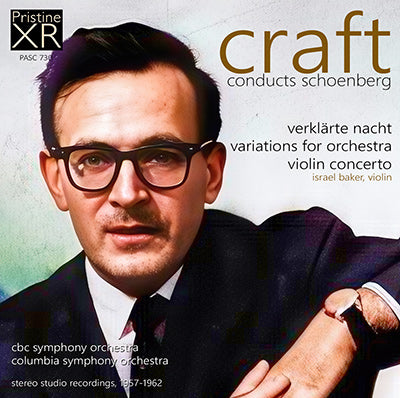
Cover artwork based on a photograph of Robert Craft
Variations for Orchestra
Violin Concerto
Total duration: 72:45
Review
Pristine Classical for presenting them so cleanly
What a wonderful reminder from the recorded archives this is of the stature of the music of Arnold Schoenberg in its various shades. The arrival of this disc comes just after the terrible news of the Los Angeles fires, including damage to the L.A. Schoenberg Archives. But his music lives on in performance such as these.
Robert Craft is most often associated with recordings of Stravinsky, of course, but this performance of the Schoenberg Violin Concerto with Israel Baker should be required listening. There is more competition in this piece than one might think, however. Hilary Hahn’s DG recording with Esa-Pekka Salonen and the Swedish RSO is rightly cited regularly as a modern miracle. And of course we are lucky to have two performances by Louis Krasner, a musician also intimately associated with Berg’s Violin Concerto: His performance with the New York Philharmonic and Mitropoulos might not have the all-embracing confidence of modern performances (especially from the orchestra), but it is fueled by the fires of authenticity, discovery, and probably a bit of panic, too. (There is also a version with Mitropoulos and the West German Radio Orchestra, reviewed in Fanfare 8:4.) A modern interpreter who to my knowledge has yet to record the work is Patricia Kopatchinskaja, whose performance of the Schoenberg Concerto at the Proms in September last year (with the BBC Symphony under the wonderfully talented young conductor Tarmo Peltokoski) was utterly revelatory, bringing in joy via a sense of music of the dance. The Prommers loved it, and so did I.
To muddy the waters (although how wonderful it is to have such choice), Robert Craft also recorded the work with Rolf Schulte on violin and the Philharmonic Orchestra in 1999 at Abbey Road’s Studio No. 1. That recording currently resides on a Naxos disc (reviewed in 32:4). Schulte is excellent, but after hearing Kopatchinskaja live, whenever one becomes aware of a dance element it seems like Craft and Schulte are stomping down on it, quashing the music’s natural impulses. There is certainly an excitement to the busy textures, and despite this being the justly renowned Philharmonia Orchestra, some passages are distinctly seat-of-the-pants (in particular, high first violins) in execution. This is a cripplingly difficult concerto to record as well as to play. I remember sitting in on a recording in London (featuring Jack Liebeck and Andrew Gourlay) and the atmosphere in the control room was tense, to say the least. All that said, there is a resolute determination about Schulte’s performance that is most convincing.
So, then, let us turn to the current performance by Israel Baker. This release was provided for review in physical format, so I auditioned it first via speakers, followed by the various download options offered by Pristine Classical for comparison. Baker might be more famous, in Schoenbergian terms at least, for his performance of the Phantasy with Glenn Gould, but his Violin Concetto is defined by its vivacity. This is music that is fully alive, and Baker and Craft make no compromise for difficulty. The ensemble is the CBC (Canadian Broadcasting Corporation) Symphony Orchestra; the Pristine compact disc transfer is exemplary in its detail. The recording date is Friday, April 20, 1962: Perhaps the thought of a live performance some nine days later helped the performers to focus. Interestingly, one becomes aware of a certain dryness of the acoustic in the cadenza, just as one appreciates the superb dovetailing of the instrumental re-entrance. What is particularly telling in this performance is the palpable darkening of the second movement. The indication might well contain the word grazioso , but Baker and Craft dance under a gray sky. But dance they do, and one also has to pay credit to the Canadian orchestral musicians for negotiating the writing (“tricky” is an understatement) so well. Baker is impressive in the finale (simply marked Allegro ). The cadenza here finds Baker holding the strands together well, and the Pristine transfer holds its head high.
As to the digital transfers, the MP3 holds much detail and conveys Schoenberg’s colorful orchestral tapestry of timbres beautifully; the cadenzas sound a touch less harsh than via my speakers. The two FLAC options (16-bit and 24-bit) yield the best combinations of detail, timbre, and ambience, as one might expect. The combination of transparency, detail, and the stereo sound in the 24-bit incarnation makes it the one for me.
The actual order of the disc is Variations, Concerto, and Verklärte Nacht , but I considered the Violin Concerto first as it is a work urgently in need of re-evaluation. The Schoenberg Variations, op. 31 has a place in every music analyst’s heart (we tend to have them, contrary to popular rumor) but it is perhaps not his most ingratiating score. Certainly, Pierre Boulez with the Chicago Symphony presents the piece with characteristic exactitude: One can imagine that ultra-clear, batonless beat. Craft, here with the Columbia Symphony, is immediately warmer (he also recorded this with the Philharmonia: see Fanfare 23:1); but there is once again a hard-crystal edge to the upper strings on the compact disc incarnation, and Craft’s firsts are not as ultra-unanimous as those of Boulez. Not all of Schoenberg’s brilliant flecks of orchestration come through, either, but there are moments of surprise. The waltz (well, “Walzertempo,” Variation V) has character; the finale has rhythms that seem to want to bounce, and later seem scintillatingly skittish. For all of the upholstered sound of the later Philharmonia recording (currently available on Naxos; the Koch original was reviewed in Fanfare 23:1), there is an underlying edge to the CBC performance that pulls me back for more.
The comments about downloads made regarding the Violin Concerto pretty much hold for the Variations. The MP3 format gives a firm, nay excellent, starting point, but taking the escalator up to full 24-bit FLAC really pays dividends. There you get all the detail, but also more of a feeling of ambience and stereophonic direction. One final point about the Variations before we alight on more familiar territory: Listening to the work numerous times (four for Craft/CBC alone in its different Pristine formats, plus Boulez and Craft/Philharmonia) actually fully enamored me of a piece I had previously merely admired. Really making the detailed, focused listening effort pays off in spades. On each hearing, I heard more and more.
Finally, there comes Verklärte Nacht (Transfigured Night), the remarkable early work that holds a firm place in the catalog and concert stages to this day. Intriguingly, Harmonia Mundi coupled this piece with the Violin Concerto, with Isabelle Faust as the linking factor (Harding conducted the concerto; Verklärte Nacht was heard in its sextet format). Like the Variations, this Pristine Classical account presents the CBC Symphony Orchestra, and the strings do sound rather thin on top at times. Craft’s vision is an interesting one, though, one of both vortex and unstoppable momentum. The CBC players scramble a little at times to keep up, and climaxes can feel breathless rather than exultant, though; the best moments are those of quiet reflection or that feature solo strings. In keeping with Craft’s forward motion, the Adagio is not really the arrival point it can be. It’s no surprise by this stage that the 24-but FLAC is the way to go; it presents Craft’s reading in its very best light, although in the process it also highlights the dodgier moments. Recorded December 2, 1962 in Massey Hall, Toronto, this is, for me, the least convincing and valuable part of the disc.
The value of this disc, therefore, resides in the Variations and the Violin Concerto. Both are required listening, and we should be grateful to Pristine Classical for presenting them so cleanly.
Colin Clarke
