This album is included in the following sets:
This set contains the following albums:
- Producer's Note
- Full Track Listing
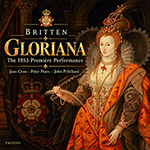
- Cover Art
GLORIANA: CEREMONY AND SOLITUDE
Britten’s Gloriana was written for one of the most conspicuous occasions imaginable: the Coronation season of Elizabeth II. Yet the opera he and his librettist William Plomer produced was anything but conventional pageantry. Their subject was the ageing Elizabeth I, caught between the demands of sovereignty and her dangerous attachment to Robert Devereux, Earl of Essex. The idea had emerged during a skiing holiday early in 1952, when Britten, Peter Pears and George Lascelles, Earl of Harewood, discussed the absence of a modern English “national opera”. Harewood suggested Lytton Strachey’s Elizabeth and Essex as a possible source, and Britten quickly recognised in it a theme that suited him perfectly: the collision between public duty and private emotion.
Plomer’s libretto drew on Strachey, but also on Elizabeth’s own words and writings, while one of Essex’s lute songs uses verse attributed to Essex himself. Britten responded with his most overtly ceremonial score, employing large choral scenes, dances, pageantry and music suggestive of the Elizabethan period. But beneath the public splendour lies a much more intimate drama. Again and again ceremony gives way to solitude: the Queen is acclaimed by her people, then shown alone; political authority alternates with emotional vulnerability; the brilliant dances and formal entertainments of court life lead eventually to betrayal, rebellion and the signing of Essex’s death warrant.
The opera was composed at remarkable speed between the autumn of 1952 and March 1953. Even the catastrophic North Sea flood of January 1953, which inundated Britten’s Aldeburgh home and threatened his manuscripts, scarcely halted the work. Imogen Holst helped rescue the papers, and Britten continued writing amid the disruption, completing the score less than three months before the first performance.
That première took place at the Royal Opera House, Covent Garden, on 8 June 1953, six days after the Coronation. John Pritchard conducted, Basil Coleman produced, John Piper designed the sets and costumes, and John Cranko provided the choreography. Joan Cross created Elizabeth, with Peter Pears as Essex, Monica Sinclair as the Countess of Essex, Geraint Evans as Mountjoy and Jennifer Vyvyan as Lady Rich. Many belonged to the circle of performers already closely associated with Britten’s operas.
The first night has passed into history as one of British opera’s great disasters, but the truth is more complicated. This was no ordinary première audience. The house was filled with royalty, politicians, diplomats and visiting dignitaries who had remained in London for the Coronation festivities. Britten had been commissioned to write an opera for a national celebration, yet had produced a searching study of an ageing monarch who must sacrifice personal happiness to the office she occupies. The mismatch between occasion and subject was profound. The opera offered neither patriotic reassurance nor a flattering Tudor pageant, but a ruler whose authority is inseparable from age, jealousy and emotional loss. The gala audience was restrained, and sections of the press were openly hostile, objecting as much to Britten’s portrayal of Elizabeth as to the music itself.
Other contemporary reactions were considerably more favourable. Critics listening to the BBC relay praised the work’s invention, pageantry and psychological insight, while Andrew Porter mounted an extensive defence of both its dramatic construction and its music. Reports of the première describe sustained applause from the Queen, and the second performance is said to have received eleven curtain calls. The famous “Gloriana fiasco” was therefore not a simple story of universal rejection, but a difficult first night rapidly hardened into legend.
The opera nevertheless disappeared from Covent Garden after its initial run, and its reputation recovered only gradually. A major revival in 1966, for which Britten revised parts of the score, helped establish that Gloriana could succeed powerfully once freed from the ceremonial expectations surrounding its birth. The BBC broadcast preserved here is therefore of particular importance. It allows us to hear the original 1953 conception, before those later revisions, and to encounter the work through the very medium in which some of its earliest listeners responded most warmly.
More than seventy years on, Gloriana seems far less an embarrassing Coronation miscalculation than a characteristically perceptive Britten opera. Asked to celebrate monarchy, he chose instead to explore its cost. The splendour is certainly there, but so are loneliness, compromise and mortality. In that tension between public image and private truth lies the work’s enduring strength.
BRITTEN Gloriana, Op. 53
Opera in Three Acts
CD 1 (68:44)
01. RADIO Introduction (0:58)
Act 1, Scene 1
02. Prelude (2:18)
03. The Tournament (4:04)
04. Recitative & Fight (1:23)
05. Entrance of the Queen (1:30)
06. Recitative (1:04)
07. The Two Lords' Explanation (1:20)
08. Raleigh's Song (1:37)
09. Ensemble of Reconciliation (4:56)
10. Recitative & Final March (1:30)
Act 1, Scene 2
11. Prelude & Dialogue (2:02)
12. The Queen's Song (2:02)
13. Cecil's Song of Government (1:44)
14. Recitative & Essex's Entry (2:19)
15. First Lute Song (1:38)
16. Second Lute Song (3:52)
17. The First Duet for the Queen & Essex (3:56)
18. Soliloquy & Prayer (4:56)
Act 2, Scene 1
19. Prelude & Welcome (3:53)
20. The Masque (9:49)
21. Finale (2:48)
Act 2, Scene 2
22. Prelude & Song (2:21)
23. Duet (1:20)
24. Double Duet (1:45)
25. Quartet (3:38)
CD 2 (76:12)
Act 2, Scene 3
26. Pavane (2:46)
27. Conversation (1:24)
28. Galliard (2:05)
29. Conversation & the Queen's Entrance (1:05)
30. Lavolta (1:29)
31. Conversation (0:43)
32. Morris Dance (1:34)
33. Recitative (0:28)
34. The Queen's Burlesque (1:38)
35. Quartet (2:27)
36. March (0:34)
37. The Queen's Announcement (2:07)
38. Ensemble (3:05)
39. Coranto (1:34)
Act 3, Scene 1
40. Prelude & Chatter (2:55)
41. Essex's Intrusion (0:55)
42. The Second Duet of the Queen & Essex (7:56)
43. The Dressing-Table Song (2:24)
44. The Entrance of Cecil (1:09)
45. Cecil's Report (0:47)
46. Discussion (0:52)
47. The Queen's Decision (1:34)
Act 3, Scene 2
48. Ballad - Rondo (9:38)
Act 3, Scene 3
49. Prelude & Verdict (5:12)
50. Cecil's Warning (1:09)
51. The Queen's Dilemma (1:46)
52. Trio (2:21)
53. Lady Essex's Pleading (2:25)
54. Penelope Rich's Pleading (1:46)
55. Epilogue (9:09)
56. RADIO Conclusion (1:16)
Cast
Queen Elizabeth I - Joan Cross
Robert Devereux, Earl of Essex - Peter Pears
Frances, Countess of Essex - Monica Sinclair
Charles Blount, Lord Mountjoy - Geraint Evans
Penelope, Lady Rich - Jennifer Vyvyan
Sir Robert Cecil - Arnold Matters
Sir Walter Raleigh - Frederick Dalberg
Henry Cuffe - Ronald Lewis
Lady-in-Waiting - Adele Leigh
Blind Ballad-Singer - Inia Te Wiata
Recorder of Norwich - Michael Langdon
Housewife - Edith Coates
Spirit of the Masque - William McAlpine
Master of Ceremonies - David Tree
City Crier - Rhydderch Davies
Sir John Harington - Leonard Law
French Ambassador - Ronald Firmager
Covent Garden Opera Chorus
Covent Garden Orchestra
conducted by John Pritchard
Basil Coleman, producer
John Piper, designs
John Cranko, choreography
Douglas Robinson, chorus master
Charles Taylor, leader
World première recorded live by the BBC at the Royal Opera House, Covent Garden, London, 8 June 1953.
Original 1953 version.
XR remastering by Andrew Rose
Total duration: 2:24:56