This album is included in the following sets:
This set contains the following albums:
- Producer's Note
- Full Track Listing
- Cover Art
This third and final volume of Pristine’s Callas aria series brings together some of her most sustained dramatic encounters. Three scenes from Spontini’s La vestale, recorded at La Scala with Tullio Serafin in 1955, lead to Verdi’s “Tu che le vanità” and the three extended Mad Scenes recorded with Nicola Rescigno and the Philharmonia in 1958.
The Spontini group completes the selections from Callas at La Scala begun in Volume 2. Reviewing the original LP in The Gramophone in June 1958, Andrew Porter set Callas beside Rosa Ponselle, whose tonal beauty remained a formidable standard. Callas brought a different intensity to the words. In “Tu che invoco” he especially admired the dramatic and tender continuation beyond Ponselle’s shorter recorded excerpt.
“O Nume tutelar” concentrates Giulia’s distress into a prayer; “Caro oggetto” completes the group. Porter also praised the balance between Callas and Serafin’s orchestra.
Elisabetta’s great scene from Don Carlo completes the Verdi recital represented in Volume 1. Its demands drew reservations from Philip Hope-Wallace in The Gramophone: his 1959 review questioned details of vocal colour and the steadiness of the ending, while his stereo reassessment sought greater weight and breadth. Admiration for Callas’s characterisation did not preclude criticism of its execution.
The Mad Scenes allow her dramatic imagination a broader canvas. In Anna Bolena, supporting voices and chorus sustain the theatrical continuity as recollection gives way to alarm, dismay and defiance. Hope-Wallace admired this emotional range. The lyricism of “Al dolce guidami” is one stage in a journey that reaches its culmination in “Coppia iniqua”.
Thomas’s Ophelia inhabits a more elusive world. Hope-Wallace found dramatic truth in the tenderness, quiet song fragments and sudden rhythmic changes of the Hamlet scene, despite a strong objection to its climactic high note. Porter’s 1960 review was exceptionally appreciative.
Bellini’s Il pirata closes the programme with another extended finale. Hope-Wallace admired the changing moods, prayerful passages and exciting conclusion, while again finding the upper notes troubling. Enthusiasm and reservation coexist throughout these reviews. Across these longer scenes, each heroine acquires her own pace of thought and her own manner of confronting catastrophe.
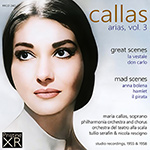
MARIA CALLAS Arias, Volume 3
Great Scenes & Mad Scenes
SPONTINI La vestale
01. Tu che invoco (Act II) (10:49)
02. O Nume tutelar (Act II) (2:30)
03. Caro oggetto (Act III) (3:49)
VERDI Don Carlo
04. Tu che le vanità (Act IV) (10:43)
DONIZETTI Anna Bolena
05. Piangete voi?... Al dolce guidami castel natio (Act II) (19:59)
THOMAS Hamlet
06. À vos jeux... Partagez-vous mes fleurs... Et maintenant écoutez ma chanson (Act IV) (10:28)
BELLINI Il pirata
07. Oh! s’io potessi... Col sorriso d’innocenza (Act II) (17:02)
Maria Callas, soprano
Orchestra del Teatro alla Scala, Milan (tracks 1–3)
conducted by Tullio Serafin
Philharmonia Orchestra (track 4)
Philharmonia Orchestra and Chorus (tracks 5–7)
conducted by Nicola Rescigno
Tracks 1–3 recorded 9–12 June 1955
Teatro alla Scala, Milan
Presented in Ambient Stereo
Track 4 recorded during sessions of 19, 21 & 24 September 1958
No. 1 Studio, Abbey Road, London
Recorded in stereo
Tracks 5–7 recorded 24–25 September 1958
Kingsway Hall, London
Recorded in stereo
XR remastering by Andrew Rose
Total duration: 75:20