This album is included in the following sets:
This set contains the following albums:
- Producer's Note
- Full Track Listing
- Cover Art
Among the many surviving post-war Ring cycles, the 1959 Covent Garden performances occupy a particularly fascinating place. They unite a remarkable company of Wagner singers, many of them veterans of Bayreuth and the international stage, with Franz Konwitschny, one of the major German conductors of his generation. Heard today, these performances offer far more than star casting. They preserve a style of Wagner singing and conducting poised between older dramatic immediacy and the more sculpted, symphonic approach that would increasingly dominate later decades.
Following Das Rheingold, this 23 September 1959 broadcast of Die Walküre brings us to the emotional heart of the cycle. If Rheingold is the glittering prelude to catastrophe, Die Walküre is where Wagner’s drama becomes painfully human: the meeting of Siegmund and Sieglinde, Wotan’s terrible conflict between power and love, Brünnhilde’s awakening compassion, and the final, devastating farewell between father and daughter. It is also the point at which a Ring performance must prove itself not merely by splendour, but by its capacity for intimacy, tenderness and sustained dramatic pressure.
The 1959 Covent Garden Ring was eagerly followed in the press, though reviewers tended to discuss the cycle as a whole rather than each broadcast separately. What emerges clearly from their accounts is that Konwitschny’s arrival was felt as a significant change after Rudolf Kempe’s earlier Royal Opera performances. Critics noted that Kempe had shaped the four operas with a strong sense of overall continuity, while Konwitschny worked in shorter spans, giving particular scenes a vivid surge and theatrical sharpness. He was not a conductor afraid of rough edges or dramatic force, and contemporary reports suggest that he could drive climaxes with considerable power while remaining unusually attentive to the balance between stage and pit.
That quality is essential in Die Walküre, where voices must ride the orchestra without being submerged by it. The cast is led by Astrid Varnay as Brünnhilde, Hans Hotter as Wotan, Ramón Vinay as Siegmund and Amy Shuard as Sieglinde. Varnay was already one of the great Brünnhildes of the age, a singer whose vocal authority and dramatic concentration had become defining features of post-war Wagner performance. Hotter’s Wotan likewise needs little introduction: by 1959 he had lived with the role for years, and his command of text, colour and inward conflict remained among the wonders of the Wagnerian stage.
The particular revelation for London audiences was Amy Shuard. Contemporary comment singled her out as one of the outstanding successes of the cycle. In one of her first major Wagner roles, she was praised for vocal power, sympathetic acting and firmness of line. In an opera where Sieglinde can too easily become merely the object of Siegmund’s ardour or Wotan’s decree, Shuard evidently made a strong impression as a living, suffering woman, giving the first act its necessary emotional charge.
Ramón Vinay’s Siegmund was more controversial. By this stage in his career he brought immense experience and unmistakable presence, though some critics found aspects of the portrayal vocally and dramatically strained. Yet there is a compelling historical interest in hearing him here, not as an abstract ideal of lyrical heroism, but as a stage animal of the old school, throwing himself into Wagner’s drama with the authority of a singer who had inhabited this repertoire at the highest level.
Konwitschny’s Walküre may not always seek polish for its own sake. Its virtues lie elsewhere: momentum, urgency, strong theatrical profile and an instinctive understanding that Wagner’s orchestra must breathe with the singers. In the great confrontations of Act II and the long farewell of Act III, the performance belongs to a tradition in which the Ring is first and foremost music drama, alive in the theatre, under pressure, and unfolding before an audience rather than preserved under studio glass.
The BBC sound is again remarkable for its period. Despite the inevitable limitations of a live Covent Garden relay from 1959, the balance between voices and orchestra is natural and engaging, with a strong sense of stage space and theatrical atmosphere. Pristine’s Ambient Stereo XR remastering further opens the original broadcast image, restoring warmth, depth and presence while preserving the electricity of live performance. The result brings this great Covent Garden Walküre vividly into the present: not as a museum relic, but as a living document of Wagner performance at a crucial moment in its post-war history.
3. Kühlende Labung gab mir der Quell! (8:51)
5. Friedmund darf ich nicht heißen (4:06)
6. Aus dem Wald trieb es mich fort (5:34)
7. Ich weiß ein wildes Geschlecht (5:28)
9. Schläfst du, Gast? (6:39)
10. Winterstürme wichen dem Wonnemond (2:44)
11. Du bist der Lenz (6:34)
12. Wehwalt heißt du fürwahr! (4:49)
3. Der alte Sturm, die alte Müh'! (4:24)
4. So ist es denn aus mit den ewigen Göttern (3:02)
5. Nichts lerntest du (5:37)
6. Was verlangst du? (5:22)
8. Was keinem in Worten ich künde (5:49)
9. Ein andres ist's - achte es wohl! (10:01)
10. O sag, künde, was soll nun dein Kind! (6:55)
12. Hinweg! Hinweg! Flieh die Entweihte! (8:06)
14. Hehr bist du und heilig (5:43)
15. So wenig achtest du ewige Wonne! (4:52)
2. Kehrte der Vater nur heim! (5:50)
4. Schützt mich und helft in höchster Not! (3:28)
5. Nicht sehre dich Sorge um mich (5:07)
7. Wo ist Brünnhild', wo die Verbrecherin? (3:34)
8. Hier bin ich, Vater - gebiete die Strafe! (3:55)
9. Wehe! Weh! Schwester, ach Schwester! (4:30)
11. Nicht weise bin ich, doch wusst' ich das eine (4:51)
12. So tatest du, was so gern zu tun ich begehrt? (6:31)
13. Du zeugtest ein edles Geschlecht (5:20)
14. Leb wohl, du kühnes, herrliches Kind! (2:08)
15. Denn einer nur freie die Braut (8:19)
16. Loge, hör! Lausche hieher! (5:03)
Leader: Charles Taylor
conducted by Franz Konwitschny
Sieglinde - Amy Shuard
Hunding - Kurt Böhme
Brünnhilde - Astrid Varnay
Wotan - Hans Hotter
Fricka - Ursula Böse
Gerhilde - Joyce Barker
Ortlinde - Una Hale
Waltraute - Margreta Elkins
Schwertleite - Jean Watson
Helmwige - Judith Pierce
Siegrune - Noreen Berry
Grimgerde - Heather Begg
Roßweiße - Josephine Veasey
23 September 1959
XR remastered by Andrew Rose
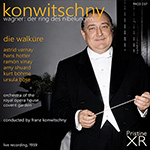
Cover artwork based on a photograph of Franz Konwitschny