

This album is included in the following sets:
This set contains the following albums:
- Producer's Note
- Full Track Listing
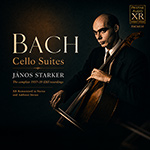
- Cover Art
János Starker’s 1957-59 Columbia recordings of Bach’s six Cello Suites occupy a fascinating place in the history of these works on record. They were not his first engagement with the Suites: earlier Nixa recordings had already established him as one of the most formidable Bach cellists of his generation. But these Columbia recordings caught him in a new phase of artistic command, still young, still incisive, yet already in possession of a rare fusion of technical discipline, tonal authority and interpretative maturity.
The Gramophone followed the sequence closely as the records appeared. Reviewing the Columbia disc of Suites Nos. 2 and 5 in April 1958, the critic noted that there was little difference in the “quality” between these performances and Starker’s earlier discs, while stressing the importance of the new recording. A solitary unaccompanied string instrument gives the engineer nowhere to hide: any weakness in focus, dynamic range or surface quality is mercilessly exposed. Yet this new Columbia issue was described as excellently produced and as containing two of the best Suites in the set. The D minor Suite was heard as sombre and noble, while the C minor Suite, with its scordatura tuning, drew particular admiration for the intelligence with which Starker made Bach’s single melodic line suggest a richer web of implied voices.
By the time Suites Nos. 1 and 3 appeared, reviewed in September 1959, Starker’s Columbia cycle was beginning to look like something more than a replacement for deleted earlier discs. The reviewer wrote that Starker’s performances had reached “a level of technical polish and interpretative ease hitherto unattained.” Comparison with the Nixa versions was instructive: the earlier performances retained their importance, but the Columbia recordings showed a greater freedom from effort, more expressive poise, and a subtler control of movement and dance rhythm. The famous G major Suite was found steadier and perhaps slightly less buoyant than before in its lighter dances, but the Sarabande was praised as finer, more expressive and beautifully poised. The C major Suite, already one of the great showcases of Starker’s clarity and energy, retained its lightness and flexibility while gaining in presence and authority.
The cycle was completed on record with Suites Nos. 4 and 6, reviewed in April 1961. Again the critic found many of the expected qualities fully present: assurance, strong rhythmic life, clean articulation and an ability to make Bach’s linear writing sound harmonically alive. There were reservations about the E-flat Prelude, whose arpeggiated writing can easily become mechanical, but Starker’s command of the faster music, especially in the D major Suite, was warmly recognised. The Sixth Suite has always presented special challenges for modern cellists. Associated in the Anna Magdalena Bach manuscript with a five-string instrument, à cinq cordes, it asks the four-string cello to reach beyond its natural comfort zone. Starker’s achievement is to make this formidable music sound happy, secure and commanding.
What emerges across these reviews is not a picture of indulgent romantic Bach, nor of austere scholarly reconstruction. Starker’s Bach is muscular, clear-eyed, inwardly expressive without theatrical excess. His discipline never freezes the music; rather, it allows the dances to breathe, the harmonic implications to speak, and the rhetoric of each movement to unfold without exaggeration. The Suites are presented as living structures: architectural, yes, but full of sinew, pulse and human heat.
For this Pristine release, the original recordings have undergone XR remastering, with Ambient Stereo processing applied to the earlier mono material. The later recordings were made in true stereo, and have therefore been preserved and remastered as such. Some of the original mono sound was constricted, but the playing beneath it was extraordinary. Pristine’s remastering opens the image, clarifies the cello’s body and resonance, and brings the listener strikingly close to the physical act of performance: bow, string, wood, rosin, breath. The result is not a modernisation of Starker’s Bach, but a revelation of it. These recordings, already admired in their own time, now speak with a renewed immediacy that makes their greatness easier to hear, and harder to resist.
STARKER plays Bach Cello Suites
Disc One (53:16)
BACH Cello Suite No. 1 in G major, BWV1007
1. 1st mvt. - Prélude (2:16)
2. 2nd mvt. - Allemande (4:40)
3. 3rd mvt. - Courante (2:20)
4. 4th mvt. - Sarabande (3:22)
5. 5th mvt. - Menuet I & II (2:54)
6. 6th mvt. - Gigue (1:34)
Recorded 22 May 1958 in EMI Studio No. 1, Abbey Road, London · Presented in Ambient Stereo
BACH Cello Suite No. 2 in D minor, BWV1008
7. 1st mvt. - Prélude (3:52)
8. 2nd mvt. - Allemande (3:46)
9. 3rd mvt. - Courante (1:39)
10. 4th mvt. - Sarabande (3:54)
11. 5th mvt. - Menuet I & II (2:38)
12. 6th mvt. - Gigue (1:46)
Recorded 30 May 1957 in Kingsway Hall, London · Presented in Ambient Stereo
BACH Cello Suite No. 3 in C major, BWV1009
13. 1st mvt. - Prélude (4:15)
14. 2nd mvt. - Allemande (3:15)
15. 3rd mvt. - Courante (2:16)
16. 4th mvt. - Sarabande (3:10)
17. 5th mvt. - Bourrée I & II (3:28)
18. 6th mvt. - Gigue (2:11)
Recorded 22-23 May 1958 in EMI Studio No. 1, Abbey Road, London · Presented in Ambient Stereo
Disc Two (62:25)
BACH Cello Suite No. 4 in E-flat major, BWV1010
19. 1st mvt. - Prélude (3:53)
20. 2nd mvt. - Allemande (3:12)
21. 3rd mvt. - Courante (2:22)
22. 4th mvt. - Sarabande (3:19)
23. 5th mvt. - Bourrée I & II (3:51)
24. 6th mvt. - Gigue (1:28)
Recorded 1 February & 9-10 June 1959 in EMI Studio No. 1, Abbey Road, London · Stereo
BACH Cello Suite No. 5 in C minor, BWV1011
25. 1st mvt. - Prélude (7:01)
26. 2nd mvt. - Allemande (4:50)
27. 3rd mvt. - Courante (2:13)
28. 4th mvt. - Sarabande (2:49)
29. 5th mvt. - Gavotte I & II (4:08)
30. 6th mvt. - Gigue (1:35)
Recorded 3 October 1957 in London · Presented in Ambient Stereo
BACH Cello Suite No. 6 in D major, BWV1012
31. 1st mvt. - Prélude (4:28)
32. 2nd mvt. - Allemande (4:55)
33. 3rd mvt. - Courante (2:26)
34. 4th mvt. - Sarabande (3:27)
35. 5th mvt. - Gavotte I & II (3:42)
36. 6th mvt. - Gigue (2:44)
Recorded 31 January-1 February 1959 in EMI Studio No. 1, Abbey Road, London · Stereo
János Starker, cello
XR Remastered by Andrew Rose
Cover artwork based on a photograph of János Starker
Total duration: 1hr 55:41
Reviews
Fanfare — James A. Altena
Issue 50:2 (Nov/Dec 2026) · Read the original review
As with Alfred Brendel, whose mammoth set of Philips recordings I recently reviewed, János Starker is an artist for whom I have long had great respect but limited affection, finding him overly cerebral and lacking in warmth. However, the Bach cello suites are works well suited to his interpretive strengths. Here Pristine reissues the first of his four complete traversals of these six iconic works, made in 1957–59 for EMI. (The other sets were made in 1963–65 for Mercury, 1984 for Sefel, and 1992 for RCA. In addition, Suites Nos. 1, 3, 4, and 6 were recorded in 1950–52 for Period, then reissued on LP by Nixa and Saga, and later on CD by Einsatz and Forgotten Records.) This EMI set differs radically from its successors in Starker’s employment of far fleeter tempos; the succeeding one for Mercury, completed only six years later, would add another 25 minutes to the total time for all six suites, and the Sefel and RCA are slower yet. For me, the later three versions drag, almost to the point of being suffocating, whereas this version is full of life. Here, Starker’s tone is beauteous, vibrant, and full; intonation is spot on; he articulates and phrases with great exactness, and employs a wide dynamic span to wonderful effect, especially in his descents to pianissimo. The combination of all these results in an arresting eloquence and sensitivity that make these pieces anything but mere technical exercises.
Suites Nos. 1, 2, 3, and 5 were recorded in mono, Nos. 4 and 6 in stereo. To the mono recordings Andrew Rose has applied the “Ambient Stereo” aspect of his patented XR remastering to make the sound more closely match that of the true stereo. Although the difference between the two is still manifest, overall the effort is a success. As usual, the physical discs come in a duofold cardboard digipak with tracks, timings, and recording information, while scores are posted online at Pristine’s website. This set now ranks for me among the finest ever made of these masterpieces; it could even be one’s desert-island choice. Emphatically recommended. James A. Altena
