
This album is included in the following sets:
This set contains the following albums:
- Producer's Note
- Full Track Listing
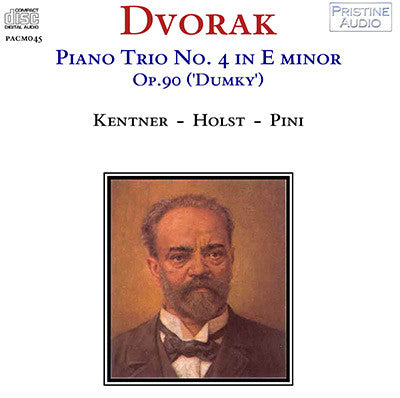
- Cover Art
Dvořák wrote his 'Dumky' Trio through the winter of 1890-91, and is his best-known use of the 'dumka', a Ukrainian lament, which had already featured in a piano piece of that name in 1876, as well as forming part of his Slavonic Dances, String Sextet, String Quartet in E flat and Piano Quintet in A. The general form is of a melancholy first section which alternates with a lively second second, and the Dumky Trio, in six movements set out in this way, uses a wide variety of keys to provide further contrast, rather than varying the form.
This wonderful wartime recording manages to capture perfectly this contrast - the opening lament in the cello, picked up by the violin, is heaving with tragedy and pathos, and yet the players skip effortlessly into the jig-like contrasting section, which they attack with a verve and wit that is to be heard throughout this recording.
Kentner, Holst and Pini's interpretation, which appears to have been ignored since its deletion from the Columbia 78rpm catalogue around 1950 (much to the disappointment of the critics of the day, who rightly referred to it as a 'splendid performance') is surely one of the great lost treasures of the shellac era. It is both a pleasure and a privilege to have it back!
Andrew Rose
KENTNER, HOLST, PINI Dvořák: "Dumky" Trio (1941)
DVOŘÁK Piano Trio No. 4 in E minor Op.90 ('Dumky')
1. I. Lento maestoso — Allegro quasi Doppio movimento (4:01)
2. II. Poco adagio — Vivace non troppo (6:24)
3. III. Andante — Vivace non troppo (5:51)
4. IV. Andante moderato — Allegretto scherzando (4:33)
5. V. Allegro (4:01)
6. VI. Lento maestoso — Vivace (4:30)
Tracks 1–6:
Louis Kentner, piano
Henry Holst, violin
Anthony Pini, cello
Recorded in 1941, released as UK Columbia DX 1017-1020
Matrix Numbers CAX 8861-8868, Takes 1, 1, 2, 2, 2, 1, 2, 1
(Duration 29'20")
Audiophile Audition review
Beautifully-restored from shellacs via the XR process by engineer
Andrew Rose... The performance itself captures the totally mercurial
temperament of the work, its integration of Bohemian rhythms, folksy
melodies, and pungent harmonic progressions, some based on germ-like
riffs that explode in the manner of Beethoven.... Kentner’s facile runs,
followed by non-legato passagework, testify to a pair of deft hands,
capable of power and plastic inflections. Great musicianship...
Review by Gary Lemco - Audiophile Audition