

This album is included in the following sets:
This set contains the following albums:
- Producer's Note
- Full Track Listing
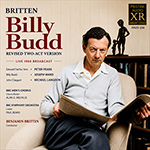
- Cover Art
Benjamin Britten’s Billy Budd has always occupied a curious position among the composer’s operatic masterpieces. Premiered at Covent Garden in 1951, it arrived in the immense shadow of Peter Grimes, yet from the beginning many musicians sensed that Britten had created something even more remarkable: a taut, psychologically charged music drama of extraordinary concentration and power.
Yet the original four-act structure posed problems. By 1960 Britten had undertaken a substantial revision, compressing the opera into two acts while tightening transitions and reshaping parts of the score. This BBC studio performance, broadcast on 13 November 1960 under the composer’s own direction, preserves that revised version at a crucial moment in the opera’s evolution.
Contemporary critics immediately recognised the significance of the revision. Writing in The Observer shortly after the broadcast, Peter Heyworth described the opera as “a score stripped for action” in which “every incident fulfils a musico-dramatic purpose”. Heard today, the performance still carries precisely that sense of dramatic concentration.
The cast assembled for the broadcast was a distinguished one even by Britten standards. Peter Pears, for whom the role of Captain Vere had been written, brings an inwardness and verbal sensitivity unmatched in this repertoire. Joseph Ward’s Billy is warm-hearted, physically vivid and touchingly direct, while Michael Langdon gives a darkly compelling portrayal of Claggart.
Prepared here in a new Ambient Stereo XR remastering from surviving archive sources, this historically important BBC broadcast emerges in remarkably vivid sound, restoring much of the drama, urgency and orchestral colour of Britten’s original transmission. As part of Pristine Classical’s ongoing series marking the composer’s anniversary year through significant historic recordings, it preserves not merely a performance, but a vital stage in the evolution of one of Britten’s greatest operatic achievements.
BRITTEN Billy Budd, Op. 50
Revised Two-Act Version
Disc One: Act I (76:58)
01. Prologue - I am an old man... (4:36)
02. Scene 1 - Pull, me bantams! (5:36)
03. Boat ahoy! (3:09)
04. First man forward! (2:32)
05. Your name? (2:24)
06. Billy Budd, king of the birds! (2:13)
07. I heard you! (3:28)
08. Come along, kid! (8:23)
09. Christ! The poor chap... (1:12)
10. What's that? What's those whistles? (2:03)
11. Starry Vere we call him (7:10)
12. Boy! Gentlemen, the King! (5:03)
13. Ay, ay, Spithead! (1:03)
14. We are, sir, Claggart is an able one (6:36)
15. We're off to Samoa... (3:29)
16. Hi! You... (2:48)
17. Over the water... (6:38)
18. Come here (4:26)
19. Billy!... Hist! Billy Budd! (3:57)
20. Dansker, old friend... (4:30)
Disc Two: Act II (70:14)
01. Scene 1 - I don't like the look of the mist... (2:17)
02. With great regret I must disturb your honour (1:06)
03. Deck ahoy! (1:30)
04. Volunteers! Call for boarding volunteers! (7:03)
05. There you are again, Master-at-Arms (4:29)
06. Oh, this cursed mist! (4:22)
07. Claggart, John Claggart (3:18)
08. Master-at-Arms and foretopman... (3:05)
09. God o' mercy! (1:58)
10. Gentlemen, William Budd here... (1:24)
11. William Budd, you are accused... (5:07)
12. Poor fellow, who could save him? (3:58)
13. I accept their verdict (2:56)
14. Look! Through the port (5:02)
15. Here! Baby! (8:41)
16. And farewell to ye... (4:17)
17. Interlude (2:53)
18. According to the Articles of War (1:53)
19. Down all hands! (2:14)
20. Epilogue - We committed his body to the deep (4:29)
Cast
Edward Fairfax Vere, Captain - Peter Pears
Billy Budd, Foretopman - Joseph Ward
John Claggart, Master-at-Arms - Michael Langdon
Mr Redburn, First Lieutenant - John Noble
Mr Flint, Sailing Master - Denis Dowling
Lieutenant Ratcliffe - Roger Stalman
Red Whiskers, an impressed man - Max Worthley
Donald, a sailor - Tudor Evans
Dansker, an old seaman - Trevor Anthony
The Novice - Alexander Young
Squeak, a Ship's Corporal - Andrew Gold
Bosun - George Hancock
First Mate - Stanley Riley
Second Mate - George Packnell
Maintop - Lloyd Strathsmith
The Novice's Friend - Ranken Bushby
Arthur Jones, an impressed man - George Stern Scott
Four Midshipmen - Robert Finlay, David Green, Andrew Pullinger, Nicholas Tong
Cabin Boy (spoken) - John Tibbett
Choir of Watford Boys' Grammar School
Music Master: John Tidcock
BBC Men's Chorus
Chorus Master: Alan G. Melville
BBC Symphony Orchestra
Leader: Paul Beard
Benjamin Britten, conductor
Meredith Davies, associate conductor
Basil Coleman, producer
BBC Third Programme studio recording, broadcast 13 November 1960.
Revised two-act version prepared by the composer for this BBC production.
XR Remastered by Andrew Rose
Cover artwork based on a photograph of Benjamin Britten
Total duration: 2hr 27:09
Reviews
Fanfare — Dominic Hartley
Issue 50:2 (Nov/Dec 2026) · Read the original review
For lovers of Britten opera, this new release from Pristine is an event. It’s the first recording of the two-act version of Billy Budd. But the broadcast it’s taken from was also the catalyst for that version, which has been the form in which the opera has been seen and heard since. There’s real historical significance here.
Some context. The 1951 premiere of Budd at Covent Garden consisted of four acts separated by three intervals. It was positively received. But for a work whose tension ratchets up moment by moment, the loss of dramatic momentum between acts understandably bothered Britten. He disliked much of what he saw of the German premiere of the work in Wiesbaden in March the next year but he did like the fact that the first two and last two acts were presented together with only a single interval in the middle. A month later he tried the same thing at a Covent Garden performance, convinced that the work’s intensity would be “quite enormously increased.”
It wasn’t, however, until 1959, when the BBC’s Third Programme proposed to Britten a revival of the work for a radio broadcast, that the composer gave thought to how to formalize the two-act experiment of earlier in the decade. Acts III and IV were relatively easily fused. More work was needed on the ending of act I to ensure dramatic congruence with act II, and Britten worked with the original librettists E. M. Forster and Eric Crozier to come up with a scenario that would lead naturally into the Cabin Scene at the start of act II. Britten wanted “a scene about Vere, but not with him.” The result—cutting the original “Muster” scene, replacing it with one where “Starry Vere” is discussed almost as a legend, and then leading us straight to the man himself alone with his Plutarch—is an inspired piece of dramaturgy. This is the version that the BBC recorded on 8 November 1960 and broadcast five days later. Miraculously, we can all now hear it.
Let me say at this stage that I have tried very hard not to let my excitement get the better of me when listening to this, but in two important ways, I prefer this recording to the one Britten recorded for Decca in 1967. First, the sheer tension and dramatic momentum Britten achieves with the BBC forces is extraordinary. I don’t know that I have ever heard Britten the conductor as possessed and driven as he is here. Second, the three principals sing and act even more convincingly than in 1967. Two are the same, of course, but both Peter Pears as Vere and Michael Langdon as Claggart are in slightly better voice in 1960 and project a positively febrile sense of stress, several notches above that found later in the decade. Joseph Ward’s Billy is a revelation. Twenty-eight at the time of the recording, he’s utterly convincing and makes Peter Glossop in 1967 sound markedly “mature” for the part. The great Peter Heyworth, writing after the broadcast described “a score stripped for action.” My goodness, how well Britten and his forces leaped at the opportunity the revisions permitted.
I would never, ever want to be without the Decca recording, of course, but it’s a surprise and delight to discover how good this “newcomer” is. The venue for the recording was the BBC Camden Theatre—a Victorian venue taken over by the BBC after the Second World War—and the venue’s excellent natural acoustics shine through here. Andrew Rose has again used Pristine’s Ambient Stereo XR to excellent effect on what I assume was a mono off-air recording. I’ll say again: this release is an event. Anyone with an interest in Britten’s music has to hear it. Dominic Hartley
