This album is included in the following sets:
This set contains the following albums:
- Producer's Note
- Full Track Listing
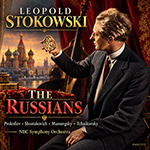
- Cover Art
Leopold Stokowski’s three seasons with the NBC Symphony Orchestra coincided with a moment when Russian music carried meanings far beyond the concert hall. Between 1941 and 1944 the United States and Soviet Union became uneasy wartime allies, Shostakovich’s Leningrad Symphony became an international symbol of resistance, and Prokofiev’s music for Alexander Nevsky, conceived before the war, suddenly acquired a striking new relevance. Stokowski was ideally placed to exploit this repertoire. His enthusiasm for Russian music stretched back decades, while his championing of Shostakovich had already brought the Sixth Symphony its first performance outside the Soviet Union in Philadelphia in 1940.
Prokofiev’s The Love for Three Oranges excerpts opened Stokowski’s NBC concert on 18 November 1941. Nine days later he would make a studio recording of the same three pieces, but this earlier performance has the freedom and electricity of live music-making. Reviewing its later issue, Jonathan Woolf found the NBC Symphony “superbly drilled”, while the March, taken at exhilarating speed, has a military brilliance entirely appropriate to Stokowski’s conception.
Shostakovich’s Sixth Symphony followed in the same session, continuing after the scheduled broadcast had ended. Its unusual design had puzzled audiences from the beginning: a long, introspective Largo followed by two increasingly extrovert movements, ending not in tragedy but in an almost manic Presto. Stokowski had been among its earliest and most determined advocates. At the 1940 American première, Virgil Thomson found the work “clear, obvious, effective, old-fashioned”, while Edwin Schloss heard in the finale “Comrade John Philip Sousa, in blouse and boots.” Stokowski himself was much more convinced, writing that repeated hearings revealed its “unusual expressive profundity”.
One week later, on 25 November 1941, another surviving continuous source carries the listener beyond the end of the scheduled NBC programme and into Stokowski’s Symphonic Synthesis from Mussorgsky’s Boris Godunov. Stokowski had long believed that orchestral adaptations could bring great dramatic music to audiences who might otherwise never encounter it. His Boris is no pot-pourri: it condenses the opera into six connected scenes, preserving its monastery bells, coronation splendour, dark processions and the death of the Tsar while dispensing with voices altogether. Modern opinion has been divided over such liberties, but Mark Swed in the Los Angeles Times described the work as “wonderfully thrill-seeking”.
Tchaikovsky provides the bridge between the two discs. The Storm, broadcast on 29 November 1942, and The Tempest, heard on 7 March 1943, are both youthful Shakespearean tone poems and both remained outside Stokowski’s commercial discography. That is surprising, for their surging climaxes, long-breathed melodies and opportunities for glowing orchestral colour might almost have been designed for him. Reviewing these NBC performances more than sixty years later, a MusicWeb critic found them “typically visceral and occasionally even wilful”.
The centrepiece of the collection is Prokofiev’s Alexander Nevsky, given its first American performance on 7 March 1943, with Jennie Tourel, the Westminster Choir and the NBC Symphony Orchestra. The cantata had grown from Prokofiev’s score for Sergei Eisenstein’s 1938 film depicting the medieval Russian defeat of the invading Teutonic Knights. By 1943 its scenes of invasion, devastation and resistance required little explanation. A surviving contemporary programme records that the New York Times praised the work’s unusual dramatic force and its unavoidable resonance with the current war in Russia, calling it a “composition with a unique dramatic effect.” Prokofiev himself explained that, although he had rebuilt the music according to purely symphonic principles, something of Eisenstein’s visual world remained embedded in it.
Jennie Tourel, born in the Russian Empire and later one of the outstanding mezzo-sopranos of her generation, was Stokowski’s soloist in the première. The engagement came at a decisive point in her American career; a few years later Time recalled that Stokowski had chosen her for Alexander Nevsky just as her reputation was beginning to take off.
The collection closes with another piece that Stokowski effectively made his own. His orchestration of Mussorgsky’s Pictures at an Exhibition was conceived in conscious contrast to Ravel’s famous transcription. Where Ravel favoured transparency and virtuoso brilliance, Stokowski sought darker sonorities, heavier basses, massed brass, percussion and eventually organ. His opening Promenade emerges from low strings and woodwind rather than trumpet, and he omitted Tuileries and The Marketplace at Limoges, believing their specifically French character out of place in the Russian sequence. Modern critics have variously called the result darker, more pungent and more Russian than Ravel; whatever one’s preference, the two versions inhabit remarkably different orchestral worlds.
These broadcasts therefore amount to more than a miscellaneous Russian anthology. They document Stokowski using one of America’s finest orchestras as both virtuoso instrument and experimental laboratory, revisiting music he had championed for years while introducing audiences to works they scarcely knew. Heard together, they also capture something particular to their moment: Russian music performed in wartime New York with an urgency that neither conductor nor audience could have regarded as merely historical.
STOKOWSKI The Russians
CD 1 (76:48)
PROKOFIEV The Love for Three Oranges - three excerpts
01. Infernal Scene (2:58)
02. The Prince and the Princess (4:16)
03. March (1:49)
Recorded 18 November 1941, Cosmopolitan Opera House, New York
SHOSTAKOVICH Symphony No. 6
04. I. Largo (16:52)
05. II. Allegro (6:03)
06. III. Presto (7:25)
Recorded 18 November 1941, Cosmopolitan Opera House, New York
MUSSORGSKY/STOKOWSKI Boris Godunov - Symphonic Synthesis
07. Outside the Novodievichi Monastery (6:34)
08. Coronation of Boris (5:16)
09. Monks chanting in the Chudov Monastery (2:14)
10. Siege of Kazan (1:24)
11. Outside the Church of Saint Basil (3:58)
12. Death of Boris (3:46)
Recorded 25 November 1941, Cosmopolitan Opera House, New York
TCHAIKOVSKY The Tempest, Op. 18
13. The Tempest, Op. 18 (14:07)
Recorded 7 March 1943, NBC Studio 8-H, Radio City, New York
CD 2 (77:01)
TCHAIKOVSKY The Storm, Op. 76
01. The Storm, Op. 76 (10:23)
Recorded 29 November 1942, NBC Studio 8-H, Radio City, New York
PROKOFIEV Alexander Nevsky, Op. 78
02. Russia under the Mongol Yoke (3:00)
03. Song about Alexander Nevsky (2:25)
04. The Crusaders in Pskov (7:04)
05. Arise, Russian People! (2:31)
06. The Battle on the Ice (11:50)
07. The Field of the Dead (6:23)
08. Alexander's Entry into Pskov (4:28)
Jennie Tourel, mezzo-soprano
Westminster Choir
Recorded 7 March 1943, NBC Studio 8-H, Radio City, New York
Sung in English
MUSSORGSKY/STOKOWSKI Pictures at an Exhibition
09. Promenade (2:00)
10. Gnomus (2:19)
11. Promenade (1:14)
12. The Old Castle (3:42)
13. Bydło (2:08)
14. Promenade (0:58)
15. Ballet of the Unhatched Chicks (1:07)
16. Samuel Goldenberg and Schmuyle (2:54)
17. Catacombs (1:55)
18. Cum mortuis in lingua mortua (2:47)
19. The Hut on Fowl's Legs (Baba-Yaga) (2:54)
20. The Great Gate of Kiev (4:49)
Recorded 21 March 1943, NBC Studio 8-H, Radio City, New York
NBC Symphony Orchestra
conducted by Leopold Stokowski
Producer and XR remastering: Andrew Rose
Total duration: 2hr 33:49