

This album is included in the following sets:
This set contains the following albums:
- Producer's Note
- Full Track Listing
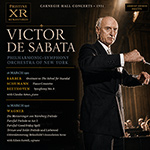
- Cover Art
In March 1951 Victor de Sabata appeared at Carnegie Hall as guest conductor of the Philharmonic-Symphony Orchestra of New York, in a group of concerts later drawn upon for CBS broadcast. The dates given here are the concert dates, not the broadcast dates. The broadcasts themselves came later, introduced on air by Jim Fassett, and were edited from the original programmes.
The first concert represented here took place on 18 March 1951, with Claudio Arrau as soloist. The printed programme also included Debussy’s Iberia, but the CBS transcription preserved here gives us Barber’s Overture to The School for Scandal, Op. 5, Schumann’s Piano Concerto in A minor, and Beethoven’s Symphony No. 8 in F major. De Sabata was making his first guest appearance of the season with the orchestra, and contemporary criticism was fascinated, if not entirely persuaded, by his personality on the podium. Olin Downes heard a conductor of strong effects, concerned less with literal textual polish than with atmosphere, colour and dramatic projection.
Barber’s overture was still a relatively modern American score in 1951, composed in 1932 and inspired by Sheridan’s comedy. It is an ideal curtain-raiser: quick-witted, brilliantly scored and full of theatrical sparkle. In this context it also reminds us that De Sabata’s visit was not simply a parade of old-world Austro-German monuments. He could bring his operatic instinct for character and timing to a score whose energy depends on precision, brightness and lift.
Schumann’s Piano Concerto placed De Sabata alongside Claudio Arrau, one of the great serious pianists of the age. Arrau’s playing was sometimes described in terms of intellectual weight and classical restraint, qualities that suit a concerto which resists empty display. Schumann’s soloist is not a conquering hero set against the orchestra, but a poetic presence woven into it. The critic found Arrau a little held back on this occasion, yet the surviving performance allows us to hear the meeting of two large musical temperaments: Arrau’s inward gravity and De Sabata’s taste for colour and expressive surge.
Beethoven’s Eighth Symphony completed the surviving part of the 18 March programme. Compact, energetic and often slyly comic, it is a work whose apparent lightness can deceive. Its wit is structural, rhythmic and dramatic, and in De Sabata’s hands it becomes less a polite Classical interlude than a finely sprung orchestral mechanism, alert to sudden turns and flashes of temperament.
The second concert heard here took place on Easter Sunday afternoon, 25 March 1951, and was devoted to Wagner, with Eileen Farrell as soloist. This concert followed an orchestral-only Wagner programme earlier in the same period, which perhaps explains the slightly tangled trail left by the contemporary reviews. The printed 25 March programme included Forest Murmurs from Siegfried, but the edited CBS transcription heard here centres on the Prelude to Die Meistersinger von Nürnberg, the Prelude to Act I and Good Friday Spell from Parsifal, the Prelude and Liebestod from Tristan und Isolde, and Brünnhilde’s Immolation Scene from Götterdämmerung.
Farrell was warmly received. Her Wagner singing was praised for its fullness, warmth and command, and the source recording captures her with particular success. The Tristan and Götterdämmerung excerpts demand not only power but breadth of line and emotional concentration, and Farrell brings both scale and human warmth to music that can too easily become merely monumental.
The orchestral Wagner reveals De Sabata at his most characteristic: grand, theatrical, sometimes extravagant, but never anonymous. One critic thought him happiest when able to “shake the roof”; another heard vitality even where refinement was not the principal virtue. These performances confirm that impression. De Sabata’s Wagner is not neutral, devotional wallpaper. It is painted in dark colour, strong gesture and high relief.
The original tapes had suffered considerable degradation, but this has been successfully addressed in the present XR remastering. The resulting sound from both concerts is excellent for its age and source, with the vocal material especially vivid. Ambient Stereo has been used to open the acoustic without falsifying the historical character of the recordings: Carnegie Hall, great artists, broadcast microphones, and interpretative risk caught in the act.
DE SABATA New York Broadcasts, 1951
Disc one (71:54)
1. RADIO Introduction (1:45)
2. BARBER Overture, The School for Scandal, Op. 5 (9:51)
SCHUMANN Piano Concerto in A minor, Op. 54
3. 1st mvt. - Allegro affettuoso (16:26)
4. 2nd mvt. - Intermezzo: Andantino grazioso (5:45)
5. 3rd mvt. - Allegro vivace (11:46)
Claudio Arrau, piano
BEETHOVEN Symphony No. 8 in F major, Op. 93
6. 1st mvt. - Allegro vivace e con brio (9:29)
7. 2nd mvt. - Allegretto scherzando (3:47)
8. 3rd mvt. - Tempo di menuetto (4:35)
9. 4th mvt. - Allegro vivace (7:28)
10. RADIO Conclusion (1:02)
Disc two (74:41)
1. RADIO Introduction (1:30)
2. WAGNER Die Meistersinger von Nürnberg - Prelude (9:48)
3. WAGNER Parsifal - Prelude to Act I (12:51)
4. WAGNER Parsifal - Good Friday Spell (13:46)
5. WAGNER Tristan und Isolde - Prelude and Liebestod (17:44)
6. WAGNER Götterdämmerung - Brünnhilde’s Immolation Scene (17:56)
Eileen Farrell, soprano
7. RADIO Conclusion (1:06)
Philharmonic-Symphony Orchestra of New York
conducted by Victor de Sabata
XR Remastered by Andrew Rose
Live CBS recordings made at Carnegie Hall, New York City
Recorded 18 & 25 March 1951
Broadcast 25 March & 1 April 1951
Total duration: 2hr 26:35
Reviews
Fanfare — James A. Altena
Issue 50:2 (Nov/Dec 2026) · Read the original review
Victor de Sabata (1892–1967) left a tragically small recorded legacy for a conductor of his extraordinary stature. An accomplished pianist and violinist, he was encouraged to take up a conducting career by Toscanini, though like Furtwängler he considered himself to be a composer by vocation and a conductor only by avocation. In 1918 he became the conductor of the Monte Carlo Opera Orchestra, and in 1930 succeeded Toscanini as the principal conductor of La Scala, Milan. (The two men became estranged for two decades over artistic and political differences—Toscanini was a committed anti-Fascist, whereas de Sabata was a friend of Mussolini—but they eventually reconciled in 1954.) He held the latter position until late 1953, when a severe heart attack forced him to cease conducting in public, though he held the administrative position of artistic advisor to the opera house through 1957. Interpretively, de Sabata was similar to Toscanini in his extraordinary ability to memorize scores, his exacting demands for precision of execution and total commitment from instrumentalists and singers working under his baton, and the fiery nature of his interpretations. They differed in that de Sabata employed a far more plastic approach to tempos, with numerous shifts of speed between sections and application of rubato.
In the studio, de Sabata made a few recordings in 1933 with the Turin RAI Symphony for Parlophone, a few more sides in 1939 with the Berlin Philharmonic for Polydor, then a few more sides for Decca in 1946, followed by some sets for HMV with the Accademia di Santa Cecilia Orchestra in 1947–48 and finally his complete LP recordings of Tosca and the Verdi Requiem from 1953 and 1954 at La Scala. The fabled Tosca with Callas, di Stefano, and Gobbi—considered by me and a number of other critics to be the greatest studio recording of a complete opera ever made—was to have been the first of a number of recordings with de Sabata and Callas, but the conductor’s heart attack short-circuited those plans. From live broadcasts, there are several surviving complete operas (Il barbiere di Siviglia, Chant du rossignol, Tristan und Isolde, Aida, Macbeth, and two performances of Falstaff), fragments from a few others (Andrea Chénier, La bohème, and Otello), several New York Philharmonic concerts from March 1950 and March 1951, and a few other works from concerts with other orchestras. Unfortunately the recorded sound of the live operas ranges from mediocre to almost intolerable.
These two New York Philharmonic concerts actually were broadcast by CBS Radio one week after the actual performances: that of March 18 was transmitted on March 25, and that of March 25 on April 1. Due to time restrictions, one additional work performed on each program was not broadcast; Debussy’s Iberia was omitted from the March 18 concert, and the “Forest Murmurs” from Wagner’s Siegfried from the March 25 concert. One regrets the loss of these two items, not just for the sake of having the complete programs but because the performances of all of the other works are so sensational. Andrew Rose’s brief liner notes for this release state that “The original tapes had suffered considerable degradation, but this has been successfully addressed in the present XR remastering.” This is not self-promotional hyperbole; I have some of these performances on previous CD releases, and the improvement in sonic quality here is a couple of quantum leaps ahead of those earlier efforts. While not having the exceptional sonic range of the 1953 Mahler Fourth with Bruno Walter that Rose recently released, the sound quality is quite satisfactory in terms of frequency range, clarity of instrumental lines, and overall balances.
The first concert opens with Samuel Barber’s coruscating 1931 overture for Richard Brinsley Sheridan’s 1777 comedic masterpiece The School for Scandal. To Barber’s deft capturing of the play’s intrigues, de Sabata appropriately adds a flavor of Italian commedia dell’arte in a lithe, buoyant rendition. The performance of the Schumann Piano Concerto that follows has excited very different reactions. In Fanfare 29:3 Michael Fine opined that the conductor and pianist “play with an expressive, even daring rubato which is nearly operatic in its freedom and inflection. Happily, they are in perfect tune with each other,” whereas in 30:2 Mortimer H. Frank complained that the performance “offers as fussy and affected a first movement as one is likely to hear, with tempos hauled about and rhythm frequently ruptured.” I side completely with Fine here. Normally I am not a fan of Arrau, finding his playing to be ponderous, but there are exceptions, particularly early in his career. Here the Chilean virtuoso ably captures the mercurial contrast in the composer’s psyche between Eusebius and Florestan, and except for one brief passage in the finale that is too chipper the Italian maestro is perfectly in sync with him. Beethoven’s Eighth Symphony is dispatched with brisk energy in an interpretation of Haydnesque wit, which is exactly how I like to hear it. A bit oddly, in each of the four movements the first one or two beats of the first measure are slightly under tempo compared to the rest of the movement, as if either de Sabata or the orchestra momentarily has trouble getting into proper gear.
The concert of Wagner excerpts previously appeared on a Urania CD in 2001, reviewed by William Youngren in 24:6. I urge everyone reading these lines to consult his review in the online Archive; as it makes any commentary by me largely superfluous, I will keep my own remarks short. This is superlative Wagner. The Prelude to Die Meistersinger has noble gravitas, but no lack of energy. The two excerpts from Parsifal surprise in that a conductor so renowned for his incendiary temperament proves so skilled at achieving a sense of solemn spaciousness and contemplation. I was absolutely enthralled by a passage in the “Good Friday Spell,” in which de Sabata perfectly captures the sense of anguished interiority in Parsifal by tapering the orchestra down to a solo clarinet playing piano at 6:10, followed by a moment of silence in which one could hear the proverbial pin drop—not one person in the audience makes a rustle or lets out a cough. The Tristan Prelude builds slowly and inexorably from brooding languor to ecstatic passion, with Eileen Farrell delivering a magnificent Liebestod. Then, surpassing herself, she offers what to my ears is the greatest rendition of Brünnhilde’s “Immolation Scene” I have ever heard. De Sabata’s conducting is astounding in its perfect gauging of agogic adjustments, while Farrell offers not only refulgent beauty of tone (so rare in Wagnerian sopranos) and total technical security but also exemplary diction that for once enables one to understand and follow exactly what Brünnhilde is thinking and feeling.
The disc case features a cover photo of de Sabata, and provides tracks, timings, and recording information. Musical scores are posted on Pristine’s website. At this point, my 2026 Want List may consist almost entirely of releases on this label, as this joins previous ones with Bruno Walter (three!) and Fritz Kreisler as prime candidates for inclusion. And one’s mouth positively waters at the possibilities for further de Sabata/NYP releases by Pristine from the March 1950 concerts: symphonies by Beethoven (the Fifth), Dvořák (the Ninth), Franck, and Sibelius (the First); a Brahms Violin Concerto with Nathan Milstein; a Rachmaninoff Rhapsody on a Theme of Paganini with Artur Rubinstein; and shorter orchestral works by Dukas and Ravel. In any case, this release is urgently, emphatically recommended. James A. Altena
