

This album is included in the following sets:
This set contains the following albums:
- Producer's Note
- Full Track Listing
- Cover Art
The current volume of our series devoted to Frederick Stock’s purely orchestral recordings with the Chicago Symphony begins with his final recordings for Columbia, as well as the first disc made upon his return to Victor at the end of 1941, placed here because it would not have fit with his remaining late Victors on the single release that will conclude this series.
Between the end of Volume 4 and the first work on this volume, Stock made his only two concerto recordings for Columbia. On the same day (6 March 1940), he set down the Tchaikovsky Violin Concerto with Milstein and the Saint-Saëns Cello Concerto No. 1 with Piatigorsky. As both of these have seen several CD reissues already, they are omitted from this series.
The next session, held on 23 November 1940, featured Stock’s only electrical recording made in New York while the orchestra was on tour, the Brahms Third Symphony. Stock’s reading here, like many of the other performances on this release, is filled with an energy and forward momentum that belies his reported health problems which had led to the engagement of Toscanini’s assistant from the New York Philharmonic, Hans Lange, to join the CSO as assistant conductor several years earlier to help shoulder the workload.
The remaining Columbias in this release were all set down during two very fruitful days of recording the following year, Friday and Saturday April 25th and 26th, 1941. These were given over to recording mainly shorter pieces (overtures and “pops” material), with the only extended work being the Schumann Fourth. It is noteworthy that of the seven complete symphonies Stock recorded over his career, two were by Schumann (this and the 1929 Victor recording of the “Spring” Symphony on Volume 2 (PASC 684)). By this time in his career, Stock’s approach had changed from the rather gemütlich approach of the earlier recording to a more driven, Toscanini-like reading, entirely appropriate to this more dramatic score.
Stock’s largely conservative discography might blind us to the fact that he was a champion of contemporary repertoire throughout his career. He was the first to perform the Mahler Seventh in the USA; and a year after Stokowski had given the American première of the Eighth in Philadelphia in 1916, Stock programmed it in Chicago. In 1921, he conducted the world première of Prokofiev’s Piano Concerto No. 3 with the composer as soloist, and was the first to champion Florence Price by conducting her First Symphony in 1933.
For the orchestra’s 50th season (1940-41), Stock commissioned a number of famous composers to contribute new works to be premièred by the ensemble, including Stravinsky’s Symphony in C, Miaskovsky’s Symphony No. 21, Kodaly’s Concerto for Orchestra and Milhaud’s First Symphony. The only work which Stock recorded from this endeavor was Walton’s Scapino Overture. Scapino was an Italian Commedia dell’Arte figure known to escape scrapes and close calls with his wits, and Walton constructed an aptly fleet work to showcase him. This disc, recorded three weeks after its première on 3 April 1941, utilizes the original scoring for large orchestra. In 1950, Walton revised the score for smaller forces in a version that was first given by Furtwängler and the Philharmonia Orchestra that year. The work is close in spirit to Arthur Benjamin’s “Overture to an Italian Comedy” which closes this release, although the Benjamin predated the Walton by several years.
As far as the rest of the repertoire goes, Glazunov must have been one of Stock’s favorite composers, because his works are featured in his discography as far back as his early acoustic recordings as well as in his late-Twenties Victors. Here, he gets to record three full discs of the composer’s works. The Liadov was never issued on 78s, probably because it was an “odd side” that didn’t have a coupling. And Stock’s arrangement of Paganini’s “Moto Perpetuo”, with its quotations from Beethoven’s Eroica/Prometheus music in counterpoint, is much cleverer than Toscanini’s more straightforward all-string arrangement recorded two years earlier.
Our next volume will be the final one in this series, featuring the remainder of Stock’s non-concerto Victors from 1941.
Mark Obert-Thorn
FREDERICK STOCK and The Chicago Symphony, Volume 5
disc one (75:42)
BRAHMS Symphony No. 3 in F major, Op. 90
1. 1st Mvt. - Allegro con brio (8:46)
2. 2nd Mvt. - Andante (7:53)
3. 3rd Mvt. - Poco allegretto (6:08)
4. 4th Mvt. - Allegro - Un poco sostenuto (8:39)
Recorded 23 November 1940
Matrices: XCO 29139-2, 29140-1, 29141-1, 29142-2, 29143-1, 29144-1, 29145-1 & 29146-1
First issued on Columbia 11505/8-D in album M-443
Recorded 25 April 1941 ∙ Matrices: XCO 30554-1 & 30555-3
First issued on Columbia 11945-D
5. WALTON Scapino, a Comedy Overture (9:24)
SCHUMANN Symphony No. 4 in D minor, Op. 120
6. 1st Mvt. - Ziemlich langsam - Lebhaft (8:09)
7. 2nd Mvt. - Romanze: Ziemlich langsam (4:23)
8. 3rd Mvt. - Scherzo: Lebhaft (4:11)
9. 4th Mvt. - Langsam - Lebhaft (7:07)
Recorded 25 April 1941
Matrices: XCO 30751-2, 30752-1, 30753-2, 30754-1, 30755-1 & 30756-1
First issued on Columbia 11581/3-D in album M-475
Recorded 25 April 1941 ∙ Matrices: XCO 30816-2. 30817-1 & & 30818-1
First issued on Columbia 11605/6-D in album X-203
10. ENESCU Romanian Rhapsody No. 1, Op. 11 (11:02)
disc two (77:22)
GLIÈRE Symphony No. 3 in B minor, “Ilya Murometz”
1. 3rd Mvt. - The Palace of Prince Vladimir (7:22)
Recorded 25 April 1941 ∙ Matrices: XCO 30966-1 & 30967-2 ∙ First issued on Columbia 11697-D
Recorded 25 April 1941 ∙ Matrices: XCO 30968-1 & 30969-2 ∙ First issued on Columbia 11771-D
Recorded 26 April 1941 ∙ Matrix: XCO 30819-1 ∙ First issued on Columbia 11606-D in album X-203
Recorded 26 April 1941 ∙ Matrices: XCO 30970-2 & 30971-1 ∙ First issued on Columbia 11665-D
Recorded 26 April 1941 ∙ Matrices: XCO 30972-3, 30973-1 & & 30974-1 ∙ First issued on Columbia 11681/2-D in album X-214
Recorded 26 April 1941 ∙ Matrices: XCO 30975-1 & 30976-1 ∙ First issued on Columbia 11934-D in album X-232
Recorded 26 April 1941 ∙ Matrices: XCO 30977-1 & 30978-1 ∙ First issued on Columbia 11933-D in album X-232
Recorded 26 April 1941 ∙ Matrix: XCO 30979-1 ∙ Unissued on 78 rpm
Recorded 26 April 1941 ∙ Matrix: XCO 30980-2 ∙ First issued on Columbia 11682-D in album X-214
Recorded 26 April 1941 ∙ Matrix: XCO 30981-2 ∙ First issued on Columbia 11738-D
Recorded 26 April 1941 ∙ Matrices: XCO 30546-1 & 30547-2 ∙ First issued on Columbia 11621-D
Recorded 22 December 1941 ∙ Matrices: CS 070159-1 & 070160-1 ∙ First issued on Victor 11-8157
2. GLAZUNOV Carnaval Overture, Op. 45 (8:43)
3. REZNIČEK Donna Diana - Overture (3:52)
4. TOCH Pinocchio: A Merry Overture for Orchestra (6:32)
5. BRAHMS Tragic Overture, Op. 81 (11:11)
6. GLAZUNOV Concert Waltz No. 1, Op. 47 (6:52)
7. GLAZUNOV Concert Waltz No. 2, Op. 51 (7:12)
8. LIADOV Baba Yaga, Op. 56 (2:49)
9. BRAHMS Minuet from Serenade No. 1 in D major, Op. 11 (4:20)
10. PAGANINI (arr. Stock) Moto Perpetuo, Op. 11 (3:48)
11. PONCHIELLI Dance of the Hours from La Gioconda (8:12)
12. BENJAMIN Overture to an Italian Comedy (6:29)
Frederick Stock ∙ Chicago Symphony Orchestra
Producer and Audio Restoration Engineer: Mark Obert-Thorn
All recordings made in Orchestra Hall, Chicago, except for the Brahms Third, which was recorded in Liederkranz Hall, New York City
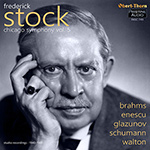
Cover photo of Frederick Stock by George Nelidoff kindly provided by the Rosenthal Archives of the Chicago Symphony Orchestra (Frank Villella, archivist).
Total duration: 2hr 33:02
Fanfare Review
The musicians are concentrating, interacting with each other, and playing with style and commitment … it has never sounded as full and rich as it does here
This fifth volume of Pristine’s series devoted to Frederick Stock’s Chicago Symphony recordings has been restored brilliantly by Mark Obert-Thorn. The set features two major Romantic symphonies and a wonderful variety of the kind of shorter works that regularly made their appearance in subscription concerts before the 1960s. These recordings were made in 1940 and 1941, and with one exception they were made in Orchestra Hall. The exception is Brahms’s Third Symphony, which was recorded in Liederkranz Hall in New York City.
Stock did not possess the highly individual musical personality of some of his contemporaries, particularly Mengelberg, Toscanini, and Furtwängler. The more one hears of his recorded legacy, however, the more evident his strengths become. His 37-year tenure as music director in Chicago was not the result of institutional inertia. It was indicative of a deep satisfaction with his work from the CSO musicians, the orchestra’s board and management, and the city’s music lovers.
While Stock’s performances may lack the unique touches that immediately identify Mengelberg and Furtwängler in just a few chords, his conducting is in no way anodyne. Very few of his recordings come across as if they are on autopilot. The musicians are concentrating, interacting with each other, and playing with style and commitment. We hear a level of precision that was not typical for its time. Anyone who believes that Fritz Reiner and Georg Solti bear total responsibility for the excellence of the CSO is undervaluing how Stock shaped the internal culture of the orchestra.
Those qualities are particularly evident on CD 2, which contains most of the orchestral miniatures. It is hard to imagine a more convincing case being made for Ernst Toch’s Pinocchio: A Merry Overture , which is played with enthusiasm and now sounds far better than it did on the muddy Past Masters transfer on an earlier release. The two concert waltzes by Glazunov are played with a warm suppleness that makes you wonder why they aren’t heard as often as Johann Strauss’s chestnuts. The accuracy and élan of the CSO strings is shown off in Stock’s arrangement of Paganini’s Moto Perpetuo , and there is abundant buoyancy in Walton’s Scapino and Arthur Benjamin’s Overture to an Italian Comedy .
There are only a few performances that fail to take wing. Brahms’s Tragic Overture is square and heavy-handed, and Resniček’s Donna Diana overture is breathlessly rushed. For the most part, however, Stock and the orchestra get the most out of these miniatures, making me wish that today’s conductors would pay similar attention to this corner of the repertoire.
The two major symphonies, Brahms’s Third and Schumann’s Fourth, are important representations of Stock’s art. The Brahms suffers a bit from the dry acoustic of Liederkranz Hall and Columbia’s close microphone placement. The lack of space around the orchestra, in combination with Stock’s quick tempos, particularly in the first movement, gives the reading a breathless quality. The Brahms was recorded in November 1940, at the beginning of the World War II draft, which ultimately took a toll on American orchestras (and, conversely, opened the way for women to join them). The orchestral playing, particularly from the woodwinds, is distinguished by both brilliance and sensitivity.
The Schumann Fourth was recorded in April 1941, by which time the CSO had lost some of its important players to the military, but there is no hint of deterioration in the ensemble. The richer Orchestra Hall acoustics, and perhaps the CSO’s greater comfort playing in its home, results in a performance that has a more natural flow. In both works Stock’s predilection for quick tempos is evident, but along with it there is flexibility and suppleness of phrasing to provide a balance in the conductor’s tautness.
Today’s Chicago Symphony Orchestra is recognized as one of the world’s finest. Pristine’s restoration of Stock’s recordings makes clear his foundational role in establishing that greatness. As usual, ordering from Pristine’s website, pristineclassical.com, gives you a choice of download formats or CDs, along with scores and complete discographic information. Some of this material was issued by the CSO itself, but it has never sounded as full and rich as it does here.
Henry Fogel
Fanfare, JAN/FEB 2026