The review quoted under Additional Information contrasts the present recording with a
release by Munch and the BSO, and notes the problems of tuning. Indeed, for
those sensitive to these matters the French recording is astonishing for the
fact that it was ever passed for release.
This Pristine XR remastering has used the magic of the Grammy
Award-winning Capstan pitch correction software to retune the orchestra and
organ so that they actually match, unlike the astonishingly out-of-tune
original LP! No wonder this otherwise excellent recording has never been
reissued - every junction between organ and strings was painful to hear if
you'd any sensitivity towards pitch. They must have had cloth ears at the time:
straight from the LP the organ comes in at A=444.85 whilst the orchestra plays
up at A=452.11. For the curious, the latter is almost a quarter-tone sharp of
standard pitch, where A=440Hz. It is indeed now a recording transformed!
There is of course no such problem with the Gloria, which in this
32-bit XR remastering sounds, well, glorious - and fully in tune.
With the space left to me, I decided to add not a contemporary
recording, nor even music by Poulenc, but four rare French 78rpm sides the
composer recorded in 1937 of piano duets by one of his great mentors, Erik
Satie, which I don't believe have seen any commercial issue since their rather
obscure 78rpm incarnation. My thanks to Al Schlachtmeyer for his generous
donation of these discs.
Andrew Rose
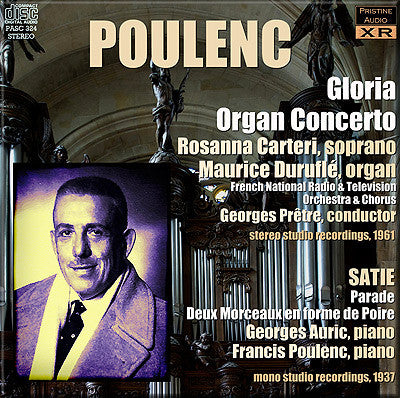
POULENC Gloria, Organ Concerto; Poulenc plays Satie duets (1961/1937)
POULENC Gloria in G major, for soprano, chorus and orchestra
1. 1. Gloria in Excelsis Deo (3:16)
2. 2. Lauamus Te (3:11)
3. 3. Domine Deus (4:39)
4. 4. Domine Fili Unigenite (1:31)
5. 5. Domine Deus, Agnus Dei (7:37)
6. 6. Qui sedes ad dexteram Patris (7:11)
Rosanna Carteri, soprano
French Radio-Television Chorus
Yvonne Gouverné director
Recorded 15 February, 1961, Salle Wagram, Paris, in the presence of the composer
POULENC Organ Concerto in G minor, for organ, strings and timpani
7. Poulenc: Organ Concerto in G minor (22:52)
Maurice Duruflé organ
Recorded 21 February, 1961, Church of Saint-Etienne du Mont, Paris
Gloria and Organ Concerto, tracks 1–7: French National Radio & Television Orchestra
Georges Prêtre conductor
Transfers from Columbia LP SAX2445
SATIE Parade
8. Prélude du Rideau Rouge — 1. Prestigitateur Chinois (4:17)
9. 2. Petite fille américane — Rag Time du Paquebot (2:48)
10. 3. Acrobates — Suite au prélude du Rideau Rouge (4:12)
SATIE Deux Morceaux en Forme de Poire
11. 1. Enlevé II (2:38)
12. 2. Redite (1:23)
Satie duets, tracks 8–12: Georges Auric piano
Francis Poulenc piano
Recorded Paris (?), 1 August, 1937
Transfers from Editions de la Boite à Musique 78s nos. 16 & 17
Matrix Numbers PART 1014-1017
(Presented in Ambient Stereo)
XR remastering by Andrew Rose at Pristine Audio, January 2012
Cover artwork based on a photograph of Francis Poulenc and the Organ of the Church of Saint-Etienne du Mont, Paris
Total duration: 65:35
REVIEW (1961 recordings)
This strange accident of a simultaneous issue of two recordings of an unfamiliar and hitherto generally unavailable work—for the Poulenc organ concerto is known to the British record public only through an American disc which was obtainable on special order eleven years ago—is a singularly unfortunate one, for they both happen to be extremely good, and each will inevitably affect the other's sales. The concerto, written in 1938 and first performed by Maurice Duruflé, Columbia's soloist, is in one continuous movement, which however falls into four sections. Its essential unity is underlined by a four-note motive which appears throughout in various guises, and those who are usually put off by Poulenc's short-breathed phrases will find that there is here a far greater sense of continuity—it is certainly the best of his concertos. In the opening, and elsewhere, side-long reverences are made to the spirit of Bach (the echo of the G minor Fantasia can scarcely be accidental), and despite the marking of Allegro giocoso for the first main section and a most exuberant finale, there are undertones of serious drama—and the last pages of the work are prayerful (1938 and all that?). Prêtre takes the Allegro giocoso faster and more dramatically than Munch, and this is indeed almost the only real difference in reading between the two. Both soloists, and both orchestras, are excellent, both performances are alert, vital and rhythmic, and both, despite the formidable difficulties of balancing an orchestra against a modern full organ, are brilliantly engineered, giving clarity as well as warmth. The Boston strings make the more ravishing sound at the ires doux et intense section and in the final pages, and the RCA recording is very slightly more forward, but the reason why, after careful comparison, I come down on the side of RCA is nothing to do with the quality either of players or recording. It is simply that the French Radio Orchestra has not tuned exactly enough to the organ, and though the variation in pitch is not noticeable so long as the organ employs upper octave couplings, when it uses eight-foot one alone (as in the dialogues in the Andante moderato, or in solo reed passages) it is apparent that the strings are tuned ,lightly sharper.
The question of couplings is bound to enter into consideration, and here again both firms put up most attractive proposi'ions. RCA has the first decent LP (the one previous version was very poor) of Stravinsky's light-hearted ballet score for Balanchine, in which he cheerfully flirts with 'Fchaikovsky, Johann Strauss, The Barber of Seville and even previous works of his own. The Boston Orchestra, playing with virtuosity and the utmost subtlety of nuance, gives )t a witty, incisive, deliciously pointed performance which is beautifully balanced and recorded. All Stravinskians will want this.
All Poulenc fans, on the other hand, will want this first recording of his Gloria, written for the Koussevitzky Foundation and given 'ts premiere last year in—ironically enough, in the present context—Boston. (The first European performance took place in Paris on February 14th, 1961, and this recording was made the following day.) Like so many of Poulenc's religious works, it finds the composer at his best: behind its joyous, lucid façade lies a deep sincerity, which in the Doming Deus attains real beauty. In this movement Rosanna Carteri floats her octave rises exquisitely and is most touching in her litany of "Qui tollis peccata mundi". The chorus sings with firm tone (though the tenors are unnecessarily aggressive in their "Miserere nobis") and is well balanced with the orchestra and organ (no trouble with pitch this time). As in Jeu de Cartes, there are influences for those who care to discover them: Stravinsky himself (particularly in the jagged opening of the Laudamus te), Ravel, even Verdi (there is an almost exact echo of Otello at the end of the Domine Deus —but it always was a good phrase!) ; but there are so many individual fingerprints that it could never be mistaken for the work of anyone else.
L.S. - The Gramophone, June 1962