

This album is included in the following sets:
This set contains the following albums:
- Producer's Note
- Full Track Listing
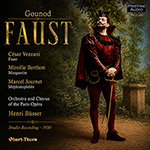
- Cover Art
When the French branch of the Gramophone Company recorded Charles Gounod’s Faust in Paris during 1930, it preserved far more than a celebrated opera. Conducted by Henri Büsser with the orchestra and chorus of the Paris Opéra, this recording captures an entire performing tradition at its height: the supple diction, conversational elegance and stylistic poise of French opera between the wars. Nearly a century later, it remains one of the most idiomatic and compelling recorded accounts of Faust.
Recorded between February and November 1930, the original issue occupied forty sides of 78 rpm discs. Although not absolutely complete, it presented a remarkably substantial version of the opera for its time, including the Walpurgis Night music and ballet, and was described by a contemporary reviewer as “practically complete.” At a time when the limitations of the 78 rpm disc usually demanded extensive cuts, this was an ambitious undertaking that preserved not only Gounod’s score but also a performing tradition already beginning to disappear.
Henri Büsser (1872-1973) brought unique authority to the project. A pupil of both Charles Gounod and Jules Massenet, he belonged to the last generation with direct personal links to the composer. Throughout a long career as conductor, composer and teacher, Büsser became one of the foremost custodians of the French operatic tradition.
His conducting avoids heaviness and theatrical excess, favouring clarity, flexibility and close attention to the natural accents of the French language. The result is a performance of remarkable continuity, despite having been assembled over many recording sessions. Büsser’s spacious pacing favours the long-spun melody while allowing Gounod’s orchestral colours to emerge with unusual transparency.
As Faust, César Vezzani (1888-1951) brings heroic ardour and unmistakable vocal glamour. One of the leading French dramatic tenors of his generation, he combines lyrical warmth with ringing power, qualities heard to memorable effect in Salut! demeure chaste et pure and the final prison scene. His performance preserves one of the fullest surviving documents of a remarkable artist whose career was centred largely within France.
Mireille Berthon (1889-1955) sings Marguerite with refinement and emotional restraint rather than overt sentimentality. Her poised phrasing, clear diction and finely focused tone exemplify the distinctive virtues of French singing between the wars. From the sparkle of the Jewel Song to the pathos of the church scene and the serenity of the final redemption, Berthon creates a Marguerite whose character develops naturally through the drama rather than serving simply as a showcase for vocal display.
The dominant dramatic personality of the set, however, is Marcel Journet (1868-1933) as Méphistophélès. By 1930 he was already celebrated at Covent Garden, La Scala, the Metropolitan Opera and the Paris Opéra. His Devil is urbane rather than grotesque, seductive rather than merely sinister. In Le veau d’or, temptation is conveyed through elegance and intelligence rather than brute force, while throughout the opera his superb command of both voice and language creates one of the most compelling assumptions of the role ever preserved on disc.
The supporting cast, together with the orchestra and chorus of the Paris Opéra, contribute immeasurably to the performance’s authenticity. Modern listeners may initially be surprised by its elegance and intimacy, yet these very qualities give the recording its enduring value. Rather than treating Faust as grand spectacle alone, Büsser and his singers reveal a work of wit, tenderness, sensuality and psychological subtlety.
The Paris Opéra Orchestra plays with a refinement and pliancy characteristic of the French school, from the pearly woodwinds to the burnished strings and sensitive balances. The chorus, too, is notable for the unity of its French diction and the natural flow of its ensembles, essential in an opera where choral comment and atmosphere are so integral to the drama.
Far from being merely a historical document, this 1930 Faust remains a vivid window into a vanished French operatic tradition, preserved with extraordinary vitality by artists who understood its language and style from within. Its historical importance is matched by its enduring musical conviction, qualities that continue to make it one of the finest French opera recordings of the 78 rpm era.
GOUNOD Faust
CD 1 (77:20)
ACT ONE
01. Introduction (4:29)
2 October 1930; CG 869-3 (Disque Gramophone L 806)
02. Rien! En vain j’interroge (4:46)
1 April 1930; CF 3122-1 (Disque Gramophone L 806)
03. Ah! Paresseuse fille qui sommeille encor! (1:33)
04. Aux champs l’aurore nous rappelle (1:09)
2 April 1930; CF 3123-3 (Disque Gramophone L 807)
05. Mais, ce Dieu, que peut-il pour moi? (3:37)
06. À moi les plaisirs (5:31)
3 April 1930; CF 3128-2 & 3129-2 (Disque Gramophone L 807 & L 808)
ACT TWO
07. Vin ou bière, bière ou vin (4:46)
20 February 1930; CF 2963-2 & 2964-2 (Disque Gramophone L 808 & L 809)
08. O sainte médaille (1:35)
09. Avant de quitter ces lieux (4:35)
15 October 1930; CG 951-2 (Disque Gramophone L 809)
2 October 1930; CG 882-2 [part] (Disque Gramophone L 810)
10. Le veau d’or est toujours debout (1:55)
2 October 1930; CG 882-2 [part] (Disque Gramophone L 810)
11. Merci de ta chanson! (2:33)
12. De l’enfer qui vient émousser nos armes (2:05)
31 March 1930; CF 3115-2 (Disque Gramophone L 810)
13. Nous nous retrouverons, mes amis! (1:26)
14. Ainsi que la brise légère (2:40)
3 April 1930; CF 3132-2 (Disque Gramophone L 811)
15. Ne permettrez-vous pas ma belle demoiselle (3:55)
3 April 1930; CF 3133-2 (Disque Gramophone L 811)
ACT THREE
16. Faites-lui mes aveux (2:55)
17. C’est ici? (2:01)
31 March 1930; CF 3118-1 (Disque Gramophone L 812)
18. Quel trouble inconnu . . . Salut! Demeure (4:34)
1 April 1930; CF 3120-1 (Disque Gramophone L 812)
19. Alerte! La voilà (0:38)
10 November 1930; CG 859-4 [part] (Disque Gramophone L 813)
20. Je voudrais bien savoir . . . Il était un roi de Thulé (4:44)
10 November 1930; CG 859-4 [part] (Disque Gramophone L 813)
31 March 1930; CF 3117-2 [part] (Disque Gramophone L 813)
21. Un bouquet! . . . Ah, je ris de me voir si belle (5:27)
31 March 1930; CF 3117-2 [part] (Disque Gramophone L 813)
1 April 1930; CF 3121-2 (Disque Gramophone L 814)
22. Seigneur Dieu, que vois-je! (2:59)
10 November 1930; CG 860-4 [part] (Disque Gramophone L 814)
23. Prenez mon bras un moment (6:01)
10 November 1930; CG 860-4 [part] (Disque Gramophone L 814)
10 November 1930; CG 870-2 (Disque Gramophone L 815)
24. Il était temps! (1:18)
19 November 1930; CG 877-2 [part] (Disque Gramophone L 815)
CD 2 (78:56)
ACT THREE - continued
01. Il se fait tard, adieu! (3:44)
19 November 1930; CG 877-2 [part] (Disque Gramophone L 815)
02. O nuit d’amour, ciel radieux (5:03)
31 March 1930; CF 3119-3 (Disque Gramophone L 816)
15 October 1930; CG 950-2 [part] (Disque Gramophone L 816)
03. Tête folle! . . . Il m’aime! (3:12)
15 October 1930; CG 950-2 [part] (Disque Gramophone L 816)
ACT FOUR
04. Seigneur, daignez permettre (4:48)
20 March 1930; CF 3078-1 (Disque Gramophone L 817)
05. Quand du Seigneur le jour luira (4:12)
20 March 1930; CF 3079-3 (Disque Gramophone L 817)
06. Déposons les armes! (3:03)
20 March 1930; CF 3080-1 (Disque Gramophone L 818)
07. Gloire immortelle de nos aïeux (3:05)
20 March 1930; CF 3081-1 (Disque Gramophone L 818)
08. Allons, Siebel! Entrons dans la maison (0:48)
09. Qu’attendez-vous encore? (1:09)
10. Vous qui faites l’endormie (2:45)
13 October 1930; CG 934-2 (Disque Gramophone L 819)
11. Que voulez-vous, messieurs? (3:54)
13 October 1930; CG 935-2 (Disque Gramophone L 819)
12. Par ici, par ici, mes amis! (2:00)
31 March 1930; CF 3116-2 (Disque Gramophone L 820)
13. Écoute-moi bien, Marguerite (4:15)
2 April 1930; CF 3124-1 (Disque Gramophone L 820)
ACT FIVE
14. Dans les bruyères (3:06)
3 April 1930; CF 3134-2 (Disque Gramophone L 821)
15. Jusqu’aux premiers feux du matin (3:23)
3 April 1930; CF 3135-2 (Disque Gramophone L 821)
16. Les Nubiennes (2:05)
13 March 1930; CF 3061-2 [part] (Disque Gramophone L 822)
17. Adagio (3:36)
13 March 1930; CF 3062-2 (Disque Gramophone L 822)
18. Danse antique (1:26)
13 March 1930; CF 3061-2 [part] (Disque Gramophone L 822)
19. Variation de Cléopâtre (1:19)
20. Les Troyennes (2:08)
13 March 1930; CF 3063-1 (Disque Gramophone L 823)
21. Variation du miroir (1:26)
22. Danse de Phryné (2:35)
13 March 1930; CF 3064-1 (Disque Gramophone L 823)
23. Que ton ivresse, ô volupté (1:52)
3 April 1930; CF 3130-1 [part] (Disque Gramophone L 824)
24. Va-t’en! (3:56)
3 April 1930; CF 3130-1 [part] (Disque Gramophone L 824)
2 October 1930; CG 883-1 [part] (Disque Gramophone L 824)
25. Mon cœur est pénétré d’épouvante! (5:24)
2 October 1930; CG 883-1 [part] (Disque Gramophone L 824)
13 October 1930; CG 936-2 [part] (Disque Gramophone L 825)
26. Alerte, alerte, ou vous êtes perdus (2:50)
13 October 1930; CG 936-2 [part] (Disque Gramophone L 825)
3 April 1930; CF 3131-2 [part] (Disque Gramophone L 825)
27. Sauvée! Christ est ressuscité! (1:39)
3 April 1930; CF 3131-2 [part] (Disque Gramophone L 825)
Performers
Faust - César Vezzani, tenor
Marguerite - Mireille Berthon, soprano
Méphistophélès - Marcel Journet, bass
Valentin - Louis Musy, baritone
Dame Marthe Schwertlein - Jeanne Montfort, mezzo-soprano
Siébel - Marthe Coiffier, soprano
Wagner - Michel Cozette, baritone
Orchestra and Chorus of the Paris Opéra
conducted by Henri Büsser
Producer and Audio Restoration Engineer: Mark Obert-Thorn
Total duration: 2hr 36:16
Reviews
Fanfare — James A. Altena
Issue 50:2 (Nov/Dec 2026) · Read the original review
While Gounod’s Faust still maintains an important place in the standard repertoire throughout the opera world, it no longer holds the dominant position it once had. It is amazing to consider the work’s early discography, which not only easily outstripped that of any other opera but covered four different languages to boot. First was a 1908 Gramophone recording in German on 34 single-sided discs, with Bruno Seidler-Winkler conducting the impressive trio of Emmy Destinn, Karl Jörn, and Paul Knüpfer. Next came a 1912 Opéra-Comique edition on 28 Pathé double-sided discs, with François Ruhlmann leading Jeanne Campredon, Léon Beyle, and André Gresse, plus Jean Noté as Valentin. In 1920 Carlo Sabajno set down an Italian version for La Voce del Padrone on 20 double-sided discs, with Gemma Bosini, Giuliano Romagnola, and Fernando Autori. Then, in 1929–30, Thomas Beecham made an English-language abridged recording for Columbia on 16 double-sided discs, with Miriam Licette, Heddle Nash, and Robert Easton. There were also sets of excerpts recorded in French by HMV live at Covent Garden in 1928 (Eugene Goossens with Joseph Hislop and Feodor Chaliapin), in Italian for Columbia in 1929 (Lorenzo Molajoli with Gina Cigna, Antonio Melandri, and Nazzareno de Angelis), in French for Columbia between 1929 and 1931 (Eugène Bigot with Marthe Nespoulos, Georges Thill, and Fred Bordon), and a 1930 abridged recording in French for Polydor (Albert Wolff with Germaine Martinelli, René Lapellerie, and José Beckmans, plus Charles Cambon as Valentin), followed by a 1931 German “Kurzoper” abridged set for Polydor (Hermann Weigert with Hedwig von Debicka, Helge Rosweange, and Eduard Kandl, plus Heinrich Schlusnuss as Valentin). All of this leads up to the recording under review here.
This legendary 1930 HMV recording on 20 78rpm double-sided discs of Gounod’s masterpiece has been both well- and ill-treated on compact disc. There have been seven previous CD transfers (by date and label): 1988 Music Memoria, 1989 Legendary Recordings, 1993 Pearl, 1998 Malibran, 2002 Andante, 2007 Cantus Classics, and 2007 Membran / Documents. That looks quite impressive on paper, but at least four of these issues are essentially worthless. The first two had serious issues with correct pitching, pitch stabilization, and other issues, and were spread out over three CDs instead of two to boot. The last two issues are on labels that notoriously pirate previous issues from other labels, and in the case of Membran the sound often is degraded by poor remastering techniques. Of the other three, the Andante set is the one to have, due to both the best remastering, its lavish presentation (in a CD-sized, 238-page hardbound book), and (for avid Faust collectors) its inclusion in a four-CD set of the contemporaneous 1930 Polydor abridged recording mentioned above, plus a CD of excerpts sung by several famous singers. Its disadvantages are that it spreads this Faust onto a third CD instead of fitting onto two discs, the expense of acquiring the larger set, and the fact that it and all of the other transfers are now out of print. (The Discogs website is at present the best hunting ground for these previous sets. The Pearl issue is an honest if typically more noisy transfer; that of Malibran—the label is listed as “CDRG” on Discogs—is more heavily filtered, though not to a seriously damaging degree. A choice between the Pearl and Malibran issues will depend on personal tastes.)
Most fortunately, there is no need to find any of those previous transfers (unless one wants the booklet and supplemental recordings in the Andante set), because we now have this fabulous new remastering by Mark Obert-Thorn. Like Marston, Obert-Thorn is a byword for excellence in remastering of historic recordings, and here he really has outdone himself. Shellac surface noise is virtually absent, and instrumental details that I never heard in any of the previous transfers leap out of the speakers. This remastering has caused me to re-evaluate several aspects of this set, the first being the conducting of the extremely long-lived Henri Büsser (1872–1973). Büsser was a musical polymath. The son of an organist, he studied at the Paris Conservatoire under Franck, Gounod, and Massenet; in 1892 Gounod helped him to secure the post of organist at the main church of the wealthy Parisian suburb of Saint-Cloud, where he served for 30 years. In 1904 Büsser joined the Conservatoire’s faculty, and the next year he became the conductor of the Paris Opéra. From 1939 to 1941 he was the director of the Opéra-Comique. He was also a composer and arranger; he wrote 15 operas, and Debussy entrusted him with orchestrating his Petite Suite. As a musicologist he edited a volume of the works of Rameau and reconstructed the original 1841 score of Adolphe Adam’s Giselle. At age 80 he married the famous acoustic-era soprano Yvonne Gall and outlived her, dying only 17 days short of his 102nd birthday. From the previous transfers of this set I had heard, Büsser had struck me as being merely a routinier, technically competent but unimaginative. Now, thanks to Obert-Thorn’s wizardry, I can hear clearly the conductor’s intimate mastery of the French Romantic style, with a flexible beat that has a light bounce that gives and takes with the words and mood as needed, fluid phrasing, clear articulation, and piquant harmonic color.
Among the singers, the two stars are tenor César Vezzani (1886 or 1888–1951) and bass Marcel Journet (1868–1933). Ironically, although this recording was made with the Paris Opéra, Vezzani never sang at that house. Instead, he made his career at the Opéra-Comique (making his stage debut in 1911) and various provincial houses in France and the French colonies in North Africa until a stroke disabled him in 1948. He was recognized as the successor to Agustarello Affre as France’s greatest dramatic tenor. While sometimes criticized for a lack of subtlety or refinement, Vezzani had a viscerally thrilling voice with a clarion top, plus excellent diction that served his interpretations well. It has become common to cast the role of Faust with lyric tenors, but that is due in good part simply to a lack of heroic tenors capable of undertaking the role. There is a good argument to be made for Vezzani being the finest singer to assume this role in a complete recording of the opera.
For his part, Journet was not only the uncontested successor to Pol Plançon in the French bass repertoire, but also rightly regarded as one of the three or four great bass singers of his generation. Here, at age 62, his voice is a virtual miracle, almost as fresh and secure as those of singers half his age. His interpretation of Méphistophélès is absolutely nonpareil; only Ezio Pinza comes within hailing distance of him. Here there is no need for crude schticks of the devil as a sneering, leering, snarling caricature. Instead, Journet portrays the tempter as Gounod intended and the music dictates: elegant, suave, sophisticated, with his cunning cloaked in outwardly beguiling manners until he is ready to unsheathe his claws against seemingly trapped victims. Journet’s singing realizes these aspects to perfection. His voice has a beautifully burnished timbre and liquid legato; his top is totally secure (he made his magnificent recording of Wotan’s farewell, a baritone role, at almost the same time as this set). As with Vezzani, his diction is exquisite (how much is lost when that is not the case in French opera!), and he can shade his vocal coloration at will to express the text. (Listen, for example, to his use of nasal mask inflection for mocking effect in “Le veau d’or.”) His one fault is a frequent tendency to run slightly ahead of Büsser’s beat.
The rest of the cast is solid, but not on the same level. Mireille Berthon (1889–1955) sang leading roles at the Paris Opéra from 1922 to 1937, and appeared as a guest at numerous opera houses in the Mediterranean ambit and in South America. Her voice has a somewhat metallic timbre, and her top notes lack sheen, so she is not really suited to the role of Marguerite as a vulnerable and naïve girl, and she is not careful of intonation on the odd note. That said, Obert-Thorn’s remastering has taken off the unpleasant edge that afflicted her singing in previous issues, so now she emerges as acceptable and professional. Baritone Louis Musy (1902–1981) also comes off better than before, though his singing of “Avant de quitter” remains a disappointment with his extremely nasal, unheroic sound and indifferent intonation; he is much better in his act IV confrontation with Méphistophélès. He too made his career primarily at the Opéra-Comique, and in 1947 became its director of staging. Marthe Coiffier is an ideal Siébel, with a lovely, bell-like voice; in the small roles of Dame Marthe and Wagner, Jeanne Montfort and Michel Cozette are both satisfactory. If one could swap out Berthon and Musy with Ninon Vallin and Charles Cambon, one would have a vocally perfect Faust.
The orchestral playing and choral singing are both open to criticism for roughness of execution. Despite its prestige, the Paris Opéra did not possess top-notch ensembles at this time, and we tend to forget just how much standards of orchestral and choral performance have advanced in the past 40 to 50 years. That said, they are technically adequate, and stylistically they certainly have the music in their bones, which is more than can be said for many more polished groups playing this music nowadays. The score has a few cuts. The largest is the customary omission of act IV, scene 1 between Marguerite and Siébel, before Marguerite goes to the church to pray. Also excised are the short orchestral prelude to act III, Faust’s drinking song in act V, and the short orchestral apotheosis at the end of act V following the climactic trio.
A nonmusical aspect of this issue that deserves special praise is the printed materials. This is without a doubt the most beautiful issue of a CD I have ever seen. The front cover features a superbly colorized representation of Marcel Journet as Méphistophélès in the act III garden scene, with a magnificently subtly rendered forest. The elegant typeface includes beautiful antiquing of larger letters, and the layout of text is equally attractive. As usual, a duofold cardboard case holds the CDs in cutout pockets; there are brief but trenchant liner notes by Obert-Thorn, and the score is available on Pristine’s website. As an authentic realization of a historic French performance style that was lost with the conflagration of WW II, the importance of this reissue can scarcely be overstated, and it is guaranteed to grace my 2027 Want List. Despite its secondary imperfections, highest possible recommendation. James A. Altena
