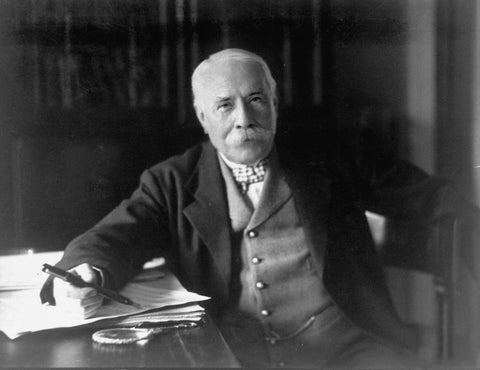
Elgar
Although Elgar is often regarded as a typically English composer, most of his musical influences were not from England but from continental Europe. He felt himself to be an outsider, not only musically, but socially. In musical circles dominated by academics, he was a self-taught composer; in Protestant Britain, his Roman Catholicism was regarded with suspicion in some quarters; and in the class-conscious society of Victorian and Edwardian Britain, he was acutely sensitive about his humble origins even after he achieved recognition. He nevertheless married the daughter of a senior British army officer. She inspired him both musically and socially, but he struggled to achieve success until his forties, when after a series of moderately successful works his Enigma Variations (1899) became immediately popular in Britain and overseas. He followed the Variations with a choral work, The Dream of Gerontius (1900), based on a Roman Catholic text that caused some disquiet in the Anglican establishment in Britain, but it became, and has remained, a core repertory work in Britain and elsewhere. His later full-length religious choral works were well received but have not entered the regular repertory.
In his fifties, Elgar composed a symphony and a violin concerto that were immensely successful. His second symphony and his cello concerto did not gain immediate public popularity and took many years to achieve a regular place in the concert repertory of British orchestras. Elgar's music came, in his later years, to be seen as appealing chiefly to British audiences. His stock remained low for a generation after his death. It began to revive significantly in the 1960s, helped by new recordings of his works. Some of his works have, in recent years, been taken up again internationally, but the music continues to be played more in Britain than elsewhere.
Elgar has been described as the first composer to take the gramophone seriously. Between 1914 and 1925, he conducted a series of acoustic recordings of his works. The introduction of the moving-coil microphone in 1923 made far more accurate sound reproduction possible, and Elgar made new recordings of most of his major orchestral works and excerpts from The Dream of Gerontius.
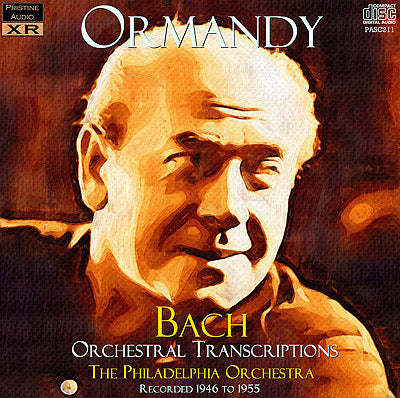
Elgar
BACH Orchestral Transcriptions
Recorded 1946-1955
Total duration: 79:52
The Philadelphia Orchestra
conducted by Eugene Ormandy
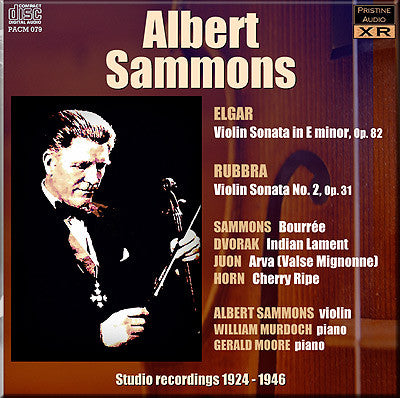
RUBBRA Violin Sonata No. 2 in A major, Op. 100
Short works by Sammons, Dvorák, Juon, Horn
Total duration: 55:38
William Murdoch, piano
Gerald Moore, piano
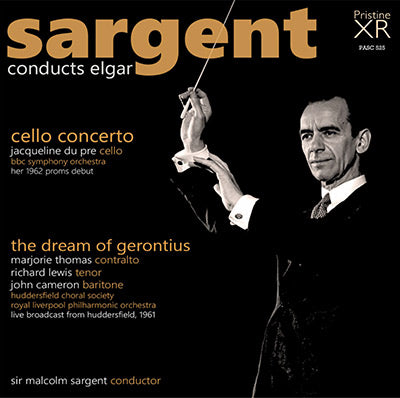
ELGAR Cello Concerto
ELGAR The Dream of Gerontius
Live concert broadcasts, 1961 & 1962
Total Duration: 1hr 58:32
Jacqueline du Pré, cello
BBC Symphony Orchestra
Richard Lewis, tenor
Marjorie Thomas, mezzo
John Cameron, baritone
Hudderfield Choral Society
Royal Liverpool Philharmonic Orchestra
Sir Malcolm Sargent, conductor
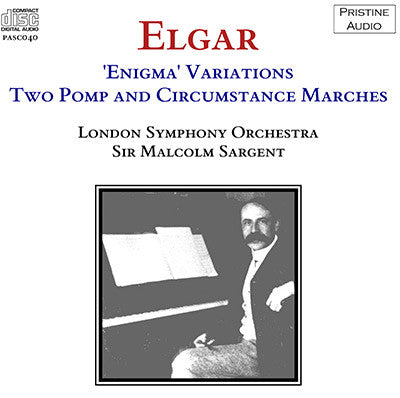
ELGAR "Enigma" Variations
ELGAR Pomp and Circumstance Marches 1 & 4
Recorded in 1953
Duration: 43:10
London Symphony Orchestra
Conductor: Sir Malcolm Sargent
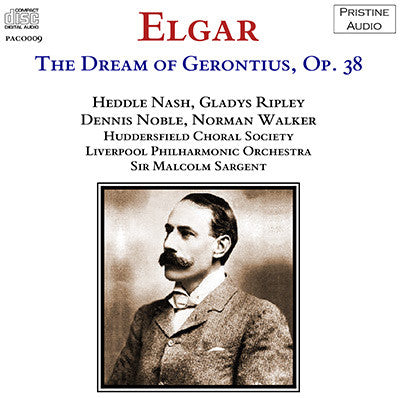
Recorded in 1945
Duration:1hr 30:04
Dennis Noble, Norman Walker
Huddersfield Choral Society
Liverpool Philharmonic Orchestra
Sir Malcolm Sargent, conductor
BACH Violin Sonatas 1 & 2
BACH Concerto for Two Violins
HANDEL Violin Sonata No. 4
TARTINI Violin Sonata in G
TARTINI Violin Concerto in D minor
MOZART Violin Sonata No. 21
MOZART Violin Concerto No. 4
short works by BACH, EXAUDET, TARTINI, VERACINI
BEETHOVEN Violin Concerto
WEBER Violin Sonata No. 3
PAGANINI Caprices
SCHUBERT Rondo
MENDELSSOHN Violin Concerto
BRAHMS Violin Concerto
BRAHMS Violin Sonata No. 3
Music by Berlioz, Hubay, Elgar, Kreisler, Dvořák, Chabrier, Rimsky-Korsakov, Falla
WARLOCK Capriol Suite
PROKOFIEV Violin Concerto
BARTÓK Hungarian Folk Tunes
BARTÓK Romanian Folk Dances
IVES Violin Sonata No. 4
BLOCH Violin Concerto
music by Debussy, Ravel, Milhaud, Lie, Szymanowski, Scriabin, Stravinsky
MENDELSSOHN Violin Concerto
BRAHMS Violin Concerto
BRAHMS Violin Sonata No. 3
Music by Berlioz, Hubay, Elgar, Kreisler, Dvořák, Chabrier, Rimsky-Korsakov, Falla
Studio recordings, 1926-1946
Total duration: 2hr 27:05
Joseph Szigeti, violin
Egon Petri, piano
Kurt Ruhrseitz, piano
Nikita Magaloff, piano
Constant Lambert ∙ Philharmonia Orchestra
Sir Thomas Beecham ∙ London Philharmonic Orchestra
Sir Hamilton Harty ∙ Hallé Orchestra