This album is included in the following sets:
This set contains the following albums:
- Producer's Note
- Full Track Listing
- Cover Art
Maria Callas’s great recital discs were never merely collections of attractive arias. They were demonstrations of range, character and dramatic imagination, assembled at a moment when her voice could move from lyric tenderness to florid brilliance and tragic declamation with extraordinary speed. This second volume brings together three such strands: a single Puccini aria from the September 1954 sessions, the complete programme of her celebrated Lyric and Coloratura recital, and three La Scala scenes recorded the following year. Originally issued across separate Columbia recital LPs, they now form a coherent portrait of Callas moving between intimacy, virtuosity and full operatic tragedy.
“Senza mamma” finds Callas at her most inward. The line is restrained, the grief concentrated, and the emotion allowed to emerge through the shape of the phrase rather than through external display. That same ability to create a person within a few minutes governs the Cilea, Giordano and Catalani arias that follow. In Adriana’s entrance aria, Callas catches both the actress’s professional poise and the vulnerability beneath it; in “Poveri fiori” the lament is darker and more private. “La mamma morta” and “Ebben? ne andrò lontana” reveal the breadth of her lyric manner, where the voice may not always possess conventional smoothness, but the words are never neutral and the musical line is never merely decorative.
A 1955 review in The Gramophone of the original recital recognised precisely this tension. Its critic heard occasional heaviness, strain and awkwardness, yet also “great tenderness and simplicity, deep emotion” and an exceptional command of vocal characterisation. The review admired the distraught Margherita of Mefistofele, the chromatic control of Lakmé’s “Dov’è l’indiana bruna?”, and the sheer versatility of a programme that moves from verismo intensity to Rossinian and Meyerbeerian display.
That versatility remains the album’s central fascination. “Una voce poco fa” is less a polite showpiece than a portrait of intelligence sharpening into resolve; “Ombra leggera” tests agility and lightness; the Verdi bolero demands ease, brilliance and rhythmic buoyancy. Callas does not approach these arias as a sequence of technical hurdles. Each becomes a miniature drama.
Tullio Serafin is crucial to the effect. With the Philharmonia Orchestra in Watford and the Orchestra del Teatro alla Scala in Milan, he gives Callas room to colour a phrase without allowing the pulse to slacken. The accompaniments are alert, flexible and notably free of theatrical exaggeration. Serafin knew her voice intimately and understood that its most compelling effects often came not from forcing the drama forward, but from creating the space in which a word, a pause or a sudden change of colour could register fully.
The final three tracks deepen that dramatic concentration. “Dei tuoi figli” from Medea is not simply an aria but an eruption of maternal anguish and moral terror, shaped with the authority that made the role one of Callas’s most formidable stage creations. The two extended scenes from La sonnambula show another side of her art. In “Come per me sereno” the innocence is never insipid, while “Ah! non credea mirarti” is spun with a fragile inwardness that makes the cabaletta’s release all the more exhilarating.
When The Gramophone reviewed the La Scala LP in June 1958, it described Medea as “a great Callas showpiece” and judged this excerpt “certainly exciting”, finding Callas “at the top of her form”. That verdict catches the authority of the performance: even in a short extract, the role seems fully present, with the vocal line carrying both supplication and threat.
That balance of reservation and admiration now reads less like equivocation than accuracy. Callas’s greatness did not depend upon an immaculate surface. It lay in her ability to make every phrase carry intention, to turn ornament into psychology and vocal colour into theatre. These recordings preserve that art at full stretch. They reveal a singer capable of tenderness, fury, brilliance, melancholy and madness, often within the space of a single side. The voice may occasionally show effort; the imagination never does.
MARIA CALLAS Arias, Volume 2
Lyric and Coloratura Arias
PUCCINI Suor Angelica
01. Senza mamma (5:36)
CILEA Adriana Lecouvreur
02. Ecco: respiro appena... Io son l’umile ancella (3:49)
03. Poveri fiori (3:13)
GIORDANO Andrea Chénier
04. La mamma morta (4:53)
CATALANI La Wally
05. Ebben? Ne andrò lontana (4:52)
BOITO Mefistofele
06. L’altra notte in fondo al mare (7:29)
ROSSINI Il barbiere di Siviglia
07. Una voce poco fa (6:53)
MEYERBEER Dinorah
08. Ombra leggera (5:42)
DELIBES Lakmé
09. Dov’è l’indiana bruna? (8:06)
VERDI I vespri siciliani
10. Mercè, dilette amiche (4:01)
CHERUBINI Medea
11. Dei tuoi figli (4:55)
BELLINI La sonnambula
12. Compagne, teneri amici... Come per me sereno (5:49)
13. Oh! se una volta sola... Ah! non credea mirarti... Ah! non giunge (13:57)
Maria Callas, soprano
Philharmonia Orchestra (tracks 1-10)
Orchestra del Teatro alla Scala, Milan (tracks 11-13)
conducted by Tullio Serafin
Tracks 1-10 recorded 15-21 September 1954
Watford Town Hall
Tracks 11-13 recorded 9-12 June 1955
Teatro alla Scala, Milan
XR remastering by Andrew Rose
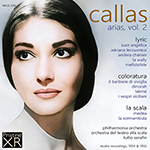
Cover artwork based on a photograph of Maria Callas
Total duration: 79:15