

This album is included in the following sets:
This set contains the following albums:
- Producer's Note
- Full Track Listing
- Cover Art
Bartók’s Sonata for Solo Violin occupies a unique place in Menuhin’s career. The work was composed in 1944 at Menuhin’s request, and he gave its first performance in New York on 26 November of that year. Bartók died less than a year later, leaving the sonata as one of his final completed works. Menuhin returned to it in June 1947 at Abbey Road, setting down what appears to be the first recording of the work. As such, this performance stands not merely as an early document, but as a direct continuation of the composer-performer relationship from which the sonata itself had emerged.
The sonata’s four movements - Tempo di ciaccona, Fuga, Melodia and Presto - trace a path from severe, almost architectural contrapuntal writing to a finale of extraordinary rhythmic vitality. In Menuhin’s performance, the music retains its structural clarity while revealing a strong sense of expressive purpose. Writing in 1948, The Gramophone described the performance as displaying “incredible virtuosity and superb musicianship”, adding that it must rank “as one of the outstanding achievements of our time.” Such contemporary testimony is borne out by the recording itself, which captures the work at a point when it was still new, its idiom not yet absorbed into the mainstream of violin playing.
The Violin Sonata No. 1 in F minor by Prokofiev, recorded the following year in the same Abbey Road studio, presents a very different but equally compelling sound world. Begun in 1938 and completed in 1946, the sonata received its first performance in Moscow in October of that year. Menuhin’s 1948 recording with the pianist Marcel Gazelle is among the earliest accounts of the work and appears very likely to have been its first commercial recording in the West, following shortly after the initial Soviet recording by David Oistrakh and Lev Oborin.
Where Bartók’s sonata explores the possibilities of the violin alone, Prokofiev’s work unfolds as a tense and often sombre dialogue between violin and piano. The opening Andante assai, with its spectral, descending scales, sets the tone for a work in which lyricism is frequently shadowed by unease. The central movements contrast a sharply etched Allegro brusco with a more inward Andante, before the finale returns to the atmosphere of the opening in music of remarkable intensity. Reviewing the recording in 1949, The Gramophone described it as “an authoritative performance of a remarkable work”, noting in particular the expressive depth of the slow movement.
Taken together, these recordings document Menuhin at a pivotal moment in his artistic development. In Bartók’s sonata he appears as the work’s dedicatee and first interpreter, preserving on disc a piece closely bound to his own musical identity. In Prokofiev’s sonata he assumes a different role, that of an early advocate bringing a recent and little-known work to a wider audience beyond its country of origin. Both performances were made at a time when this repertoire was still in the process of establishing itself, and both retain the sense of immediacy that comes from such proximity.
Heard today, they offer not only historical insight but performances of enduring conviction, shaped by a musician deeply engaged with the challenges and possibilities of the modern violin repertoire. In this new Pristine Ambient Stereo XR remaster, these historic recordings are heard with a new clarity, depth and presence that bring their immediacy vividly to life.
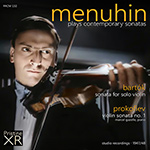
MENUHIN plays contemporary sonatas
BARTÓK Sonata for Solo Violin, Sz. 117, BB 124
1. 1st mvt. - Tempo di ciaccona (9:39)
2. 2nd mvt. - Fuga (4:30)
3. 3rd mvt. - Melodia (6:57)
4. 4th mvt. - Presto (5:11)
Recorded 2-3 June 1947 in EMI Studio No. 3, Abbey Road, London · First issued on HMV DB9231/33 (special order)
Yehudi Menuhin, violin
PROKOFIEV Violin Sonata No. 1 in F minor, Op. 80
5. 1st mvt. - Andante assai (6:16)
6. 2nd mvt. - Allegro brusco (6:56)
7. 3rd mvt. - Andante (6:59)
8. 4th mvt. - Allegrissimo - Andante assai, come prima (6:36)
Recorded 30 September - 1 October 1948 in EMI Studio No. 3, Abbey Road, London · First issued on HMV DB6845/47
Yehudi Menuhin, violin
Marcel Gazelle, piano
XR Remastered by Andrew Rose
Total duration: 53:04
Reviews
Fanfare — Dominic Hartley
Issue 50:1 (Sept/Oct 2026) · Read the original review
I adore this album. Two of the most uncompromising violin works of the 20th century draw something exceptional from one of the most spiritually centered violinists on record: this is Yehudi Menuhin in the late 1940s giving performances of complete and unguarded commitment of new and vital music. The Bartók was committed to disc in June 1947 at Abbey Road, the Prokofiev in the same studio 15 months later. Both are early documents of works whose idiom had not yet bedded down in mainstream playing. They catch Menuhin in the last moments of his unclouded early maturity before the bow-arm troubles that would dog the 1950s began materially to register, though if you listen carefully there are already some intonational lapses in the Bartók. They never get in the way, though.
Bartók wrote the solo sonata for Menuhin in late 1943 and early 1944. Menuhin commissioned it after Bartók heard him play the Second Concerto and First Sonata at separate New York concerts in the fall of 1943. On meeting him, the composer said that he had imagined his music could only be played that well long after his death. The premiere took place at Carnegie Hall on November 26, 1944. The 1947 Abbey Road sessions produced the work’s first commercial recording, less than two years after the composer’s death. It’s a compelling performance nearly 80 years on. The Tempo di ciaccona has a gravity that Menuhin sustains across nine and a half minutes without ever loosening his grip on the line. The Fuga is voiced with extraordinary clarity. The Melodia sings with a typically Bartókian intimacy. And the Presto has an exhilaration to it, the “buzzing insect” passages played in the diatonic version Menuhin himself proposed after he saw the quartertones Bartók originally specified, but with the alternation between muted scurrying and open-string vigor sharply differentiated.
The Prokofiev, recorded in the fall of 1948, was the first commercial Western recording of the F-Minor Sonata, following the Soviet premiere recording by Oistrakh and Oborin in 1946. The sonata had taken Prokofiev eight years to complete (1938–46), and Myaskovsky famously told him on hearing the premiere that he had written a work of genius. Oistrakh handed Menuhin the score in Prague in May 1947, 18 months before the Abbey Road sessions. So, a transmission almost as direct as with the Bartók, and one that helps account for the intensity of advocacy on the disc.
The Andante assai opens with a ghostliness few violinists find—an etiolated tone perfectly suited to the music’s pallid, half-lit gravity. When the “wind in a graveyard” scales arrive (Prokofiev’s own image for them) Menuhin’s bow weight is so attenuated that the line seems barely connected to the instrument. The Allegro brusco is bruising, the sardonic second subject delivered with exactly the wry detachment the composer required. The Andante finds Menuhin at his most lyrical. And in the finale he sounds genuinely abandoned to the music, his technique surmounting Prokofiev’s formidable writing, the return of the graveyard scales now lighter still. It’s thrilling playing. Throughout, Marcel Gazelle is the most responsive of collaborators.
Andrew Rose’s Ambient Stereo XR remaster depth and air to the mono originals without any sense of artificiality. Welcome, discreet touches.
Was there ever a more charismatic violinist-communicator than Menuhin at his peak? With these new works there is also a fervency to the playing born of his complete belief in them and his concern that we should believe too. We absolutely do. Dominic Hartley
Fanfare — Henry Fogel
Issue 50:2 (Nov/Dec 2026) · Read the original review
Listeners who are not familiar with Yehudi Menuhin in his younger days are likely to underestimate his technical ability. As was well documented, Menuhin’s playing deteriorated after his celebrated period as a child prodigy. By the mid-1950s (he was born in 1916) his intonation was wayward and his bowing inconsistent. But hearing these two recordings made in 1947 (Bartók) and 1948 (Prokofiev) reminds us of what a remarkable musician he was.
Menuhin commissioned the Bartók Sonata for Solo Violin near the end of the composer’s life and the two stayed in communication during its composition. This recording was the work’s first. Menuhin digs into the score with a ferocious intensity, refusing to prettify it. He revels in difficult double stops, clarifies the different lines in the second movement fugue, and brings both a full rich tone and passionate incisiveness to the final Presto. Because of Menuhin’s relationship with the Bartók sonata, this recording has always been considered a classic. It benefits from Andrew Rose’s XR Ambient Stereo remastering process, sounding better than any of the previous EMI versions I am familiar with.
Less famous but just as impressive is his recording of Prokofiev’s First Violin Sonata. This was its second recording, the first being by David Oistrakh and Lev Oborin. Oistrakh’s playing has its appeal because it is more traditionally beautiful, but Menuhin might better capture the angst at the core of this work—it was composed between 1938 and 1946, a difficult time for Russia and for Prokofiev personally. Menuhin and pianist Marcel Gazelle deliver a reading that is almost terrifying in its intensity. In the second movement Allegro Brusco Menuhin takes his cue from “brusco” (brusque), emphasizing the music’s anger.
This release will surprise anyone who sees Menuhin as a gentler, more serene artist. These are two thrillingly intense performances, made when his technique was still intact and he was still considered one of the world’s great violinists. Rose’s superb restorations give them a well-earned new life.
Pristine recordings are available from their website, pristineclassical.com, as downloads in various formats or on CD. Henry Fogel
