

This album is included in the following sets:
This set contains the following albums:
- Producer's Note
- Full Track Listing
- Cover Art
" There is no doubt whatever in my mind that Gould is superior in every way"
- The Gramophone, 1958
REVIEW - UK LP ISSUE
With two piano versions and two harpsichord versions, competition is now
equal, at least numerically. As A.R. left the matter, in his review of
the Leonhardt performance, the better of the two harpsichord versions
was Landowska’s. Of the two pianists, there is no doubt whatever in my
mind that Gould is superior in every way. Some of his tempi may be fast,
but his is a speed connected with urgency more than with show or
brilliance. He carries a phrase through a gigantic upward or downward
sweep, effortless, controlled, and clear as crystal. Those listeners
who, unlike Count Kayserling, fall asleep rather than keep awake through
this forty-five minute ritual, will have no difficulty in keeping their
eyes and ears open when they play this new Philips recording.
Gould
has some of the clearest keyboard counterpoint I have heard for a long
time and (unlike Demus) is sparing in his use of the pedal. Compare, for
instance, the two versions of Variation 11, or of 14. In both cases
Gould is faster, but the odd thing is that he is also clearer. Demus
produces a thick, rather muddy sound, makes too much of descending bass
figures, and plods rather than plays. Sometimes I found it hard to
believe that two corresponding variations were really the same music!
The
Philips disc is helped by really splendid recording, with the piano
tone full and sonorous, yet capable of the fine expressiveness required
for Variations 21 and 25. This is a performance that I shall treasure,
for it has the kind of architecture in tone which is often longed for
but rarely found.
D.S., The Gramophone, January 1958
Review of Philips SBL.5211
Glenn Gould's legendary 1955 recording of the Goldberg Variations needs no introduction. From the very first it was recognised as a classic - not just in the review reproduced here, but two years earlier in Harold Schonberg's "Letter from America", in which he wrote a single line: "An interesting Columbia debut is that of Glenn Gould, a young Canadian pianist who played Bach's Goldberg Variations with some original ideas that never sound eccentric."
On more than one occasion I've been asked whether it might be possible to excise Gould's extraneous noises, to which the answer is, in some cases, yes, in others, not yet... In this new XR remastering this was not the aim, though some have gone. Rather, my intention was to improve the sound of the piano. My hope was to find significant tonal improvements - an A-B comparison with the best existing transfers suggests this has been achieved, with the piano now appearing as a full, three-dimensional instrument where before it was rather flat and dull.
I resisted the temptation to pad out this release with extra material. This is the Gould Goldberg, and it's never sounded better.
Andrew Rose
GOULD Bach: Goldberg Variations (1955)
BACH Goldberg Variations
1. Aria (1:54)
2. Variatio 1. a 1 Clav (0:45)
3. Variatio 2. a 1 Clav (0:38)
4. Variatio 3. Canone all’Unisono. a 1 Clav (0:55)
5. Variatio 4. a 1 Clav (0:29)
6. Variatio 5. a 1 ô vero 2 Clav (0:37)
7. Variatio 6. Canone alla Seconda. a 1 Clav (0:34)
8. Variatio 7. a 1 ô vero 2 Clav. al tempo di Giga (1:08)
9. Variatio 8. a 2 Clav (0:46)
10. Variatio 9. Canone alla Terza. a 1 Clav (1:21)
11. Variatio 10. Fughetta. a 1 Clav (0:55)
12. Variatio 11. a 2 Clav (0:56)
13. Variatio 12 a 1 Clav. Canone alla Quarta in moto contrario (1:02)
14. Variatio 13. a 2 Clav (1:09)
15. Variatio 14. a 2 Clav (0:59)
16. Variatio 15. Canone alla Quinta. a 1 Clav. Andante (2:17)
17. Variatio 16. Ouverture. a 1 Clav (1:18)
18. Variatio 17. a 2 Clav (0:54)
19. Variatio 18. Canone alla Sesta. a 1 Clav (0:46)
20. Variatio 19. a 1 Clav (0:43)
21. Variatio 20. a 2 Clav (0:48)
22. Variatio 21. Canone alla Settima (1:43)
23. Variatio 22. a 1 Clav. alla breve (0:42)
24. Variatio 23. a 2 Clav (0:55)
25. Variatio 24. Canone all'Ottava. a 1 Clav (0:57)
26. Variatio 25. a 2 Clav. adagio (6:29)
27. Variatio 26. a 2 Clav (0:53)
28. Variatio 27. Canone alla Nona. a 2 Clav (0:50)
29. Variatio 28. a 2 Clav (1:11)
30. Variatio 29. a 1 ô vero 2 Clav (1:00)
31. Variatio 30. a 1 Clav. Quodlibet (0:48)
32. Aria da Capo (2:11)
Recorded 10, 14 & 16 June, 1955, Columbia 30th Street Studios, New York
First issued on Columbia ML 5060
Producer and XR remastering engineer: Andrew Rose
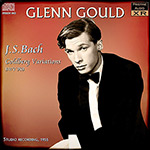
Cover artwork based on a photograph of Glenn Gould
Total duration: 38:33
Glenn Gould, piano
MusicWeb International Review
It was in any case always good but here certainly sounds fuller in Ambient Stereo...
It would be otiose to attempt a detailed critical commentary on this
iconic, landmark recording by the 22-year-old Glenn Gould. Most admirers
will already own this, the alpha version, and also the omega of 1982,
made just before his death at fifty. They are both essential listening
to those who can tolerate Gould’s vocalise and interpretative
eccentricities; those who cannot will already know to leave this alone.
Most previous issues from Sony and Naxos have either supplemented the
Goldbergs with some complementary pieces such as fugues or a Partita, or
have paired the two recordings. Pristine choose here to leave the
Variations unadorned at a mere 38 and a half minutes, Gould having
chosen the first time around to ignore repeats. That might seem unduly
parsimonious or reverential to some collectors. However, sound engineer
Andrew Rose has marginally reduced some of the extraneous noises and
enhanced the depth of the original, mono piano sound. It was in any case
always good but here certainly sounds fuller in Ambient Stereo.
Unfortunately, as a corollary to that process, the thuds and thumps of
the original have become more pronounced. I am not sure that I do not
prefer the slightly drier ambience of my 1992 20-bit re-mastering from
Sony; indeed I have become so used to it that I fancy Gould’s conception
is better served by the slightly more distanced, mono sound.
In short, if you already own this in a previous Sony incarnation, I
wouldn’t rush to replace it with this from Pristine. Convert though I am
to the Ambient Stereo re-mastering process, I do not think that on this
occasion I would recommend this Pristine issue over the one from Sony.
Ralph Moore
MusicWeb International, December 2013
