
This album is included in the following sets:
This set contains the following albums:
- Producer's Note
- Full Track Listing
- Cover Art
"It's good to have these classic and interpretatively superb
recordings of one of Bach's most compelling organ works available.
The transfer quality is almost as satisfying as the performance. "
- Mark Sealey - MusicWeb International CD of the Month, Sept. 2010
Helmut Walcha's Bach recordings are rightly hailed as some of the greatest of the twentieth century. He recorded more or less the complete organ music twice for DG – the first time around (1947-52) in mono, and then again a few short years later (1956-71), remaking the series in stereo. As a result the mono recordings soon slipped into a kind of semi-obscurity, with later reissues concentrating on the stereo equivalents.
There is some kind of sense in this for the listener – by comparison to the potentially room-filling and awe-inspiring sound of a church organ and its attendant acoustics which envelop you when listening to stereo recordings, it seems to me that more than usual is somehow lost in a mono organ recording; the instrument seems considerably diminished, the impact distant, one-dimensional and uninspiring.
This was the sound I heard coming from my speakers when I started transferring the first of five LP sides which together made up the source material for this release (the sixth side featured older recordings of a different organ), and I was deeply ambivalent with regard to the possibilities offered by the recordings. It was more through a sense curiosity than any real hope that I began experimenting with the restoration and remastering of such unlikely work – and a feeling that Pristine really had managed to neglect the organ repoertoire over the last five or so years.
The first sign that all was considerably better than I at first thought came with XR re-equalisation – by now the minor irritants of vinyl surface noise had already been dealt with and I saw immediately from the frequency response curve that much musical information had probably been somewhat buried by poor recording equipment. In particular the magnificent lower registers of the organ were often muted to the extent that they were barely audible; restoring these to their more normal levels had literally ground-shaking consequences! Further up the frequency range and there again was more to be heard than the records ever suggested – with XR re-equalisation what was beginning to emerge suggested something of the full grandeur of the instrument itself.
I still had a problem, however. One of the great aspects of listening to a church or cathedral organ is the effect the building's acoustics have on the sound experience, as one is enveloped in sound which appears to arrive from all directions and none at the same time. This seemed more than Pristine's Ambient Stereo processing normally delivers, so I turned instead to the option of using advanced convolution reverberation. This takes the acoustic 'sound' of a real location and maps it digitally, allowing the reverberation from that space to be used in an exceptionally realistic manner for other recordings.
Although I did not have an acoustic mapping of the church used for this recording, what I did have in my collection was a remarkably similar church. The village church of Cappel, in which stands the beautiful Schnitger Organ heard here, is rather small and unassuming – its shorter reverberant decay time blurs the music less and allows one to hear much more fine finger-work than might be apparent in a larger church or cathedral. By mixing in a small amount of convolution reverb derived from a very similarly sized and constructed church I was able to take this recording a final step closer to reality and realise the full sense of presence and place captured in the grooves of those 60 year-old LPs.
In fact, so convinced am I that this recording really needs this additional 'help' that I've taken the unprecedented step of offering it only as an Ambient Stereo recording – in all formats. Without it the recordings seemed (to me) somewhat ineffectual and dusty relics, superseded by their later re-recordings. With it they're truly alive and astonishingly vivid and contemporary – given full rein and a good bass response from your loudspeakers the grander works are truly awe-inspiring to hear, while the more contemplative pieces completely hold the attention. In short, I'm delighted and just a little overwhelmed by what has been possible here – as I hope you will be too.
Andrew Rose
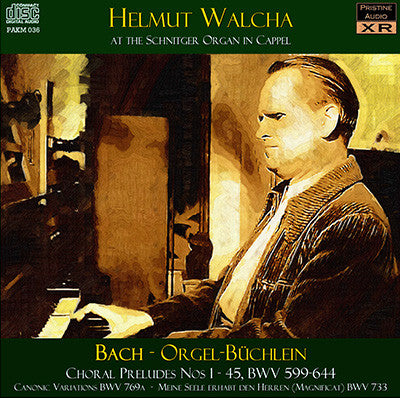
WALCHA Bach: Orgel-Büchlein (1950/52)
J. S. BACH Orgel-Büchlein - Choral Preludes 1-45, BWV 599-644
1. Nun komm, der Heiden Heiland (BWV 599) (1:48)
2. Gott, durch deine Güte — Gottes-Sohn ist kommen (BWV 600) (1:07)
3. Herr Christ, der ein'ge Gottes-Sohn — Herr Gott, nun sei gepreiset (BWV 601) (2:07)
4. Lob sei dem allmächtigen Gott (BWV 602) (0:57)
5. Puer natus in Bethlehem (BWV 603) (1:06)
6. Gelobet seist du, Jesu Christ (BWV 604) (1:34)
7. Der Tag, der ist so freudenreich (BWV 605) (1:54)
8. Vom Himmel hoch, da komm' ich her (BWV 606) (0:44)
9. Vom Himmel kam der Engel Schar (BWV 607) (1:11)
10. In dulci jubilo (BWV 608) (1:43)
11. Lobt Gott, ihr Christen, allzugleich (BWV 609) (0:53)
12. Jesu, meine Freude (BWV 610) (2:55)
13. Christum wir sollen loben schon (BWV 611) (2:15)
14. Wir Christenleut' (BWV 612) (1:31)
15. Helft mir Gotts Güte preisen (BWV 613) (1:13)
16. Das alte jahr vergangen ist (BWV 614) (2:21)
17. In dir ist Freude (BWV 615) (2:53)
18. Mit Fried' und Freud' ich fahr' dahin (BWV 616) (2:25)
19. Herr Gott, nun schleuß den Himmel auf (BWV 617) (2:34)
20. 0 Lamm Gottes, unschuldig (BWV 618) (3:51)
21. Christe, du Lamm Gottes (BWV 619) (1:37)
22. Christus, der uns selig macht (BWV 620) (2:33)
23. Da Jesus an dem Kreuze stund (BWV 621) (1:29)
24. 0 Mensch, bewein dein Sünde groß (BWV 622) (4:33)
25. Wir danken dir, Herr jesu Christ, daß du für uns gestorben bist (BWV 623) (1:26)
26. Hilf, Gott, daß mir's gelinge (BWV 624) (1:38)
27. Christ lag in Todesbanden (BWV 625) (1:26)
28. Jesus Christus, unser Heiland, der den Tod überwand (BWV 626) (1:04)
29. Christ ist erstanden (BWV 627-Vers 1) (1:30)
30. Christ ist erstanden (BWV 627-Vers 2) (1:28)
31. Christ ist erstanden (BWV 627-Vers 3) (1:55)
32. Erstanden ist der heil'ge Christ (BWV 628) (0:50)
33. Erschienen ist der herrliche Tag (BWV 629) (1:25)
34. Heut' triumphieret Gottes Sohn (BWV 630) (1:42)
35. Komm, Gott Schöpfer, Heiliger Geist (BWV 631) (0:59)
36. Herr Jesu Christ, dich zu uns wend' (BWV 632) (1:18)
37. Liebster Jesu, wir sind hier (BWV 633) (2:01)
38. Dies sind die heil'gen zehn Gebot (BWV 635) (1:33)
39. Vater unser im Himmelreich (BWV 636) (1:42)
40. Durch Adams Fall ist ganz verderbt (BWV 637) (2:35)
41. Es ist das Heil uns kommen her (BWV 638) (1:15)
42. Ich ruf zu dir, Herr jesu Christ (BWV 639) (2:21)
43. In dich hab' ich gehoffet, Herr (BWV 640) (1:17)
44. Wenn wir in höchsten Nöten sein (BWV 641) (1:57)
45. Wer nur den lieben Gott läßt walten (BWV 642) (2:32)
46. Alle Menschen müssen sterben (BWV 643) (1:47)
47. Ach wie nichtig, ach wie flüchtig (BWV 644) (1:03)
Issued as Archiv LPs APM 14021 & 14022
Recorded June 1950 and September 1952.
Produced by Dr. Erich Thienhaus
J. S. BACH Canonic Variations on 'Von Himmel hoch, da komm ich her', BWV 769a
48. Canonic Variations on 'Von Himmel hoch, da komm ich her' (BWV 769a) 1 — Canone all' ottava (1:27)
49. Canonic Variations on 'Von Himmel hoch, da komm ich her' (BWV 769a) 2 — Alio Modo in Canone alla Quinta (1:22)
50. Canonic Variations on 'Von Himmel hoch, da komm ich her' (BWV 769a) 3 — L'altra Sorte del'Canone all'rovercio (2:23)
51. Canonic Variations on 'Von Himmel hoch, da komm ich her' (BWV 769a) 4 — Canone alla settima, cantabile (2:54)
52. Canonic Variations on 'Von Himmel hoch, da komm ich her' (BWV 769a) 5 — Canon per augmentationem (2:59)
J. S. BACH Meine Seele erhabt den Herren (Magnificat), BWV 733
53. Meine Seele erhabt den Herren (Magnificat) (BWV 733) (4:20)
Tracks 48–53:
Recorded 9th, 20th & 21st June 1950.
Produced by Dr. Erich Thienhaus
Issued as Archiv LPs APM 14030
Helmut Walcha, Schnitger Organ, Capel, Germany
Transfers from Archiv LPs APM 14021, 14022 and 14030
XR remastering by Andrew Rose at Pristine Audio, May 2010
Cover artwork based on a photograph of Helmut Walcha
MusicWeb International Review
Walcha's understanding of Bach's purpose is evident in every note and bar
Helmut Walcha's (1907-1991) recordings of the Bach organ repertoire
are amongst the most celebrated of the twentieth century for
their magnificence, eloquence and perception. Walcha recorded
more or less the entire repertoire twice, for DG … in
mono from 1947 to 1952 and again in stereo between 1956 and
1971. It is the former, the mono series on the splendid Schnitger
Organ in the church of Saints Peter and Paul in Cappel (the
CD and Pristine Audio's website are inconsistent with the town's
spelling) in Lower Saxony, which has been expertly transferred
to two CDs by Andrew Rose of Pristine Audio.
In fact, the lively, resonant and full sound is likely to be
the first thing you notice. It's quite remarkable. True, there
are moments of slight wow and flutter. But they really are very,
very slight. There are no other 'artefacts', distortion or interference
with our enjoyment of the music.
The Orgel-Büchlein, or Little Organ Book, was a product
of Bach's years at the court in Weimar (1708-1714). Originally
there were to have been 164 chorale preludes suited to all times
of the liturgical year. Although there are traces of the 47th,
only 46 were ever completed. The Orgel-Büchlein should
be considered a collection in its own right of music for the
instrument (chorale preludes are small-scale works based on
chorale melodies), music for church services with implied religious
affirmation, an exploration of compositional techniques, and
even a teaching aid. CD 1 contains the first 28 chorale preludes
of the Orgel-Büchlein, that is BWV 599 to 626; CD 2 the
last 18, BWV627 to 644. The three versions of Christ ist
erstanden, BWV 627 are recorded.
Walcha's understanding of Bach's purpose is evident in every
note and bar. He plays with a dignity and detachment that eschew
romantic overlay or intonation. That's not to say that the performances
lack colour. They do not. His tempi and phrasing, for example,
are full of meaning. Such a number as Christ lag in Todesbanden,
BWV 625 [CD.1 tr.27], for example, is typical of the immense
emotion (in this case a weighty and inescapable pain) which
Walcha packs into less than a minute and a half … several
of the chorale preludes in the Orgel-Büchlein last under
a minute, many under two and few are longer than three.
It's thus necessary for a sensitive interpreter to understand
the overall direction, and the traditions of Baroque provincial
organ composition for that matter, in which Bach was working.
The chorale preludes in the Orgel-Büchlein will not sound
well if treated as an unrelated series of one-offs. Continuity,
which is not the same as uniformity, is important. It's Walcha's
immense experience of Bach and the organ as well as great insight
into the religious purpose behind the Orgel-Büchlein that
make these such valuable interpretations. And the fact that
this understanding leads to a degree of variety whereby the
particular import and impact of each prelude is fully communicated
such that each is a delight on its own - despite forming part
of a whole.
In a way this comes - paradoxically - from a refusal by Walcha
to 'editorialise', to impose his own conception on Bach's music.
When Bach was subdued (as in Das alte Jahr vergangen
ist, BWV 614 [CD.1 tr.16], for example), Walcha is subdued;
when exuberant (as in In Dir ist Freude, BWV 615,
the very next prelude), Walcha is exuberant. This is classic
and ultimately very satisfying playing.
No standalone CDs of Walcha's recordings of the Orgel-Büchlein
alone seem to be available. Even if they were, these two Pristine
Audio CDs retail for a price less than what they would cost.
Even then, it's the stately and perceptive interpretation that
truly recommends these recordings. When you consider the excellent
sound quality, they're hard to resist.
Mark Sealey
