
This album is included in the following sets:
This set contains the following albums:
- Producer's Note
- Full Track Listing
- Cover Art
"Heifetz's greatest achievement in the recording studio"
These recordings, remarkably for a violin player who had
such a long and illustrious career, represent the only complete set of
Bach's Sonatas and Partitas for Solo Violin recorded by Heifetz. Prior
to the 1952 recordings he made a handful of recordings in 1935 for HMV
which appear to have been unissued at the time in favour of Yehudi
Menuhin's discs - records suggest some of Heifetz's 1930s EMI Bach
recordings finally saw release in the mid-1970s.
I have also included his very first recording of any of
these works, a 1925 early electric which partnered a short piece by
Couperin on a single side of a one-off disc which appeared both in the
UK on HMV and in the USA on Victor.
The 1952 recording has suffered at the hands of a number
of remastering engineers, not least RCA Victor's own - a CD issue of
these recordings I've heard can only be described as vile. Hopefully
nobody will say the same of this new remastering, which aims to restore a
clarity and directness of tone to this wonderful set of performances
that has been all-too-often absent elsewhere.
Andrew Rose
HEIFETZ Bach: Sonatas & Partitas for Solo Violin (1952/1925)
BACH Sonatas and Partitas for solo violin, BWV1001-1006
Recorded 21st October 1952 (Sonata No. 1 & Partita No. 3), 22nd October 1952 (Sonata No. 3), 23rd October 1952 (Partita No. 1), 24th October 1952 (Sonata No. 2, Partita No. 2), RCA Victor Studios, Hollywood, California, USA.
First issued as RCA Victor 3 LP set LM 6105.
BACH Sonata No. 1 for solo violin
1. I. Adagio (4:45)
2. II. Fugue (Allegro) (4:49)
3. III. Siciliana (4:08)
4. IV. Presto (3:39)
BACH Partita No. 1 for solo violin
5. I. Allemande (4:57)
6. II. Double (2:24)
7. III. Courante (2:45)
8. IV. Double (4:03)
9. V. Sarabande (2:46)
10. VI. Double (1:46)
11. VII. Bourrée (2:55)
12. VIII. Double (3:08)
BACH Sonata No. 2 for solo violin
13. I. Grave (3:38)
14. II. Fugue (6:05)
15. III. Andante (5:41)
16. IV. Allegro (5:30)
BACH Partita No. 2 for solo violin
17. I. Allemande (3:13)
18. II. Courante (2:45)
19. III. Sarabande (3:09)
20. IV. Gigue (3:51)
21. V. Chaconne (13:16)
BACH Sonata No. 3 for solo violin
22. I. Adagio (3:52)
23. II. Fugue (8:46)
24. III. Largo (2:38)
25. IV. Allegro assai (4:48)
BACH Partita No. 3 for solo violin
26. I. Preludio (3:16)
27. II. Loure (4:13)
28. III. Gavotte en rondeau (2:44)
29. IV. Menuet I (1:28)
30. V. Menuet II (2:08)
31. VI. Bourrée (1:26)
32. VII. Gigue (2:02)
BACH Partita No. 3: Menuetts I and II (1925 recording)
33. Menuetts I and II (1925 recording) (2:29)
Recorded 29th December, 1925, Victor Studios, Camden, New Jersey, USA, issued in the USA as Victor 6564 and in the UK as HMV DB945, Matrix Number CVE 34072
XR remastering by Andrew Rose at Pristine Audio, February 2011
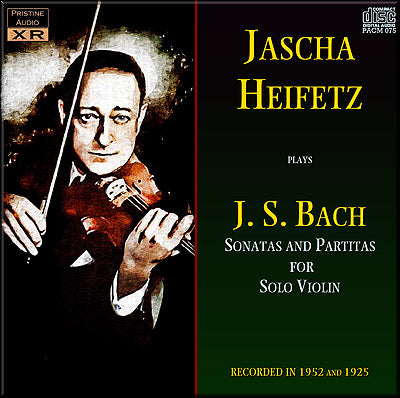
Cover artwork based on a photograph of Jascha Heifetz
Total duration: 2hr 9:01
Jascha Heifetz, violin
Gramophone Historic Review
Perhaps these discs are Heifetz's greatest achievement in the recording studio
To
my shame, I had not heard these performances before, yet although I
would hardly wish normally to listen consecutively to six unaccompanied
violin works, I have several times heard these three discs through in
rapt fascination. Heifetz is a violinist, not a scholar, and as such
probably is not considered highly these days as a Bach player. But so
much the worse for the people who do the rating, for these performances
are practically as good as the music itself.
Their prime
characteristic is an absolute and unflinching clarity which perfectly
conveys the music's power and directness—in the complex opening Adagio
of Sonata No. 3, for example. Add to this an unswerving integrity of
line, even in the fugues which, the Second Partita's Chaconne
notwithstanding, are the most astonishing movements of the astonishing
works.
Hear, too, the fullness and variety of tone
throughout—how many voices the violin is proved to have during the
Chaconne! —the sustained expressive force of movements such as the
Allemande of Partita No. 1 or the richly elaborated Grave of the Second
Sonata, and the wonderful resilience of quick pieces like the Gigue from
Partita No. 2, a true sublimated dance.
Perhaps these discs are Heifetz's greatest achievement in the recording studio.
The Gramophone, June 1973
