
This album is included in the following sets:
This set contains the following albums:
- Producer's Note
- Full Track Listing
- Cover Art
Regular readers of our weekly newsletter will know that Pristine recently took delivery of a large collection of classical vinyl discs, and over the last few weeks I've been sifting through them, pulling out interesting recordings and then checking for references to them on the Internet.
The Orff caught my eye thanks to the inclusion on the front cover, in bold capitals, of the line 'RECORDED UNDER THE SUPERVISION OF CARL ORFF'. Searching for references to this I ended up at a site which claims to be “the definitive web site” for this particular piece of music, and indeed, there's a reference to the Sawallisch recording right there.
More than that though, it reads (to me at least) as something of a challenge:
“There is a historical recording from the mid 1950's made in Orff's presence in which everybody puts in a lot of effort which is loudly applauded by Carl Orff himself on the last track but the quality of the recording means that we can't really evaluate it against later recordings.”
To be honest, having read that I thought I'd be in for something of a challenge, technically speaking, but no, this was a respectable recording for 1956; given that there is no applause present, at least on the British release (the site refers to a Capitol issue, which I assume is the US release though the site itself is based in Australia).
Anyway, having cleaned and transferred the LP I thought I might as well continue and see what a touch of XR remastering would do for it – generally the disc was in excellent condition, with only the odd click here and there needing my direct attention.
In fact the initial XR remastering was so successful that I decided to carry on with the recording and prepare it for full release. It is already available on CD elsewhere, and I have no idea whether the current issue is any improvement over the LP, but I'm more than pleased enough with how my own work has brought the very best out of this perhaps definitive (supervised by Carl Orff, remember!) performance, with frequency extension both at the bottom and top end of the range. Furthermore, where previously it was a little harsh and forward in the upper mid-range, there is now a much fuller and more convincing overall tonal balance.
Overall an excellent recording of this major work, with the Ambient Stereo version to be particularly recommended.
Andrew Rose
SAWALLISCH Orff: Carmina Burana (1956)
ORFF Carmina Burana
1. Fortuna Imperatrix Mundi — i O Fortuna (2:43)
2. Fortuna Imperatrix Mundi — ii Fortune plango vulnera (2:41)
3. I — Primo vere ( In Spring ) — iii Veris leta facies (3:25)
4. I — Primo vere ( In Spring ) — iv Omnia sol temperat (2:04)
5. I — Primo vere ( In Spring ) — v Ecce gratum (2:35)
6. Uf dem Anger ( In the Meadow , On the Lawn ) — vi Tanz ( Dance ûinstrumental) (1:47)
7. Uf dem Anger ( In the Meadow , On the Lawn ) — vii Floret Silva (3:13)
8. Uf dem Anger ( In the Meadow , On the Lawn ) — viii Chramer, gip die varwe mir (3:06)
9. Uf dem Anger ( In the Meadow , On the Lawn ) — ix. Reie — Swaz hie gat umbe — Chume, chum, geselle min (4:22)
10. Uf dem Anger ( In the Meadow , On the Lawn ) — x Were diu werlt alle min (0:52)
11. II — In Taberna ( In the Tavern ) — xi Estuans interius (2:25)
12. II — In Taberna ( In the Tavern ) — xii Olim lacus colueram (3:11)
13. II — In Taberna ( In the Tavern ) — xiii Ego sum abbas (1:34)
14. II — In Taberna ( In the Tavern ) — xiv In taberna quando sumus (3:08)
15. III — Cour d'amours ( Court of Love ) — xv Amor volat undique (3:13)
16. III — Cour d'amours ( Court of Love ) — xvi Dies, nox et omnia (2:17)
17. III — Cour d'amours ( Court of Love ) — xvii Stetit puella (1:49)
18. III — Cour d'amours ( Court of Love ) — xviii Circa mea pectora (2:03)
19. III — Cour d'amours ( Court of Love ) — xix Si puer cum puellula (0:56)
20. III — Cour d'amours ( Court of Love ) — xx Veni, veni, venias (0:57)
21. III — Cour d'amours ( Court of Love ) — xxi In trutina (1:48)
22. III — Cour d'amours ( Court of Love ) — xxii Tempus est iocundum (2:06)
23. III — Cour d'amours ( Court of Love ) — xxiii Dulcissime (0:36)
24. Blanziflor et Helena ( Blanchefleur and Helen ) — xxiv Ave formosissima (1:42)
25. Fortuna Imperatrix Mundi ( Fortune, Empress of the World ) — xxv O Fortuna (reprise) (2:38)
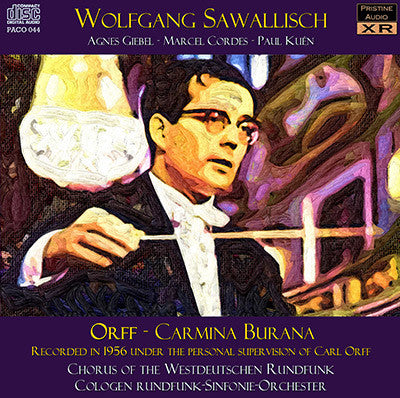
Recorded in 1956 under the personal supervision of Carl Orff
Transfer from UK Columbia LP 33CX1480 in the Pristine Audio collection
XR remastering by Andrew Rose at Pristine Audio, May 2010
Cover artwork based on a photograph of Wolfgang Sawallisch
Total duration: 57:11
Agnes Giebel, soprano
Marcel Cordes, baritone
Paul Kuén, tenor
Chorus of the Westdeustchen Rundfunk
Chorus-master: Bernhard Zimmerman
Cologne Rundfunk-Sinfonie-Orchester
conductor Wolfgang Sawallisch
MusicWeb International Review
You’ll want this because it has the blessing of the composer.
Who would have thought that Carmina Burana would have
become the public success that it has become? Is it the simplicity
of the language, the fact that it makes an easy impact, that
it’s modern music for the man in the street, or is it
simply the splendid gaudiness of it all? I think that it’s
a bit of all of them.
I don’t think that I’ve heard the complete work
for some twenty five years so I welcomed this chance to re-acquaint
myself with the piece. It’s still very entertaining, contrasting
big choruses - the famous O Fortuna, which opens and
closes the work - with the delightful dance number for female
voices Chramer, gip die varwe mir (Merchant, give me
the colour to redden my cheeks), the magnificently bibulous
scene In the Tavern with the beauty of The Court of
Love. It must be said that it’s a very clever concoction,
but clever is the word. No matter how I look at the piece I
find little of substance but lots of very attractive and engaging
pieces.
Carmina Burana has reached a very wide audience so whatever
I think of the qualities of the work are of no consequence.
This recording was made under the supervision of the composer
himself, so we must assume that this is how Orff wanted the
work to be heard. It is certainly a very fine performance, soloists,
chorus and orchestra are all attentive to the music, and Sawallisch’s
direction is tight and to the point. However, overall, the performance
lacks impetus, it’s far too earthy and it is too short
on unbridled excitement. But you’ll want this because
it has the blessing of the composer. The sound is boxy and the
lack of reverberation, and feel of the hall in which it was
recorded, make the sound somewhat bland. Despite all this, if
you’re a fan, it should be on your shelf.
If you’re after sonic thrills in this work - and it’s
full of them - I have always loved Frühbeck de Burgos’s
fabulously free-wheeling version on EMI Classics (with Lucia
Popp, Gerhard Unger, John Noble, and Raymond Wolansky, with
the Wandsworth School Boys’ Choir and the New Philharmonia
Chorus and Orchestra - only currently available as a download).
This is one of EMI’s very best recordings of anything,
and it’s a great, unbuttoned, performance. But it must
be said that this Sawallisch recording will give lots of pleasure.
Bob Briggs, 2010
