
This album is included in the following sets:
This set contains the following albums:
- Producer's Note
- Full Track Listing
- Cover Art
“There exist three live Furtwängler recordings of this symphony (plus another, 1954, version of doubtful origin). A 1944 recording in remarkably good sound with the Vienna Philharmonic Orchestra [Pristine PASC 260] was issued by Unicorn-Kanchana and DG (both nla) and preserves a spacious, noble performance. Then there is a recording originally issued in Germany by Electrola (nla) which comes from a performance which took place in Berlin on March 14th, 1949; and finally there is the performance we have here, which was played on the day after the Electrola version.
This remarkable reading reaches us under some handicap. The basic sound is somewhat hard and edgy, and in climaxes it breaks up and distorts badly. There must also have been a late winter virus epidemic in the city, and the affected members of the audience seem deliberately to have chosen the most rapt, quiet passages for their explosive coughs. Also, at various points piston-engined aeroplanes drone over the Titania Palast. [The Berlin airlift was still in progress, ending in May 1949-Ed.] Yet through all the distractions Furtwängler shines at his most remarkable, inspirational best, more so I feel than in the earlier Vienna version.
At the beginning of the work there is a strong and immediate feeling of mystery and tension, and the movement unfolds in dramatic, majestic fashion, superbly paced but excitingly subjective too, with marked fluctuations of pulse and tempo. No other conductor, surely, could respond so eagerly to detail and yet preserve the music's argument and sense of architecture so effectively. The Scherzo has a fast, urgent basic tempo, with middle sections by contrast painted in gentle, intimate pastel shades. The long Adagio has fewer idiosyncratic touches, and moves gently but firmly onwards, with climaxes majestically and triumphantly realized. There is a tremendous sense of power in the finale and contrasting episodes are now sharply, dramatically delineated. As to the complexities of the coda, well, they disappear into a foggy din. What a pity.
Nevertheless, here is another superlative Bruckner Eighth. Sympathetic listeners will need their own internal filter system, and fill in detail from their own imagination, but such effort will be amply rewarded.”
Alan Sanders, Gramophone, September 1990
This 34-year-old review pinpoints precisely what was right – and wrong – with this 75-year-old recording. On one hand the performance is rightly lauded as one of the finest interpretations of Bruckner’s 8th Symphony to be captured for posterity, with Furtwängler “at his most remarkable, inspirational best”.
The review also skewers the recording’s multitude of flaws: a particularly bronchial audience, brittle sound which veers into overload distortion during the loudest passages, all exacerbated at one point by the Berlin Air Lift going on outside the concert hall.
Happily, what was impossible 34 years ago is no longer necessarily untreatable today. The sound, no longer “hard and edgy” is full and warm, clear and vibrant. The distortions, whilst not totally cured, have at least been tamed considerably. Approximately 95 per cent of the coughing has been either eradicated or pushed back to the distant entrance lobby, and those pesky aeroplanes have largely flown off. And if the coda might remain a little misty at the edges, it is no longer a “foggy din”. With so many distractions no longer present, this “superlative Bruckner Eighth” is free to shine again.
Andrew Rose
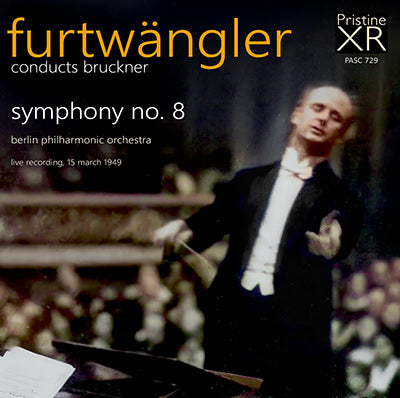
FURTWÄNGLER conducts Bruckner
BRUCKNER Symphony No. 8 in C minor (Haas edition)
1. 1st mvt. - Allegro moderato (15:27)
2. 2nd mvt. - Scherzo. Allegro moderato - Trio. Langsam (13:40)
3. 3rd mvt. - Adagio. Feierlich langsam, doch nicht schleppend (24:54)
4. 4th mvt. - Finale. Feierlich, nicht schnell (21:51)
Berlin Philharmonic Orchestra
conducted by Wilhelm Furtwängler
XR remastering by: Andrew Rose
Cover artwork based on a photograph of Furtwängler
Live recording by RIAS
Recorded at Titania Palast, Berlin, 15 March, 1949
Total duration: 75:52
Review
This new Pristine Audio release is a total game-changer
Wilhelm Furtwängler has four surviving broadcasts of Bruckner’s mighty Eighth Symphony, two each with the Berlin Philharmonic (March 14 and 15, 1949) and the Vienna Philharmonic (October 17, 1944 and April 10, 1954). Of these the 1954 performance (the only one in which Furtwängler used the 1892 Haslinger-Schlesinger-Lienau edition, the first published version of the score) is considered weak and unrepresentative of the conductor at his best. Of the other three performances (for which Furtwängler used his own modified version of the 1939 Haas edition that combines aspects of the 1887 and 1890 versions of the score), a majority of the conductor’s fans (such as my colleague Henry Fogel) give pride of place to the 1944 performance, while cherishing the greatness of the two 1949 outings as well. On the other hand—perhaps I simply imprinted on it, having heard it first of the three—I have always been partial to the March 15, 1949 performance in this release. The recorded sound of the two 1949 performances is superior to that from 1944 (the latter now best heard in the transfer in the 18-CD Orfeo set from 2014 of Furtwängler’s 1944–54 Vienna Philharmonic radio broadcasts). While that from the March 14 rendition (best heard in the 1998 Testament release), sans audience, has better sound, I have always found the March 15 performance before a live audience (a bronchially afflicted one, alas) to have an extra degree of intensity and frisson. Even in 1949, though, the top frequencies were heretofore truncated, and the middle and lower frequency ranges somewhat murky, though the 13-CD Audite set from 2009 of the conductor’s Berlin Philharmonic RIAS broadcasts was a marked improvement over previous issues.
Put simply, this new Pristine Audio release, in which Andrew Rose employs his patented XR remastering technology, is a total game-changer. Right at the very opening of the first movement, I was knocked back in my chair by the opening violin tremolo, recessed and subdued in previous issues but now projected with total clarity. For a moment it struck me as being almost too brilliant, because I have been so used to hearing it the other way. It brought to mind people who have complained that in the restorations of Michelangelo’s paintings in St. Peter’s at the Vatican, or the cleaning of stained-glass windows in several famous medieval cathedrals, the colors are now too bright. But the clarification of sonic textures here extends down into the middle and lower ranges as well; one can now actually hear exactly what Furtwängler is doing to shape the music there, instead of having only a rough idea. Rose has also managed to remove or tame a good deal of the coughing and other background noise, including the sound of planes landing and taking off during the Berlin Airlift. (Listen to the background rumble at 2:34 to 2:41 in the first movement for a sample. Ironically, this noise is slightly more audible on this Pristine release than in its Audite predecessor because of Pristine’s enhancement of frequency ranges from top to bottom.) The sound quality now is within hailing distance of that from March 14.
The performance itself has tremendous, almost frightening, intensity. Whereas most of Furtwängler’s performances became broader in his final years, this one is a bit fleeter than its 1944 predecessor: 15:35, 14:27, 25:43, 22:52 in 1944 vs. 15:27, 13:40, 24:54, 21:51 here. It is also more urgent than its companion rendition from the previous day, for which the timings are 15:55, 14:22, 25:26, 22:51. Some commentators have dubbed this symphony the “Apocalyptic,” and under Furtwängler’s baton it indeed assumes the cataclysmic character of that biblical book, with alternate passages of transcendental majesty, overwhelming terror, and mystical contemplation. For me, no other conductor has succeeded in encompassing the full spectrum of all of these dimensions to the degree that Furtwängler accomplishes here.
The CD issue comes in a digipak with brief notes and a photo of the conductor on the cover; a PDF of the score is provided by Pristine with the online digital download. This release is a guaranteed entry for my 2025 Want List; highest possible recommendation.
James A. Altena
