
This album is included in the following sets:
This set contains the following albums:
- Producer's Note
- Full Track Listing
- Cover Art
Generally speaking these recordings provided reasonably straightforward work for the remastering engineer, especially coming, as this volume has, a good number of sonatas into the series, with many carefully-chosen settings now determined for the series, restoration techniques suitable for the material worked out, and only minor variations to be found. The Moonlight offers slightly higher background hiss - this seems to be a characteristic of this work in a number of recordings, possible as a result of the works intrinsically wide dynamic range.
Andrew Rose
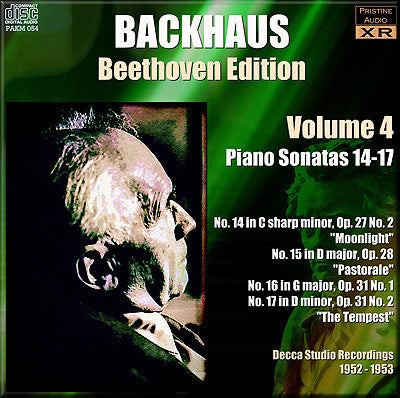
BACKHAUS Beethoven: Complete Piano Sonatas, Vol. 4 (1952/53)
BEETHOVEN Piano Sonata No. 14 in C sharp minor, Op. 27 No. 2 "Moonlight"
1. I. Adagio sostenuto (5:18)
2. II. Allegretto (2:24)
3. III. Presto agitato (7:28)
Recorded October 1952
Issued as Decca LXT 2780
BEETHOVEN Piano Sonata No. 15 in D major, Op. 28 "Pastorale"
4. I. Allegro (6:43)
5. II. Andante (6:02)
6. III. Scherzo — Allegro vivace (2:12)
7. IV. Rondo — Allegro non troppo (4:27)
Recorded November 1953
Issued as Decca LXT 2903
BEETHOVEN Piano Sonata No. 16 in G major, Op. 31 No. 1
8. I. Allegro vivace (4:53)
9. II. Adagio grazioso (8:26)
10. III. Rondo — Allegretto — Presto (6:05)
Recorded November 1953
Issued as Decca LXT 2950
BEETHOVEN Piano Sonata No. 17 in D minor, Op. 31 No. 2 "The Tempest"
11. I. Largo — Allegro (8:26)
12. II. Adagio (6:48)
13. III. Allegretto (6:15)
Recorded May 1952
Issued as Decca LXT 2747
Wilhelm Backhaus piano
Recording producer: Victor Olof
Recorded at Victoria Hall, Geneva
Gramophone Historic Review
The last movement, needless to say, is played in the grand manner and is undeniably exciting
The last movement, needless to say, is played in the grand manner and is undeniably exciting, but without the fine nuances of phrasing and articulation Gieseking gives us. The recording stands up pretty well to the pianist's assault on the last movement and is rather fuller in tone than Gieseking's in the preceding movement, although never more than adequate."
A.R. The Gramophone, October 1953 (Reviewing LXT2780, excerpt concerning Sonata No. 14)
"His " Pastoral " Sonata can be compared with that of Denis Matthews on Columbia 33SX1021, reviewed by L.S. last month (a review I am entirely at one with). In I Matthews is smooth, reflective and sober ; he observes the repeat. Backhaus, without repeat, is rougher ; on the last page he disregards the pianissimo. In the first section of II Matthews is far steadier and more sensitive than Backhaus, but he smooths down the discords too much. In the section marked l' is tesso tempo Backhaus suddenly achieves that sparkling elegance which is a mark of his playing at its best here Matthews conveys the impression of alertness but with unsuitable timidity. In III the English pianist is too tame, slightly too slow. And his lack of power in IV is all too apparent ; how exciting Backhaus is as he works towards the climax."
A.R. The Gramophone, June 1954 (Reviewing LXT2903, excerpt concerning Sonata No. 15)
