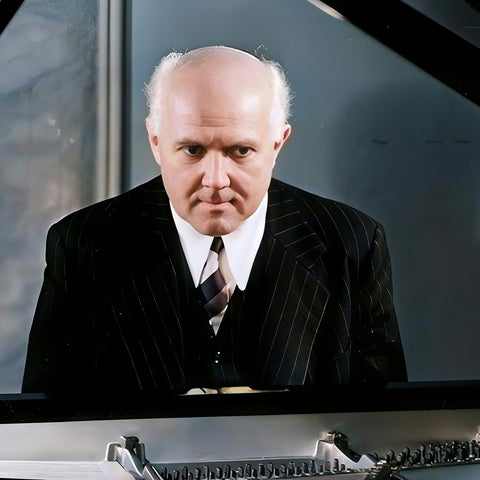
Walter Wilhelm Gieseking (5 November 1895 – 26 October 1956) was a French-born German pianist and composer.
Born in Lyon, France, the son of a German doctor and lepidopterist, Gieseking first started playing the piano at the age of four, but without formal instruction. His family travelled frequently and he was privately educated.
From 1911 to early 1916, he studied at the Hanover Conservatory. There his mentor was the director Karl Leimer, with whom he later co-authored a piano method. He made his first appearance as a concert pianist in 1915, but was conscripted in 1916 and spent the remainder of World War I as a regimental bandsman. His first London piano recital took place in 1923, establishing an exceptional and lasting reputation.
Because of his gifts — he had a natural technique, perfect pitch, and an abnormally acute faculty for memorization — Gieseking was able to master unfamiliar repertoire, however difficult, with relatively little practice. From his early instruction in the Leimer method, he usually studied new pieces away from the piano. It became well-known to the public, for instance, that he often committed new works to memory while traveling by train, ship or plane. Sometimes, according to Harold C. Schonberg's book The Great Pianists (1963), he could even learn an entire concerto by heart in one day.
Gieseking had a very wide repertoire, ranging from various pieces by Bach and the core works by Beethoven to the concertos of Rachmaninoff and more modern works by composers such as Busoni, Hindemith, Schoenberg and the lesser-known Italian Petrassi. He gave the premiere of Pfitzner's Piano Concerto in 1923. Today, though, he is particularly remembered for his recordings of the complete piano works of Wolfgang Amadeus Mozart and the two French impressionist masters Claude Debussy and Maurice Ravel, virtually all of whose solo piano music he recorded on LP for EMI in the early 1950s (the Mozart and Debussy sets have recently been re-released on CD), after recording much of it with even greater youthful vitality for Columbia in the 1930s and 1940s, some of which have also been re-released on CD.
Gieseking's 1944 performance of Beethoven's "Emperor" Concerto, in which anti-aircraft fire is audible, is one of the earliest stereo recordings, although his rendition of the same work in 1934 for Columbia, with Bruno Walter conducting the Vienna Philharmonic, is not only decidedly superior but one of the greatest concerto recordings ever made. His later 1930s Columbia concerto recordings of Mozart K. 271, Grieg and Beethoven Op. 15 under Hans Rosbaud in Berlin are just as outstanding in their own right, as is his early-1930s Franck Symphonic Variations under Henry Wood in London. In December, 1955, Gieseking suffered head injuries in a bus accident near Stuttgart, Germany, in which his wife was killed.
His last recording project was the complete cycle of Beethoven's Piano Sonatas. Gieseking suddenly fell ill in London, however, while recording Beethoven's "Pastoral" Sonata in D Piano Sonata No. 15 for HMV. He had completed the first three movements and, the following day, was due to record the rondo finale but died a few days later of postoperative complications for the relief of pancreatitis. HMV released the unfinished recording, and since then broadcast recordings of Gieseking playing all of Beethoven's Piano Sonatas (with the exception of Op. 54, which he never recorded) have been issued. Although some of his performances - particularly the live ones - could be erratic and marred by wrong notes, when Gieseking was at his best, especially in studio recording sessions, he was technically superb to the point of virtual flawlessness with immaculate, effortless ease. The subtle shadings of his piano tone, at its finest, seemed extraordinary in so physically large a man.