This album is included in the following sets:
This set contains the following albums:
- Producer's Note
- Full Track Listing
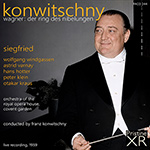
- Cover Art
The hero who knew no fear
Of the four music dramas comprising Wagner's Der Ring des Nibelungen, Siegfried is perhaps the most peculiar. After the elemental struggles of Das Rheingold and the human tragedy of Die Walküre, Wagner turns to a story that might almost be described as a fairy tale. There are dwarfs, a dragon, a mysterious traveller, a talking bird and a beautiful woman sleeping within a circle of fire. Yet beneath this apparently innocent world lies the approaching collapse of the gods, and at its centre stands a hero whose defining characteristic is not so much courage as his complete ignorance of fear.
Siegfried has grown up in the forest, raised by the dwarf Mime, who hopes to exploit the boy's extraordinary strength to recover the treasure guarded by the dragon Fafner. Ignorant of his parentage and suspicious of his guardian, Siegfried is an uncomfortable mixture of youthful exuberance, impatience, cruelty and innocence. He has no understanding of the intrigues that have shaped his destiny, nor any knowledge of the laws and obligations that govern the world around him. In this he is both the fulfilment of Wotan's hopes and a threat to everything the god has created.
The opening act establishes a remarkably different dramatic atmosphere from the preceding operas. Much of it is dominated by the exchanges between Siegfried and Mime, whose increasingly desperate attempts to manipulate his foster-son introduce an element of grotesque comedy. Mime's scheming is matched by Siegfried's exuberant contempt, and Wagner finds extraordinary musical variety in their confrontations. The forging of the shattered sword Nothung provides the act's exhilarating climax: a great display of youthful energy, with Siegfried literally hammering his inheritance into a weapon capable of destroying the old order.
Behind this seemingly domestic struggle stands Wotan, now travelling anonymously as the Wanderer. His riddling encounter with Mime is one of Wagner's most ingenious dramatic constructions. The god already knows the answers to the questions he asks, yet has lost the ability to direct events towards the outcome he desires. Knowledge and power have become separated. The Wanderer possesses the former in abundance, while the unknowing Siegfried increasingly embodies the latter.
Act II moves the action into the forest, where Wagner creates one of his most evocative orchestral landscapes. The famous Forest Murmurs offer a moment of extraordinary repose amid the plotting and violence. Siegfried, who has never known his mother, listens to the sounds of nature and wonders about his origins. The music seems briefly to suspend the immense machinery of the Ring, allowing its hero an intimacy and vulnerability that his noisy behaviour has previously concealed.
The encounter with Fafner is almost brutally straightforward. Siegfried slays the dragon without grasping the significance of his victory, and through tasting its blood acquires the ability to understand the Woodbird. He gains possession of the Ring and the Tarnhelm without appreciating their terrible history. The irony is characteristic of Wagner's conception: the innocent hero achieves effortlessly what generations of gods and dwarfs have pursued through deception, violence and the surrender of love.
The opera's unusual character is partly explained by its remarkable history of composition. Wagner completed the music of the first two acts in 1857 before abandoning the Ring for twelve years. During that interval he composed Tristan und Isolde and Die Meistersinger von Nürnberg, works that transformed his command of harmony, orchestral colour and dramatic expression. When he returned to Siegfried in 1869, he was a considerably different composer. The third act, completed in score in 1871, carries the accumulated experience of those intervening masterpieces.
That development becomes apparent as the Wanderer summons Erda and finally confronts Siegfried. The breaking of Wotan's spear is among the most decisive moments in the entire cycle. The weapon upon which the god's authority depends is shattered by the sword he once hoped would redeem his world. Wotan's power is finished, not through direct rebellion or calculated revenge, but through the actions of someone who scarcely understands what he has accomplished.
The awakening of Brünnhilde then carries the drama into a new emotional world. For the first time Siegfried confronts something that genuinely disturbs him: the mysterious figure of a sleeping woman, whose discovery awakens feelings entirely outside his experience. Brünnhilde, meanwhile, must relinquish her divine existence and confront the uncertainties of human love. Their great concluding duet celebrates a seemingly triumphant union, but its radiance is shadowed by the knowledge that this happiness cannot endure.
Siegfried thus stands at the centre of Wagner's extraordinary dramatic paradox. Its hero has overcome the dragon, destroyed the spear of a god and awakened a sleeping goddess, yet understands almost nothing of the forces he has unleashed. His innocence is both his greatest strength and his fatal weakness. The world of the Ring has acquired a new master, but whether he possesses the wisdom to govern it is another question altogether.
Konwitschny's Siegfried at Covent Garden, 1959
On 28 September 1959, the Royal Opera House, Covent Garden presented Siegfried as the third instalment of its autumn Ring cycle, under the direction of Franz Konwitschny. The performance brought together an exceptional company of Wagner singers, several of whom were closely associated with the post-war Bayreuth Festival. The production itself was not new. First staged in 1954 under Rudolf Hartmann, with designs by Leslie Hurry, it belonged to an established Covent Garden tradition that was already attracting criticism for its increasingly antiquated theatrical conventions. Musically, however, it offered London audiences something remarkable.
At the centre stood Wolfgang Windgassen, whose interpretation of Siegfried had become one of the defining achievements of his career. Windgassen was never a heroic tenor in the crudely monumental sense. His particular gifts lay in his flexibility, verbal intelligence and ability to suggest youthful spontaneity without sacrificing the musical line. His Siegfried could be impulsive, impatient and occasionally disarmingly casual, qualities that suited a character whose strength is matched by his ignorance of the world. Writing in The Spectator on 16 October, David Cairns acknowledged this apparent lack of solemnity while nevertheless calling Windgassen "the best Siegfried we have".
Hans Hotter's Wanderer provides an extraordinary counterweight. Having dominated the earlier dramas as Wotan, Hotter now presents a figure whose authority is increasingly undermined by the consequences of his own actions. His great strength was always his ability to make Wagner's text speak with philosophical and emotional significance. The Wanderer's riddling exchanges with Mime, his confrontation with Alberich and his final encounter with Siegfried demand precisely that combination of commanding presence and inward resignation. For contemporary critics, Hotter remained one of the indisputable glories of the Covent Garden cycle.
Peter Klein's Mime is another essential element in this drama of contrasting personalities. The role calls for more than the familiar caricature of a whining, malicious dwarf. Mime must be plausible both as a cunning manipulator and as a creature utterly overwhelmed by the forces he hopes to control. His exchanges with Windgassen bring much of the first act's dramatic character into focus. Otakar Kraus, returning as Alberich, supplies a different kind of menace: more concentrated and openly driven by resentment. Their scenes reveal two contrasting expressions of the same destructive ambition.
The remaining cast brings further distinction. Michael Langdon returns as Fafner, transformed from the giant of Das Rheingold into the dragon guarding the Nibelung treasure. Marga Höffgen provides Erda's sombre prophetic voice, while Jeannette Sinclair sings the Woodbird, whose apparently innocent interventions determine the course of Siegfried's journey. For the concluding scene, Astrid Varnay returns as Brünnhilde, bringing the vocal authority and dramatic intensity that had made her one of the foremost Wagner sopranos of her generation.
Konwitschny's conducting was the subject of sharply divided contemporary opinion. Succeeding Rudolf Kempe, whose performances had been admired for their architectural discipline, he brought a more forceful and sometimes less predictable theatrical temperament. Critics recognised the impact of his powerful bass sonorities and emphatic climaxes, but some questioned his control of longer musical structures. Cairns was particularly severe about passages he considered ponderous or insufficiently balanced. Such reservations deserve acknowledgement, although they reflect a particular critical perspective rather than a settled judgement upon the performance.
The production itself came under still fiercer attack. Cairns complained that the staging lacked coherence, singling out the forging scene for its unconvincing physical realism. There is an interesting historical irony here. At a time when Wieland Wagner's revolutionary Bayreuth productions were transforming expectations of Wagnerian theatre, Covent Garden was still relying upon a production conceived in substantially more traditional terms. Yet the inadequacies of the visual presentation did not prevent the singers from creating performances that retained their dramatic authority, and the BBC microphones preserved what the audience heard rather than what it saw.
That distinction gives this recording much of its enduring value. The surviving BBC broadcast offers a convincing impression of voices and orchestra sharing a theatrical space, with a natural relationship between stage and pit and a welcome clarity of orchestral detail. The Orchestra of the Royal Opera House, led by Charles Taylor, was participating in a substantial Wagnerian undertaking, not assembling isolated performances for the recording studio. The sound retains the presence and immediacy of an actual operatic occasion, qualities central to Pristine's approach to restoring these historic broadcasts.
What survives, therefore, is not a hypothetical ideal of Wagner performance, polished beyond recognition, but the work of a distinguished company meeting the demands of one of the repertory's most formidable operas. Windgassen, Hotter, Klein, Kraus and Varnay represent a Wagnerian tradition in which character, language and dramatic conviction remained inseparable from vocal achievement. Whatever the contemporary reservations about the production or its conductor, this Siegfried preserves a remarkable evening in the history of Covent Garden and an invaluable document of Wagner interpretation in the late 1950s.
WAGNER Siegfried
CD 1 (59:36)
ACT I
1. Prelude (4:45)
ACT I, SCENE 1
2. Zwangvolle Plage! Müh ohne Zweck! (4:38)
3. Hoiho! Hoiho! Hau ein! Hau ein! (1:43)
4. Da hast du die Stücken, schändlicher Stümper (2:28)
5. Als zullendes Kind zog ich dich auf (1:38)
6. Vieles lehrtest du, Mime (8:20)
7. Einst lag wimmernd ein Weib (6:01)
8. Und diese Stücken sollst du mir schmieden (1:32)
9. Da stürmt er hin! (1:51)
ACT I, SCENE 2
10. Heil dir, weiser Schmied! (3:41)
11. Hier sitz' ich am Herd und setze mein Haupt (11:44)
12. Was zu wissen dir frommt, solltest du fragen (7:57)
13. Die Stücken! Das Schwert! O weh! Mir schwindelt! (3:19)
CD 2 (70:37)
ACT I, SCENE 3
1. Verfluchtes Licht! (1:06)
2. Heda! Du Fauler! (0:30)
3. Bist du es, Kind? (2:57)
4. Fühltest du nie im finstren Wald (5:37)
5. Her mit den Stücken, fort mit dem Stümper! (3:35)
6. Nothung! Nothung! Neidliches Schwert! (8:24)
7. Hoho! Hoho! Hahei! (3:27)
8. Den der Bruder schuf (3:09)
ACT II
9. Prelude (5:57)
ACT II, SCENE 1
10. In Wald und Nacht (2:43)
11. Zur Neidhöhle fuhr ich bei Nacht (7:18)
12. Mit mir nicht, hadre mit Mime (2:46)
13. Fafner! Fafner! Erwache, Wurm! (3:19)
14. Nun, Alberich, das schlug fehl (3:57)
ACT II, SCENE 2
15. Wir sind zur Stelle! (6:02)
16. Daß der mein Vater nicht ist (1:35)
17. Aber wie sah meine Mutter wohl aus? (2:20)
18. Meine Mutter, ein Menschenweib! (5:55)
CD 3 (50:33)
ACT II, SCENE 2
1. Haha! Da hätte mein Lied (5:13)
2. Wer bist du, kühner Knabe, der das Herz mir traf? (4:28)
3. Zur Kunde taugt kein Toter (1:58)
ACT II, SCENE 3
4. Wohin schleichst du eilig und schlau (2:44)
5. Was ihr mir nützt, weiß ich nicht (2:36)
6. Willkommen, Siegfried! (8:30)
7. Da lieg auch du, dunkler Wurm! (9:35)
ACT III
8. Prelude (2:17)
ACT III, SCENE 1
9. Wache, Wala! Wala! Erwach! (2:02)
10. Stark ruft das Lied (11:12)
CD 4 (70:39)
ACT III, SCENE 1
1. Dir Unweisen ruf' ich ins Ohr (5:45)
ACT III, SCENE 2
2. Wohin, Knabe, heißt dich dein Weg? (5:53)
3. Kenntest du mich, kühner Spross (5:29)
4. Mit zerfochtner Waffe wich mir der Feige? (4:49)
ACT III, SCENE 3
5. Selige Öde auf sonniger Höh'! (6:29)
6. Das ist kein Mann! (8:17)
7. Heil dir, Sonne! Heil dir, Licht! (5:41)
8. O Siegfried! Siegfried! Seliger Held! (6:58)
9. Dort seh' ich Grane (8:07)
10. Ewig war ich, ewig bin ich (13:10)
CAST
Siegfried - Wolfgang Windgassen
Mime - Peter Klein
The Wanderer - Hans Hotter
Alberich - Otakar Kraus
Fafner - Michael Langdon
Brünnhilde - Astrid Varnay
Erda - Marga Höffgen
The Woodbird - Jeannette Sinclair
Orchestra of the Royal Opera House, Covent Garden
Leader: Charles Taylor
conducted by Franz Konwitschny
BBC radio broadcast
Royal Opera House, Covent Garden, London
28 September 1959
XR remastered by Andrew Rose
Cover artwork based on a photograph of Franz Konwitschny
CD edition: four discs in two 2-CD packages.
Total duration: 4hr 11:25