
This album is included in the following sets:
This set contains the following albums:
- Producer's Note
- Full Track Listing
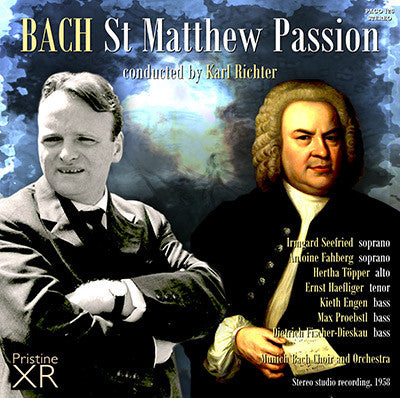
- Cover Art
“A revelation .. a monumental achievement” - The Gramophone
Karl Richter's classic 1958 St . Matthew Passion is a fabulous demonstration of just how good some of the earliest commercial stereo recordings of the late 1950s could sound. It appears on the Pristine label almost by chance - chosen as listening material whilst testing new LP replay equipment, I was so drawn into the music that I couldn't help but let it run, and run. All eight sides of it demonstrated to me how much superior the best vinyl pressings of the pre-CD era sound by comparison to almost every modern "vinyl revival" LP I've heard thus far.
Thus I had marvellous source material from which to work: XR remastering has served to "warm up" the sound, as well as dusting off the upper-end cobwebs, whilst the tape hiss which has bothered listeners to earlier reissues has been all but eliminated. The lightest touch of convolution reverberation, which reproduces the acoustic space and characteristics of a real selected concert hall, has served to soften some of the rougher edges of DGG's early stereo sound and bring an extra sense of depth and realism to the proceedings.
Andrew Rose
RICHTER Bach: St. Matthew Passion (1958)
BACH St. Matthew Passion, BWV 244
1. 1. Kommt, ihr Töchter, helft mir klagen (9:52)
2. 2. Da Jesus diese Rede vollendet hatte (1:04)
3. 3. Herzliebster Jesu, was hast du verbrochen (1:09)
4. 4. Da versammleten sich die Hohenpriester und Schriftgelehrten (4:18)
5. 5. Du lieber Heiland du (1:06)
6. 6. Buß und Reu, Buß und Reu (5:32)
7. 7. Da ging hin der Zwölfen (0:43)
8. 8. Blute nur, du liebes Herz! (5:27)
9. 9. Aber am ersten Tage der süßen Bro (3:10)
10. 10. Ich bins, ich sollte büßen (1:09)
11. 11. Er antwortete und sprach (4:26)
12. 12. Wiewohl mein Herz in Tränen schwimmt (1:35)
13. 13. Ich will dir mein Herze schenken (3:58)
14. 14. Und da sie den Lobgesang gesprochen hatten (1:30)
15. 15. Erkenne mich, mein Hüter (1:20)
16. 16. Petrus aber antwortete und sprach zu ihm (1:12)
17. 17. Ich will hier bei dir stehen (1:20)
18. 18. Da kam Jesus mit ihnen zu einem Hofe (2:33)
19. 19. O Schmerz! (2:09)
20. 20. Ich will bei meinem Jesu wachen (5:25)
21. 21. Und ging hin ein wenig (0:56)
22. 22. Der Heiland fällt vor seinem Vater nieder (1:20)
23. 23. Gerne will ich mich bequemen (4:42)
24. 24. Und er kam zu seinen Jüngern und fand sie schlafend (1:42)
25. 25. Was mein Gott will, das gscheh allzeit (1:08)
26. 26. Und er kam und fand sie aber schlafend (3:08)
27. 27. So ist mein Jesus nun gefangen (5:02)
28. 28. Und siehe, einer aus denen, die mit Jesu waren (3:22)
29. 29. O Mensch, bewein dein Sünde groß (6:51)
30. 30. Ach, nun ist mein Jesus hin! (4:02)
31. 31. Die aber Jesum gegriffen hatten (1:06)
32. 32. Mir hat die Welt trüglich gericht' (0:52)
33. 33. Und wiewohl viel falsche Zeugen herzutraten (1:29)
34. 34. Mein Jesus schweigt (1:15)
35. 35. Geduld, Geduld! (3:47)
36. 36. Und der Hohenpriester antwortete und sprach zu ihm (2:31)
37. 37. Wer hat dich so geschlagen (1:01)
38. 38. Petrus aber saß draußen im Palast (2:40)
39. 39. Erbarme dich, mein Gott (7:49)
40. 40. Bin ich gleich von dir gewichen (1:11)
41. 41. Des Morgens aber hielten alle Hohepriester und die Ältesten (2:02)
42. 42. Gebt mir meinen Jesum wieder! (3:14)
43. 43. Sie hielten aber einen Rat und kauften einen Töpfersakker (2:50)
44. 44. Befiel du deine Wege (1:30)
45. 45. Auf das Fest aber hatte der Landpfleger Gewohnheit (2:46)
46. 46. Wie wunderbarlich ist doch diese Strafe! (1:15)
47. 47. Der Landpfleger sagte (0:15)
48. 48. Er hat uns allen wohlgetan (1:20)
49. 49. Aus Liebe will mein Heiland sterben (4:33)
50. 50. Sie schrieen aber noch mehr und sprachen (2:10)
51. 51. Erbarm es, Gott! (1:02)
52. 52. Können Tränen meiner Wangen (8:08)
53. 53. Da nahmen die Kriegsknechte des Landpflegers Jesum (1:18)
54. 54. O Haupt, voll Blut und Wunden (3:02)
55. 55. Und da sie ihn verspottet hatten (1:12)
56. 56. Ja, freilich will in uns das Fleisch und Blut (0:42)
57. 57. Komm, süßes Kreuz, so will ich sagen (6:29)
58. 58. Und da sie an die Stätte kamen mit Namen Golgatha (3:59)
59. 59. Ach Golgatha, unselges Golgatha! (1:42)
60. 60. Sehet, Jesus hat die Hand (3:53)
61. 61. Und von der sechsten Stunde (3:01)
62. 62. Wenn ich einmal soll scheiden (2:03)
63. 63. Und siehe da, der Vorhang im Tempel zerriß in zwei Stück (4:06)
64. 64. Am Abend, da es kühle war (2:16)
65. 65. Mache dich, mein Herze, rein (7:10)
66. 66. Und Joseph nahm den Leib (2:54)
67. 67. Nun ist der Herr zur Ruh gebracht (2:31)
68. 68. Wir setzen uns mit Tränen nieder (6:26)
Ernst Haefliger, Tenor (Evangelist, Arien)
Kieth Engen, Bass (Jesus)
Irmgard Seefried, Sopran (Arien)
Antonie Fahberg, Sopran (1. Magd, Pilati Weib)
Hertha Topper, Alt (Arien, 2. Magd)
Dietrich Fischer-Dieskau, Bass (Arien)
Max Proebstl, Bass (Judas, Petrus, Pilatus, Hohepriester)
Walter Theurer, Wolfgang Haag, Querflöte l/ll
Edgar Shann, Oboe
Edgar Shann, Kurt Hausmann, Oboe d'Amore l/ll
Otto Büchner, Violine
Oswald Uhl, Viola da Gamba
Continuo: Oswald Uhl, Violoncello
Karl Kolbinger, Fagott • Franz Ortner, Kontrabass
Ekkehard Tietze, Hedwig Bilgram, Orgel
Münchner Chorknaben • Einstudierung Fritz Rothschuh
Münchener Bach-Chor
Münchener Bach-Orchester
Karl Richter conductor
MusicWeb International Review
Unquestionably the finest of his interpretations of the work on disc ... those new to this classic recording will enjoy the sympathetic restoration here.
Karl Richter played the harpsichord in the 1950 recording of excerpts
from the Mass in B Minor directed in Leipzig by Günther Ramin. Ramin
held the same position at St Thomas that Bach had done. That Richter
absorbed much from his eminent but now somewhat overshadowed teacher
seems self-evident from the famous studio recording Richter gave of the
Mass in 1961, a cornerstone of the LP library. The stylistic lineage is
perhaps even more clear from the recordings both men made of the St
Matthew Passion.
Ramin’s was severely abridged with many
omissions – some, indeed many, standard Leipzig ‘cuts’ at the time -
which enables the work to fit on two CDs. Made in 1941 with the St
Thomas Choir, the Gewandhaus Orchestra and some of Germany’s leading
singers, it remains a remarkable document. It’s clear from the approach
adopted by Richter in his famous recording of 1958 that the expressive
balances and stylistic approach explored by Ramin had been securely
passed on – tight rhythms but with relaxed tempos (sometimes very
relaxed) with crisp, small ensembles, and a richly warm emotional
engagement. His opening chorus which, remarkably enough, is slower than
Mengelberg’s is also a full minute slower than – but expressively
congruent with – Ramin’s 1941 reading. Thus it is for much of this 1958
recording, one that by common consent eclipses the other studio and
video recordings Richter left behind. With a more appropriate sense of
articulation and a roster of first-rank soloists largely in fresh voice
this is unquestionably the finest of his interpretations of the work on
disc and one that still stands comparison with most others of the LP
era.
In Ernst Haefliger he had one of the great Evangelists on
disc and the enormous advantage of Fischer-Dieskau’s bass solos. Irmgard
Seefried is a splendid soprano, though not always quite ideally steady,
and Hertha Töpper the reliable alto. His well-drilled Munich
instrumental and choral forces are resilient and attentive to his
demands, some of which can be rigorous and indeed onerous, when it comes
to certain tempi decisions. But all these decisions are far preferable
here than in later recordings.
As Pristine’s Andrew Rose
observes in his brief producer’s note, this early stereo was excellently
recorded. Light ‘warming’ of the sound has been judiciously applied and
some reverberation too: this won’t be to all tastes, and certainly not
those who prefer more of a facsimile of the original sound – in which
case one of the many reissues, not least DG’s own, will be the preferred
option. However those new to this classic recording will enjoy the
sympathetic restoration here.
Jonathan Woolf
MusicWeb International, June 2016
