

This album is included in the following sets:
This set contains the following albums:
- Producer's Note
- Full Track Listing
- Cover Art
Dimitri Mitropoulos's performance of Shostakovich's Symphony No. 10 with the New York Philharmonic in Athens on October 1, 1955, was both a musical and cultural landmark. Conducted in Athens's Orpheus Hall as part of the orchestra’s historic post-war European tour, the concert resonated deeply, not only due to the stature of the music but also because it marked a profoundly emotional homecoming for Mitropoulos himself, who served as musical director of the New York Philharmonic from 1949 to 1958.
Shostakovich's Tenth Symphony, completed shortly after Stalin's death in 1953, is renowned for its stark emotional intensity and complexity. Mitropoulos, famed for conducting entirely from memory and noted for his intensely physical approach, brought to this performance an unmistakable depth of expression. His interpretation reflected the tension, anguish, and tentative optimism embodied within Shostakovich's music. This symphony, with its brooding opening movement, vehement scherzo, reflective third movement, and ultimately triumphant finale, demanded a conductor capable of navigating profound emotional contrasts, a task perfectly suited to Mitropoulos’s temperament.
The Greek conductor’s association with Shostakovich's Tenth was particularly apt; Mitropoulos’s own artistic personality mirrored the symphony's inner turmoil and eventual resolution. The Athens audience, aware of Mitropoulos's international acclaim and proud of his Greek heritage, responded enthusiastically to his emotionally charged leadership. The performance served as a symbolic moment of reconciliation and cultural rebuilding, occurring just a decade after the ravages of World War II and civil strife in Greece.
Critical reception emphasized Mitropoulos’s remarkable ability to unify the orchestra into a cohesive, potent ensemble, highlighting the New York Philharmonic's capacity for nuanced expression. The emotional power of the symphony was intensified by the context: Mitropoulos’s return to his homeland was widely seen as a poignant reunion, infusing the performance with additional layers of meaning beyond the notes themselves.
Preserved in contemporary recordings, this interpretation remains a significant historical document, reflecting both the cultural importance of the event and Mitropoulos’s profound identification with Shostakovich's music. Today, this particular 1955 Athens concert performance is recognized not merely as a noteworthy musical event but as a compelling intersection of personal narrative, historical circumstance, and artistic excellence, capturing a conductor and orchestra at a moment of rare emotional and musical convergence.
In 1956, during his tenure as musical director, Mitropoulos recorded Prokofiev's Violin Concerto No. 1 with the New York Philharmonic, featuring the distinguished violinist Isaac Stern. Stern's performance, guided sensitively by Mitropoulos, is noted for its lyrical intensity, precise articulation, and richly expressive phrasing. The conductor's understanding of Prokofiev’s uniquely evocative orchestration and melodic textures complemented Stern’s virtuosity, creating a recording that remains highly regarded for its emotional depth and technical brilliance.
MITROPOULOS conducts Shostakovich & Prokofiev
PROKOFIEV Violin Concerto No. 1 in D major, Op. 19
1. 1st mvt - Andantino (8:59)
2. 2nd mvt - Scherzo. Vivacissimo (3:34)
3. 3rd mvt - Moderato. Allegro moderato (7:42)
Recorded 27 February 1956, Columbia 30th Street Studios, New York City
Isaac Stern, violin
SHOSTAKOVICH Symphony No. 10 in E minor, Op. 93
4. 1st mvt. - Moderato (20:46)
5. 2nd mvt. - Allegro (3:35)
6. 3rd mvt. - Allegro - Largo - Più mosso (11:39)
7. 4th mvt. - Andante - Allegro - L'istesso tempo (13:42)
Recorded live on 2 October 1955, Orpheus Hall, Athens, Greece
New York Philharmonic
conducted by Dimitri Mitropoulos
XR remastering by Andrew Rose
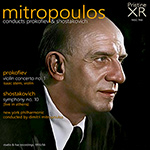
Cover artwork based on a photograph of Mitropoulos
Total duration: 69:57
Reviews
Fanfare Review
The studio account is worth having as well, but if forced to choose between the two this live account takes the palm
Dimitri Mitropoulos had a special feeling for the music of both Prokofiev and Shostakovich, and this disc pairs notable performances of works by those two composers. The Prokofiev was recorded at Columbia’s 30th St. Studio in New York City on March 3, 1958, but still in mono at that point. Isaac Stern was in peak form at this juncture, and his playing is technically quite assured. That said, although interpretively he has a good feeling for the piece, he would deepen his interpretation in his 1963 stereo remake with Ormandy and the Philadelphia Orchestra. Of course, Stern and every other violinist faces the insupportable burden of following the nonpareil premiere version on disc from 1935 by Joseph Szigeti, Thomas Beecham, and the London Philharmonic, one of the most stupefyingly great recordings of any piece of music, ever. (No matter how many times I listen to that recording, there is a particular passage played by Szigeti at about 2:20 into the second movement where I always have to pick up my jaw from off the floor in dumbfounded amazement.) Very close behind Szigeti comes David Oistrakh, who left behind multiple great accounts, beginning with four studio recordings conducted first by Prokofiev himself (1938), followed by versions with Kondrashin (1953), Matačić (1954), and Rozhdestvensky (1968), plus live accounts with Kubelík (1947), Kondrashin (1963), Ernest Bour (1963), Temirkanov (1970), Kurt Sanderling (1971), Haitink (1972), and Stig Westerberg (1974). This recordings joins numerous good accounts on a second tier below Szigeti and Oistrakh. In short, this is a fine version, but paradoxically one to be acquired more to hear the masterful conducting of Mitropoulos, and the sonic enhancement provided by the XR remastering of Andrew Rose.
Mitropoulos recorded the Shostakovich 10th in the studio with the NYP on October 18, 1954, shortly after the work’s premiere in Leningrad under Evgeny Mravinsky on December 17, 1953. This live performance was given by the conductor and orchestra on tour in Athens, Greece a year after their recording session. As their respective timings indicate—20:52 3:47 10:28 13:02 (studio) vs. 20:46 3:35 11:39 13:16 (live)—the two performances are quite similar overall as interpretations, with just the third movement being slightly broader. Both are excellent renditions, with the trade-offs between them that one might expect: the studio account has more precise playing (ensemble gets pretty hairy throughout the whirlwind second movement and at the close of the finale in the live performance), while the live performance has more interpretive intensity. The recorded sound of the live performance is excellent: warmer, more spacious, and more resonant than the quite good studio recording (I hope that Andrew Rose will take a shot at refurbishing that as well in the future). This is my favorite symphony among all those composed after Mahler, and I’m very particular about its interpretation in the first movement. Specifically, in order to capture properly the portrayal of the inexorable, crushing brutality of the Stalin regime, an ideal performance has to take it at a basically uniform tempo, and time out between about 22 to 23 minutes. Mitropoulos goes just a bit too fast in the great, extended climax for my taste—my favorite performances are by Mravinsky (live 1976 on BMG) and Karajan (live 1969 on Melodiya)—but he is close enough to my ideal to make it into my pantheon. The studio account (Sony) is worth having as well, but if forced to choose between the two this live account takes the palm. This premiere release makes this disc a virtually necessary acquisition. Very highly recommended.
James A. Altena
Fanfare, Mar/Apr 2026
Fanfare — Dominic Hartley
Issue 50:1 (Sept/Oct 2026) · Read the original review
As it happens, I’m reviewing Pristine’s two recent Mitropoulos releases in reverse order, having already covered Francescatti’s Prokofiev Second and the 1952 Shostakovich Fifth in Fanfare 49:4. I mentioned this performance briefly in that review. Returning to it has been no hardship. If anything, a second pass has only deepened my conviction that this is one of the most thrilling discs of the year.
Not for the first time, I find myself arriving at a recording after James A. Altena has had his say (also in Fanfare 49:4), and I want to underline two of his observations that resonated strongly with me. The first concerns the Shostakovich. I’m not sure I’ve ever heard a more intense account of the 10th, live or in the studio, and on those grounds alone the disc demands to be heard. Even Karajan’s celebrated Moscow performance on Melodiya doesn’t, for me, eclipse it. One can reasonably assume the Athens setting played its part in both the playing and the reception—Mitropoulos was returning to his native country at the height of his powers, and there is an unmistakable charge in the air from the first bar onward. I also agree that this live reading surpasses Mitropoulos’s own studio version, fine though that is.
On the Prokofiev I find myself more positive than my distinguished colleague. This is a very different Stern from the one some readers may be expecting, and it’s a reading quite distinct from the Szigeti and Oistrakh accounts. What sets it apart, I think, is the profoundly sympathetic accompaniment Stern receives from Mitropoulos and the New York Philharmonic—an orchestral partnership that listens, breathes, and shapes the music with him rather than simply supporting from behind. Stern’s lyricism is given room, his tone has space to bloom, and the result is a performance I really wouldn’t want to be without.
Andrew Rose’s XR remastering is, as so often, unobtrusively effective in both works, allowing the Athens occasion in particular to register with all the immediacy one could hope for from a 1955 broadcast source. Dominic Hartley