

This album is included in the following sets:
This set contains the following albums:
- Producer's Note
- Full Track Listing
- Cover Art
On the morning of Tuesday, April 27th 1926, Sir Edward Elgar stood before the Royal Albert Hall Orchestra in Queen’s Hall for his first recording session utilizing the new electrical process. He was already a veteran recording artist with a sizable catalog of acoustic discs going back to 1914, enough to later fill a four-CD reissue. Now, he was to begin re-recording some of his most important works and adding others which had not seen a previous disc release. Only this time, the recordings would not feature reduced forces playing in a small, airless studio, and captured in sound with a vastly limited frequency range; they would be done in large concert halls, in much more realistic sonics that would stand as a testament for the ages. It was perhaps with this in mind that the composer would later write that electrical recording was “the greatest discovery made up to that time in the history of the gramophone.”
At least one convention of the old acoustic process was continued by HMV even into early 1927: the substitution of tubas for string basses for a more solid low-frequency response, which can clearly be heard toward the beginning of the twelfth Enigma variation but is also present elsewhere in these recordings. This was seen by the Gramophone Company as necessary at the time, since most listeners were still using acoustic players for their discs. Indeed, HMV utilized such a machine with its heavy pickup to subject records to the “wear test”, identifying which sides would easily wear out in louder passages and need to be re-recorded. After the initial two days of recording in April, Elgar had to come back for a make-up session in August both to remake rejected sides and add new repertoire.
Looking back at the events of the week in a letter written April 29th, Elgar reflected: “It is curious that I do not tire now—3 hours solid rehearsal Sunday; – the like Monday & the concert; early on Tuesday 3 hours H.M.V. (large orchestra) Wedy afternoon also Dinner on Tuesday & Theatre last night & I am 69!!” Some of that boundless energy leaps out of the grooves of these discs, the sum of his recording activities in 1926. Cockaigne is liberally spread out over four 12-inch sides here, so the fast tempi are not a result of trying to speed up to get everything on the limits of a disc. The Bach transcription, recorded nearly a year before Stokowski’s famous first version of the Toccata and Fugue in D minor, was oddly issued only in France and Italy. (There is a bit of scrappiness in the Fugue that might account for HMV’s reluctance to release the disc in the UK, and they ultimately re-recorded it with Albert Coates two years later.)
The matrix for the other half of Elgar’s Op. 15, the Chanson de matin, was recorded at the August session but rejected as “too weak in tone”. It was remade the following year with the LSO, which accounts for why this disc features two different ensembles. (Only the Chanson de nuit with the RAHO is featured here.) The two Pomp and Circumstance marches were recorded without the small cuts Elgar took in his 1932 remakes with the BBC Orchestra, while the “Meditation” from The Light of Life had only first been set down the previous year as a filler to the composer’s acoustic version of his Second Symphony.
While the two Pomp and Circumstance Marches were well-recorded to begin with, the Enigma Variations certainly would have benefitted from a remake with superior sound. Side 5 with the tenth and eleventh variations is dim and under-recorded, while the following side’s matrix originally had annoying repeating mechanical noises, particularly in the thirteenth variation, which have been painstakingly removed manually for the first time in this transfer. Nevertheless, the set enshrines the composer’s affectionate portraits in a most authentic and heartfelt manner, culminating in a brilliant finale.
Mark Obert-Thorn
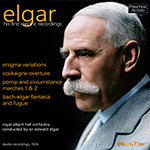
ELGAR – His first electric recordings
1. ELGAR Cockaigne (In London Town) – Concert Overture, Op. 40 (12:59)
Recorded 27 April 1926 · Matrices: CR 332-1A, 333-2, 334-1A and 335-1A · First issued on HMV D 1110/1
BACH-ELGAR Fantasia and Fugue in C minor (Elgar Op. 86 after Bach BWV 537)
2. Fantasia (4:36)
3. Fugue (3:04)
Recorded 28 April and 30 August 1926 · Matrices: CR 346-2A and 347-1A · First issued on Disque Gramophone W 749
Recorded 27 April 1926 · Matrix: CR 338-1 · First issued on HMV D 1236
4. ELGAR Chanson de nuit, Op. 15, No. 1 (4:30)
ELGAR Pomp and Circumstance – Military Marches, Op. 39
5. No. 1 in D (4:25)
6. No. 2 in A minor (4:03)
Recorded 27 April 1926 · Matrices: CR 336-2A & 337-1A · First issued on HMV D 1102
Recorded 30 August 1926 · Matrix: CR 649-2 · First issued on HMV D 1157
7. ELGAR Meditation from The Light of Life, Op. 29 (4:42)
ELGAR Variations on an Original Theme (‘Enigma’), Op. 36
8. Theme (1:42)
9. C.A.E. (the composer’s wife) (1:54)
10. H.D.S.-P. (Hew David Steuart-Powell) (0:44)
11. R.B.T. (Richard Baxter Townshend) (1:26)
12. W.M.B. (William Meath Baker) (0:29)
13. R.P.A. (Richard Penrose Arnold) (1:54)
14. Ysobel (Isabel Fitton) (1:23)
15. Troyte (Troyte Griffith) (0:53)
16. W.N. (Winifred Norbury) (1:41)
17. Nimrod (A. J. Jaeger) (2:49)
18. Intermezzo: Dorabella (Dora Penny) (2:28)
19. G.R.S. (George Robertson Sinclair) (0:48)
20. B.G.N. (Basil G. Nevinson) (2:15)
21. Romanza: *** (Lady Mary Lygon) (2:03)
22. Finale: E.D.U. (the composer) (4:37)
Recorded 28 April and 30 August 1926 · Matrices: CR 339-1A, 340-1A, 341-3, 342-1A, 343-1, 344-1A & 345-2A · First issued on HMV D 1154/7
Royal Albert Hall Orchestra
conducted by Sir Edward Elgar
Producer and Audio Restoration Engineer: Mark Obert-Thorn
All recordings made in Queen’s Hall, London
Total duration: 65:25
Reviews
Fanfare — Dominic Hartley
Issue 50:1 (Sept/Oct 2026) · Read the original review
“It is curious that I do not tire now,” Elgar wrote to a friend on April 29, 1926, two days after his first sessions in front of a microphone. He was 69, had just put in three hours of solid rehearsal on the Sunday, the same on Monday plus a concert, and had then spent another three hours on the Tuesday morning recording with a full orchestra at Queen’s Hall, with dinner and the theater bolted on for good measure. If you want proof of the energy he is talking about, listen to the way he blazes through Cockaigne. The tempos are quick but never harried, and the playing has the sprung, slightly raffish swagger that the piece needs and so rarely receives. There is no question of corners being cut to fit the four 78 sides; he simply means it like this.
These are, as the disc title makes clear, his first electrical recordings, and as I write they are exactly a hundred years old. The new process meant that an aging composer, who had been making acoustic discs since 1914, could at last be captured in something resembling a real acoustic, with a real orchestra in a real hall, rather than crammed round a horn with the double basses replaced by tubas for the sake of the cutting head. Old habits did die hard, mind you—there are still tubas under the strings here and there, most audibly at the start of the 12th Enigma variation—but the leap in realism is enormous, and Elgar himself thought electrical recording the most important thing that had happened to the gramophone in his lifetime.
By happy coincidence I have been reviewing this month the first volume of SOMM’s Elgar from the Archives series, which includes an acoustic Enigma under Henry Wood from less than two years earlier. The comparison is instructive. Mark Obert-Thorn is right to regret that the Enigma here was not better recorded—the side carrying the 10th and 11th variations is dim, and the next one had mechanical clicks that he has had to remove by hand for the first time—but Elgar’s reading still tells. Where Wood drives the portraits efficiently past the listener, Elgar finds the line and the inner voices, lingers where lingering is the point, and then unleashes a finale of real grandeur and combustibility.
For the rest, the sound is astonishingly good, even by Obert-Thorn’s standards: clean, open, with plenty of bloom around the strings and a credible bass. Performances are more uneven. The two Pomp and Circumstance marches, even with allowances made for the inherent constraints of the medium, sound oddly brittle and lightweight, lacking the swing one expects from the composer himself. The Bach transcription is effortful, and the playing in the fugue is the scrappiest on the disc—HMV thought so too, declining to release it in Britain and re-recording the piece with Albert Coates two years later. The Chanson de nuit and the “Meditation” from The Light of Life are minor pleasures, the kind of thing these sessions were designed to mop up.
None of which alters the verdict. No one who cares about English music is going to want to be without these performances, and Pristine and Mark Obert-Thorn have given them a setting that does them full justice. Dominic Hartley
