

This album is included in the following sets:
This set contains the following albums:
- Producer's Note
- Full Track Listing
- Cover Art
On Sunday afternoon, 5 December 1948, Bruno Walter returned to Carnegie Hall to conduct the Philharmonic-Symphony Orchestra of New York in Mahler’s Symphony No. 2, the “Resurrection”. It was the third performance in a remarkable sequence of concerts given that week, following earlier performances on 2 and 3 December. Joined by soprano Nadine Conner, contralto Jean Watson and the Westminster Choir under Dr John Finley Williamson, Walter brought to Mahler’s vast symphonic fresco an authority rooted not merely in tradition, but in direct personal connection to the composer’s world.
Even in 1948 Mahler’s symphonies had not yet assumed the central place they occupy today. The Second Symphony, with its immense scale, philosophical ambition and choral finale, was still regarded in many quarters as an extraordinary undertaking rather than established repertoire. Walter, however, had long been recognised as one of Mahler’s supreme interpreters. As a young chorus director at the Hamburg Opera in the 1890s, he had worked closely with Mahler himself, absorbing both the practical discipline and expressive breadth that shaped these performances decades later.
The programme note distributed at Carnegie Hall traced the work’s origins through Mahler’s years in Hamburg and his struggle to find the key to the symphony’s final movement. Only after attending the funeral of Hans von Bülow in 1894, the note explained, did Mahler discover the solution he sought, hearing Klopstock’s “Resurrection” ode sung during the service: “This struck me like a flash of lightning. Everything was revealed clear and plain to my soul.”
Reviewing the first performance in The New York Times, Noel Straus recognised immediately the exceptional stature of Walter’s interpretation. The symphony, he wrote, was “bound together from first to last with the utmost logic”, praising Walter’s “keen understanding of its every measure” and performances of rare “sensitivity, searching imagination and conveyance of every fluctuating mood from the most lyric to the most dramatic.”
Such comments go to the heart of Walter’s Mahler style. There is grandeur here, certainly, but never heaviness for its own sake. Walter shapes the gigantic structure organically, allowing its immense paragraphs to unfold naturally rather than forcing them into rhetorical display. The opening movement retains its terrifying weight and tragic momentum, while the Andante offers fleeting consolation before the sardonic Scherzo unsettles the ground once more. Jean Watson’s deeply felt Urlicht leads into a finale whose vast choral peroration emerges not as theatrical effect, but as the inevitable fulfilment of all that has preceded it.
These Carnegie Hall performances captured Walter and the New York Philharmonic at a moment of exceptional mutual understanding. The orchestra responds with power, refinement and commitment throughout, while the Westminster Choir brings both clarity and weight to the climactic pages. Heard today, the performance still carries the electricity of live occasion: not a studio reconstruction, but a living musical event unfolding before a Carnegie Hall audience less than four decades after Mahler’s death.
This set is completed by Anton Bruckner’s Te Deum, recorded at Carnegie Hall on 7 March 1953 with the New York Philharmonic, Westminster Choir and a distinguished quartet of soloists: Frances Yeend, Martha Lipton, David Lloyd and Mack Harrell. Bruckner valued the work highly, and is said to have considered it as a possible substitute finale for his unfinished Ninth Symphony. Compact in scale beside Mahler’s monumental canvas but no less fervent in expression, the Te Deum combines exultant choral writing, blazing orchestral sonorities and moments of profound devotional stillness. Walter’s performance balances grandeur with humanity, bringing warmth and momentum to music that can sometimes become merely monumental.
Pristine Audio’s Ambient Stereo XR restorations present these historic performances with renewed depth, presence and transparency, preserving both the scale of the music and the profoundly human qualities at the centre of Walter’s interpretations.
WALTER conducts Mahler and Bruckner
Disc one (48:48)
MAHLER Symphony No. 2 in C minor, “Resurrection”
1. 1st mvt. - Allegro maestoso. Mit durchaus ernstem und feierlichem Ausdruck (21:57)
2. 2nd mvt. - Andante moderato. Sehr gemächlich (11:06)
3. 3rd mvt. - Scherzo. In ruhig fliessender Bewegung (10:42)
4. 4th mvt. - Urlicht. Sehr feierlich, aber schlicht (5:03)
Disc two (54:21)
1. 5th mvt. (part 1) - Im Tempo des Scherzos. Wild herausfahrend (13:43)
2. 5th mvt. (part 2) - Wieder zurückhaltend - Langsam. Misterioso (20:31)
Nadine Conner, soprano
Jean Watson, contralto
BRUCKNER Te Deum in C major, WAB 45
3. 1. Te Deum laudamus. Allegro (6:12)
4. 2. Te ergo quaesumus. Moderato (2:12)
5. 3. Aeterna fac. Allegro. Feierlich, mit Kraft (1:27)
6. 4. Salvum fac populum tuum. Moderato (5:17)
7. 5. In te, Domine, speravi. Mäßig bewegt (4:59)
Frances Yeend, soprano
Martha Lipton, contralto
David Lloyd, tenor
Mack Harrell, baritone
Philharmonic-Symphony Orchestra of New York
Westminster Choir (Dr John Finley Williamson, director)
conducted by Bruno Walter
Mahler: Recorded live at Carnegie Hall, New York, 5 December 1948
Bruckner: Recorded at Carnegie Hall, New York, 7 March 1953
XR remastered by Andrew Rose
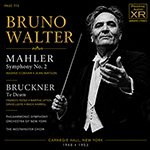
Cover artwork based on a photograph of Bruno Walter
Total duration: 1hr 43:10
Reviews
Fanfare — James A. Altena
Issue 50:1 (Sept/Oct 2026) · Read the original review
Bruno Walter left behind five recorded performances of Mahler’s “Resurrection” Symphony, four live accounts plus his studio version (which was his first stereo recording). In issue 36:3 I reviewed the Music & Arts issue of the earliest performance, from 1942, and provided basic information (including individual movement timings) about each of those performances. For convenience, here is a recap of the basics:
01/25/1942: Nadine Conner, Mona Paulee, NYP
05/15/1948: Maria Cebotari, Rosette Anday, VPO
12/05/1948: Nadine Conner, Jean Watson, NYP
02/17/1957: Maria Stader, Maureen Forrester, NYP
02/18/1957, 02/17 and 21/1958: Emilia Cundari, Maureen Forrester, NYP (studio)
Of these five performances, Walter’s 1957–58 studio account and the 1948 Vienna live performance have enjoyed multiple reissues (the Vienna one undeservedly so, as it is easily the worst of the five, with a superannuated alto soloist and the orchestra in poor form). The 1942 and 1957 live NYP performances have appeared only on Music & Arts CD issues. Until now, the scarcest version has been this one from 1948; it originally appeared on super-rare LPs from the Bruno Walter Society of Japan, and then in a four-CD set of mostly previously unissued Walter performances from Immortal Performances (IP) in Canada. I wrote the booklet notes for that set, and so Henry Fogel and Ken Meltzer reviewed it in my stead for issue 41:4. Both of them raved about it, with Fogel opining that this “seems to me to be by far Walter’s most dramatic and fiery Mahler Second performance to survive” and Meltzer adding, “This is more than a great performance. It is a precious historic treasure, a document of Bruno Walter helping to make Gustav Mahler a cornerstone of American symphonic repertoire.”
Richard Caniell at IP did an excellent job at the time with his remastering; but the technology in that realm has continued to advance, and Andrew Rose’s new XR remastering marks a major step forward. The major limitations on the IP issue were an extremely muddy bass register and dampened high frequencies. Rose has been able to remove much of the low-frequency murk and to open up the top, resulting in a significantly more natural sound without introducing any shrillness or harshness. There is also greater clarity of instrumental voices in the midrange. As before, the sound still remains somewhat poor for about the first 2:30 in the first movement, and then improves markedly. (I keep thinking that historic restoration has reached an asymptotic limit in its ability to prise improved sound out of decades-old grooves, and then a disc such as this comes along to prove me wrong. I can only wonder what another 20 years will bring, in the unlikely event I should live to hear the results.)
The performance itself remains a marvel. Although Walter’s studio account is his fastest rendition, this one has the greater febrile energy and plasticity of give-and-take that only a live performance typically provides. The vocal texts are sung in English translation rather than the original German. (Walter was always concerned that an audience understand whatever was being sung, and accordingly conducted English-language performances of Fidelio in 1945 and The Magic Flute in 1942, 1944, and 1956 at the Met, and of Bach’s St. Matthew Passion in 1943 and 1945 and the Brahms German Requiem in 1952 with the New York Philharmonic.) The Irish-Canadian alto Jean Watson (1909–after 1991) has good though not ideal clarity to her diction. In the past I was impressed with her voice as having the true alto character needed for her part; with the greater sonic clarity and amplitude Rose has provided, I can now also hear some edginess in her top notes. Watson was a good singer—she was the first Canadian to appear at Bayreuth, as Siegrune in 1955, and sang as a principal with the New York City Opera (NYCO) throughout the 1950s—but not one of Maureen Forrester’s rank. American soprano Nadine Conner (1907–2003, birth name Evelyn Nadine Henderson), who sang 249 performances at the Met in the 1940s and 1950s, does well with her smaller part. The diction of Conner and the Westminster Choir is clearer than before, but most of their lines remain indecipherable. (The translation printed in the NYP’s concert program leaflet can be viewed online at: https://archives.nyphil.org/artifact/4337640b-606e-41c8-84b2-4864d0fa158b-0.1/fullview#page/1/mode/2up. However, at points where the soloists and choir can be understood, it is clear that they are singing different words in the fifth movement than what is given in that leaflet.) Of course, the monumental choral finale cannot muster anything like the impact of a modern studio recording. But listeners willing to make allowances for a historic occasion will find this interpretation to be one to treasure.
Fittingly enough, Rose has chosen to couple the Mahler symphony with a remastering of Walter’s 1953 studio recording of Bruckner’s Te Deum. While the advance in sound quality over Sony’s most recent remastering is not great, additional spaciousness and warmth are present here due to the opening up of previously dampened higher frequencies. There are also two surviving live performances of the work with Walter, both with the Vienna Philharmonic. The first, from June 29, 1937, featuring Elisabeth Schumann, Enid Szantho (not Kerstin Thorborg, as is often mistakenly listed), Anton Dermota, and Alexander Kipnis, was given in Paris; it was recorded by HMV for commercial release, but Walter blocked its issue due to dissatisfaction with aspects of the performance. The second, from November 13, 1955, offered Hilde Güden, Hilde Zadek, Eric Majkut, and Gottlob Frick as the solo quartet. Both of those, especially the one from 1955, are far inferior to the superb 1953 studio version, which has remained a mainstay of the catalog ever since it first appeared despite being a monaural recording. Walter paces the work on the brisker side, with gravitas but not ponderousness, and secures clear, committed singing from his soloists and the choir. Of course, the New York Philharmonic once again offers a stellar turn of its own.
American soprano Frances Yeend (1913–2008) had a distinguished career at the NYCO and then the Met; American mezzo Martha Lipton (1913–2006) sang over 400 performances at the Met between 1944 and 1961, mostly comprimario parts, and made numerous recordings for Columbia. Mack Harrell (1909–1960) needs no introduction from me. The tenor has the lion’s share of the solo work, and David Lloyd is excellent. Rather confusingly, there were two noted tenors of that name who were active during the 1950s. This David Lloyd (1920–2013), originally named David Lloyd Jenkins, was an American; like Rossini, he was a “leap-year baby” born on February 29. He sang throughout the 1950s at New York City Opera and recorded with Walter, Bernstein, and Koussevitzky. He had a second career as a teacher and administrator in several music departments and companies, most notably as artistic director of Opera Saratoga from 1965–80. The other tenor was David George Lloyd (1912–1969), a Welshman who attained his greatest fame with recordings of Welsh folk songs and hymns, though he also was noted for his performances of Mozart, Verdi, and other opera composers. His career ended suddenly and tragically in 1954 when he tripped on a BBC sound stage, fell backward, and fractured his spine, requiring years of hospital stays for treatment. A brief attempt at a comeback in 1960 evinced a badly deteriorated voice.
Pristine provides a duofold cardboard digipak with the discs housed in cutaway pockets. A photo of Walter adorns the cover; the back has track, timing, and recording information; the website has brief notes plus music scores for the two works. The finale of the Mahler conveniently has a track break about halfway through, at 5:25 before the first entrance of the choir. For its sonic resurrection of the 1948 Mahler Second, this disc is a very strong candidate for my 2026 Want List; very highly recommended. James A. Altena
