

This album is included in the following sets:
This set contains the following albums:
- Producer's Note
- Full Track Listing
- Cover Art
Gustav Mahler’s Fourth Symphony occupies a special place both in the composer’s output and in Bruno Walter’s long career. Completed in 1900, it stands apart from the vast philosophical landscapes of the Second and Third Symphonies as a work of formal concentration, transparency and deceptive simplicity. Beneath its surface grace lies one of Mahler’s most subtle and elusive creations. Walter, who knew Mahler personally and worked closely with him in Vienna, remained one of the composer’s most persuasive interpreters, and few conductors brought greater authority to this music.
This live performance was given at Carnegie Hall on the afternoon of Sunday 4 January 1953, with the Philharmonic-Symphony Orchestra of New York, at a time when Walter’s late Mahler interpretations had reached full maturity. The programme opened with Mozart’s Symphony No. 35 in D major, the “Haffner”, before Mahler’s Fourth occupied the second half, with the Austrian soprano Irmgard Seefried as soloist in the finale.
Mahler came to regard the Fourth Symphony as one of his most finished creations. After the scale and complexity of the Third Symphony, he turned toward a world of greater concentration and clarity. As he told Natalie Bauer-Lechner, he was now satisfied to “pour my music into the customary molds somehow”, seeking containment rather than expansion. Yet this is no retreat. The Fourth distils Mahler’s imagination into a form lighter and more translucent, but no less profound.
Bruno Walter described the work beautifully in his book on Mahler: “In the fairy tale of the Fourth Symphony everything is floating and unburdened.” That sense of weightless motion is heard immediately in the sleigh bells and luminous opening movement, whose childlike freshness conceals remarkable structural subtlety. Walter avoids sentimentality or exaggeration; instead, the music unfolds with an inevitability that makes its simplicity feel all the more searching.
The second movement introduces “Freund Hein”, Death as a fiddler, represented by the solo violin tuned a tone higher than usual. Mahler described the music as a sudden shadow crossing the eternal blue of heaven: “It is only a sudden grisly feeling… the heavens… shine on, eternally blue.” Walter understands precisely this balance between innocence and unease. The grotesquerie is present, but never overstated; it passes like a brief chill across sunlight.
The slow movement remains one of Mahler’s most sublime inspirations, a set of variations of extraordinary serenity and inward radiance. Walter’s control of long line and orchestral breathing is especially remarkable here. The movement grows naturally toward its great climax without manipulation, its emotional force emerging through patience rather than rhetoric.
In the finale, the soprano enters with Das himmlische Leben, the child’s vision of heavenly life drawn from Des Knaben Wunderhorn. Here Irmgard Seefried proves an ideal partner. Her voice combines purity, warmth and intelligence, never treating the movement as decorative innocence but as something intimate and quietly knowing. Seefried had already sung the work with Walter at the 1951 Edinburgh Festival, and their partnership shows complete naturalness.
Reviewing an earlier performance from the same week, Olin Downes in The New York Times wrote that “Had Mahler been present… he would have rendered devout thanks.” Of Seefried he added that she was “a musician of the first class and an interpreter of the first class.”
Preserved from a remarkably fine radio broadcast source, this performance survives in sound of unusual warmth and presence for its period. Orchestral textures retain striking clarity, from the shimmer of the opening sleigh bells to the delicate transparency of the slow movement, while Seefried’s voice is caught with exceptional naturalness. Pristine’s Ambient Stereo XR remastering brings both space and immediacy, allowing Walter’s luminous balances and the orchestra’s tonal richness to emerge with rare vividness.
This 1953 performance captures Walter in one of the works most closely bound to his musical identity: humane, transparent, and free of self-display. Mahler’s Fourth can easily be made either too cosy or too portentous. Walter finds instead its perfect equilibrium, where joy and mystery, innocence and mortality remain suspended together.
WALTER conducts Mahler
1. RADIO Introduction (0:33)
GUSTAV MAHLER Symphony No. 4 in G major
2. 1st mvt. - Bedächtig (16:27)
3. 2nd mvt. - In gemächlicher Bewegung; Ohne Hast (8:51)
4. 3rd mvt. - Ruhevoll (19:10)
5. 4th mvt. - Sehr behaglich (8:13)
Live concert broadcast, Carnegie Hall, New York City, 4 January 1953
Irmgard Seefried, soprano
Philharmonic-Symphony Orchestra of New York
conducted by Bruno Walter
XR remastered by Andrew Rose
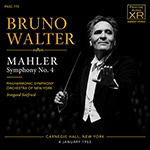
Cover artwork based on a photograph of Bruno Walter
Total duration: 53:14
Reviews
Fanfare — James A. Altena
Issue 50:1 (Sept/Oct 2026) · Read the original review
In just the previous issue, I reviewed an Archipel release (download only) of two New York Philharmonic concerts conducted by Bruno Walter, one of which included this Mahler symphony performance. I observed that little or no sound restoration seemed to have been performed in that release on the original sources, so that the primary reason for acquiring it was its addition of two new performances to Walter’s discography (Douglas Moore’s Symphony No. 2 and a live Beethoven “Emperor” Concerto with Rudolf Serkin to complement their 1941 studio recording), plus the first CD release of a third item (the overture to Weber’s Euryanthe), all three coming from the same concert in 1948. I also quoted and concurred with the lavish praise that Henry Fogel and Peter Rabinowitz showered on previous releases of this Mahler Fourth (most notably by Music & Arts). My verdict was to place this account “alongside the 1950 and 1955 Vienna Philharmonic versions (with Seefried and Hilde Güden as the respective soloists in those) as one of Walter’s three finest takes on this score. If slightly superior sonics and the very special sound of the Vienna Philharmonic in this music give those other two versions a very slight edge for preference, it is slight indeed, as conductor, soloist, and orchestra are absolutely inspired here.”
Well, as has happened before, Pristine Audio’s new release is a complete game-changer. Andrew Rose obtained a primary source recording (one that includes James Fassett’s brief broadcast introduction of the performers) with absolutely superb sound for its 1953 date. It exceeds in quality many radio broadcasts I’ve heard from 15 or even 20 years later, and Rose has enhanced it further with his signature XR remastering technology. The results offer wonderful immediacy, fullness, and naturalness, with exceptional depth and clarity of instrumental detail. (For example, soft pizzicato notes on the lower strings that previously were virtually inaudible are now readily heard. A couple of momentary, trivial instrumental slips have become discernable as well.) A concomitant though unavoidable disadvantage is that occasional coughing by some person at the front of the audience (especially in the first five minutes of the opening movement) also registers rather loudly. But in a performance of this splendor, that really doesn’t matter. The now greatly superior sonics of this recording vault it ahead of the two aforementioned Vienna Philharmonic performances to make it the version of choice for Walterians—and indeed, arguably the single greatest rendition of this work ever to appear in recorded form. That Seefried is in even more radiant voice than in the 1950 Vienna recording is icing on the musical cake. For every Mahlerian, this is now an indispensable item for his or her collection, and its entry into Fanfare’s Classical Hall of Fame amply warranted. (It is also likely to appear on my 2026 Want List.)
It is no wonder that there are no fewer than 12 extant recordings of this score with Walter—11 live plus the 1945 studio recording—for its unique intimacy among Mahler’s symphonies made it an especially apt fit to his conductorial gifts. There is, as always and above all, the humane warmth and singing lyricism of every Walter performance, built upon a strong bass foundation, with keen attention paid to bringing out inner instrumental lines and harmonies. Tempos are moderate, with subtle touches of rubato. Dynamics and articulation are finely shaded to match any given moment, and sectional balances are ideal. The virtuosity of the first chairs of the NYP is repeatedly evident. Throughout the faster movements, Walter maintains an ideal equilibrium between Mahler’s elements of innocence, droll humor, and subtle irony, with the last of these never slipping into a false sarcasm or cynicism that some other conductors mistakenly impress on the score. In the second movement, “Freund Hein” [Heinrich]—“Friend Henry,” a folkloric personification of Death as a fiddler, Walter properly has concertmaster John Corigliano, Sr. portray him as an elegant, witty gentleman (shades of Méphistophélès in the opening scene of Gounod’s Faust) rather than a sinister, menacing villain. In the finale, with seeming artlessness Seefried captures the perfect combination of dreamy innocence and wide-eyed excitement in a child’s notion of Heaven. Of course, the lengthy, slow, theme-and-variations third movement is the heart of the symphony, and it is here that Walter rises to especially great interpretive heights. This movement has specific and intense personal meaning for me—a subject upon which I expatiate in a “Music Matters” essay elsewhere in this issue for those who might be curious to know the details. Suffice it to say that Walter realizes all of my subjective understanding here to utter perfection.
As usual, the physical release comes in a cardboard digipak with a cutout pocket for the disc, adorned with a photo of Walter and including tracks, timings, and related information. A link to the musical score is provided on Pristine’s web site. I only wish that Rose had included as a filler either the Mozart Symphony No. 35 that opened the same concert, or something such as a remastering of Walter’s studio recording of the Kindertotenlieder with Kathleen Ferrier. Highest possible recommendation. James A. Altena
