
This album is included in the following sets:
This set contains the following albums:
- Producer's Note
- Full Track Listing
- Cover Art
"When this jolly old Grand Opera came to LP for the first time (except for an old Urania set) in Decca’s excellent version, which I reviewed in February, I let my pen fly along under the memory of childish enjoyments and no doubt wrote at too great a length and with undue enthusiasm of the old war horse. (I was duly snubbed.) Nor did I imagine that so soon I should have to be hearing it all over and over again. May my friendly admiration for the fustian but instinctively dramatic old work be taken for granted?
The Cetra cast is impressive and offers strong competition to the Cerquetti, Simionato, Del Monaco, Bastianini set-up on Decca. This Cetra recording is, I think, a shade brighter and often a little brittle. But both sets have plenty of perspective and atmosphere and the Cetra the rather better chorus (not that that really matters). Gavazzeni took certain things, for instance “Suicidio!”, rather more briskly than Votto, who is a “last-ouncer”. Under some of the more terrific solos and duets I could have done with more orchestral texture, but that is partly true also of Decca. One notices it in that terrific ladies’ slanging match on shipboard (“He’s mine!” “No, he’s mine, I saw him first”), where it is rather fun incidentally to hear Barbieri, in terrific form, ten times beefier than Simionato, actually “take away” the duet from Maria Callas — who wouldn’t often allow that to happen, I fancy. Simionato was a more delicate Laura than Barbieri, who hams it up a lot, though she sings "Stella marinar” affectingly. On the problem of Callas versus Cerquetti, I find I have to eat my words (honest, I hope), I said that I actually preferred Cerquetti’s “Suicidio!” to Callas’s, which at that time I knew only out of context on a 7-inch EP. In context, though plummy at the start and tremendously laboured, it is undeniably more exciting than Cerquetti’s more rapid and firmer, less melodramatic version. In spite of some painful high notes and unevenness of effect, Callas’s Gioconda is a marvellously vivid figure; everything is made memorable, convincing; everything is "dared” at its most exciting. I don’t want to seem to be going back on Cerquetti, but an aria such as “Suicidio” as the climax to a growing interpretation can sound quite different and much more artistic than when cut from its context.
How the rest of the two casts match up is largely a matter of opinion. Poggi’s attack, his accuti are unfailing. He sings very excitingly in the "Enzo Grimaldo” duet (Silveri, too, takes all his chances and is in good form, the equal of Bastianini). But Poggi cannot cope with “Cielo e mar”, or at least the musing and delicate aspects of it. He hollers. But then so does Del Monaco. Siepi is slightly preferable to the late Giulio Neri. In the Dance of the Hours (side 5) you can easily compare the two conductors. Votto is the more lush, the more given to a “telling” rubato. Some of his ensembles on this side sound congested, and though this is a decent pressing, I had a little trouble with groove jumping and pre-echoes. But anyone contemplating a complete Gioconda should examine and perhaps select this one."
P.H.-W, The Gramophone, December 1958
(NB. The UK release of this recording came some 6 years after it was made, 5 years after its original Italian issue.)
PONCHIELLI La Gioconda
disc one (54:01)
ACT 1
1. Preludio (5:02)
2. Feste e pane! (2:55)
3. E cantan su lor tombe! (2:02)
4. Figlia, che reggi Il tremulo piè (3:33)
5. L'ora non giunse ancor del vespro santo (2:54)
6. Polso di cerro! (3:42)
7. Suo covo è un tugurio (3:14)
8. Che? La plebe or qui si arroga (4:13)
9. Voce di donna o d'angelo (5:25)
10. Enzo Grimaldo, Principe di Santafior, che pensi? (2:59)
11. O grido di quest'anima (2:51)
12. Maledici? Sta ben ... l'amor t'accieca (2:16)
13. O monumento! (3:57)
14. Carneval! Baccanal! (2:30)
15. Angele Dei (6:28)
disc two (36:49)
ACT 2
1. Ho! He! Ho! He! Fissa Il timone! (4:01)
2. Pescator, affonda l'esca (1:27)
3. Pescator, affonda l'esca (2:35)
4. Sia gloria ai canti dei naviganti! (4:19)
5. Cielo e mar! (4:32)
6. Ma chi vien? (4:32)
7. Laggi nelle nebbie remote (2:26)
8. E il tuo nocchiere or la fuga t'appresta (0:43)
9. Stella del marinar! (2:11)
10. E un anatema! (0:34)
11. Là attesi e il tempo colsi (1:11)
12. L'amo come il fulgor del creato! (2:03)
13. Il mio braccio t'afferra! (1:35)
14. Maledizion! Ha preso il vol! (1:39)
15. Vedi là, nel canal morto (3:03)
disc three (75:29)
ACT 3
1. Si morir ella de'! (2:37)
2. Ombre di mia prosapia (2:26)
3. Qui chiamata m'avete? .... Bella così, madonna (3:14)
4. Morir! è troppo orribile! (2:57)
5. La gaia canzone (3:17)
6. O madre mia, nell'isola fatale (2:03)
7. Benvenuti messeri! Andrea Sagredo! (4:02)
8. Grazie vi rendo per le vostre laudi (1:33)
9. Prodigio! Incanto! (9:22)
10. Vieni! ... Lasciami! (3:12)
11. Già ti veggo immota e smorta (5:18)
ACT 4
12. Nessum v'ha visto? (5:27)
13. Suicidio! (4:37)
14. Ecco, il velen di Laura (5:04)
15. Ridarti il sol, la vita! (2:50)
16. O furibonda jena (2:42)
17. Ten va serenata (1:07)
18. La barca s'avvicina (2:00)
19. Quest'ultimo bacio che il pianto (4:47)
20. Ora posso morir. Tutto è compiuto (3:46)
21. Vo' farmi più gaia, più fulgida ancora (3:07)
CAST
La Gioconda - Maria Callas
Enzo - Gianni Poggi
Barnaba - Paolo Silveri
Laura - Fedora Barbieri
Alvise - Giulio Neri
La Cieca - Maria Amadini
Zuàne - Piero Poldi
Isèpo - Armando Benzi
Un Pilota - Piero Poldi
Chorus and Orchestra of RAI, Torino
conducted by Antonino Votto
Recorded 6 - 10 September, 1952, Auditorium della RAI, Torino
Ambient Stereo XR remastering by: Andrew Rose
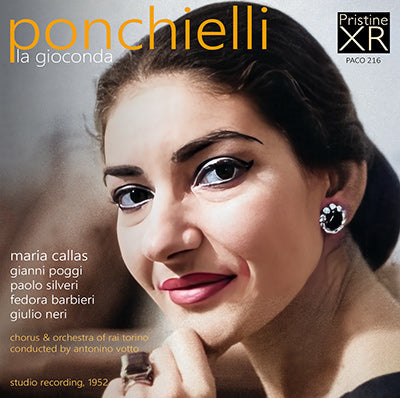
Cover artwork based on a photograph of Maria Callas
Total duration: 2hr 46:20

Review
Callas’s voice is more attractive sounding here than on all earlier issues ... The improvement is significant enough to warrant replacement
This 1952 studio recording was made for the Cetra label and is the first of two that Maria Callas made of La Gioconda . Both this set and EMI’s later stereo effort have been reviewed many times in Fanfare (you can find those reviews in the magazine’s online Archive). There is general agreement that her Gioconda was one of Callas’s significant achievements on disc, despite some vocal problems (a bit more so in the second recording).
For many, the main issue of interest here will be the sound quality of Pristine’s transfer. Does Andrew Rose’s XR Ambient Stereo remastering make a meaningful improvement on the last Warner transfer? (Warner represented a decided improvement on the dry Cetra original.) The answer is yes, and I think resoundingly so. The XR Ambient Stereo process is specifically designed to solve this kind of cramped, dry acoustic by adding a sense of space around singers and orchestra just as heard in the hall. An A-B comparison of Pristine’s remastering with Warner’s made clear that it provides a far more pleasant listening experience. Callas’s voice is more attractive sounding here than on all earlier issues.
This recording is important because Callas makes more of the character of Gioconda than anyone else on disc. Her soft singing at “Enzo adorate … ah! come t’amo” may not have the beautiful sheen offered at that moment by Zinka Milanov or Montserrat Caballé, but it is beautifully executed and is integrated into the entire scene rather than stopping the action as a standout vocal highlight. The dramatic power Callas displays in her big aria, “Suicidio!”, is in a different artistic realm than other singers inhabit. At first she spits out the words in a fury, but then her mood turns inward: she sings, “Or piombo esausta fra le tenebre” (“Now I fall exhausted into the darkness. To the task…. I now ask Heaven to let me sleep quietly in the tomb.”) Callas will break your heart with the way she empties her tone of body as the aria ends. Throughout the opera she demonstrates a mastery of color and inflection that makes her sui generis . She famously said about her Gioconda, “It’s all there, for anyone who cares to understand or wishes to know what I was about.” She was, in fact, referring to her second recording, but I think it is just as fitting for her first one.
In both sets she was saddled with a less-than-ideal supporting cast, in an opera that requires much better. The poorest partner from 1952 is tenor Gianni Poggi as Enzo. His voice is weathered, he occasionally sings under the pitch, and he emits a throttled sound that becomes tiresome quickly. “Cielo e mar!” is clumsy in its phrasing and unpleasant in its sheer vocalism. Fedora Barbieri is a fine Laura, however, and Paolo Silveri a decent enough Barnaba unless you have memories of Leonard Warren, Ettore Bastianini, and Robert Merrill. Giulio Neri’s Alvise is very strong, but Maria Amadini’s Cieca is thin-voiced and harsh. Callas’s later stereo recording is a bit more strongly cast but also not ideal.
Both recordings are led by Antonino Votto, a conductor who can serve as a definition of the term “routinier.” He understands the style and doesn’t really get in the way, but neither does he add anything meaningful to the performance. Things occasionally bog down, as in the “Dance of the Hours,” but Votto is frustrating more for what he does not do than for what he does.
The key factor here is Pristine’s restoration. This recording has always been a cornerstone of any Callas collection, and Pristine has improved upon all earlier editions, including even Naxos’s excellent version. The improvement is significant enough to warrant replacement. The CD comes with a note reproducing Philip-Hope Wallace’s 1958 Gramophone review (1958 brought the first British release of this recording).
Pristine releases are available from its website, pristineclassical.com, in a variety of streaming and download formats as well as CDs. Purchasing the recording in any form includes some substantial bonuses from Pristine. Anyone who buys the recording receives a download package which includes three PDF files: the full orchestral score, the vocal score (with piano accompaniment) and the original Italian libretto. In addition, purchasing the discs also entitles you to receive the MP3 version of the recording as a free extra to the discs.
Henry Fogel
