

This album is included in the following sets:
This set contains the following albums:
- Producer's Note
- Full Track Listing
- Cover Art
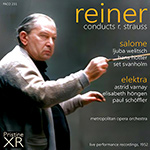
Fritz Reiner at the Metropolitan Opera: Richard Strauss Salome and Elektra
When Fritz Reiner conducted Richard Strauss’s Salome and Elektra at the Metropolitan Opera in the early 1950s, he brought to these uncompromising scores a combination of iron discipline and dramatic urgency that few conductors of the period could equal. These two one-act operas, composed within four years of one another, represent Strauss at his most extreme: orchestral writing of relentless intensity, vocal lines pushed to the limits of human endurance, and a dramatic language stripped of sentimentality. Reiner’s approach to this music was unsparing, precise, and unflinchingly modern.
The performances preserved here originate from Metropolitan Opera broadcasts given in 1952, later issued on vinyl in 1981. Although these recordings have long been valued by collectors, they deserve to be heard not merely as historical documents, but as major interpretative statements. Reiner’s command of large orchestral forces, allied to his absolute control of tempo and rhythm, brings a powerful sense of inevitability to both works. Nothing is allowed to sprawl or linger. Each scene unfolds with a taut dramatic logic that keeps the listener constantly aware of the music’s forward momentum.
Salome, first performed in 1905, remains one of the most shocking operas of its era. Its relatively brief duration conceals a densely compressed dramatic arc in which desire, obsession and brutality collide with terrifying speed. Under Reiner’s direction, the Metropolitan Opera Orchestra plays with exceptional clarity and bite. Tempi are firm, textures sharply etched, and climaxes precisely judged. There is no attempt to soften the score’s violence or eroticism. Instead, Strauss’s orchestration is presented with a hard, gleaming edge that heightens the opera’s sense of moral and psychological danger.
At the centre of the performance stands Ljuba Welitsch, whose Salome had already become one of the defining portrayals in the Metropolitan Opera’s history. Her performance combines vocal brilliance with an almost reckless dramatic immediacy. Welitsch captures both the character’s volatile youth and her chilling emotional detachment, moving effortlessly between sensuous lyricism and savage declamation. Reiner supports her without compromise, never cushioning the voice, and in doing so intensifies the sense of inexorable momentum that drives the opera towards its catastrophic final scene.
If Salome presents obsession as erotic fixation, Elektra pushes psychological extremity still further. Strauss’s 1909 score abandons almost all traces of lyrical consolation, replacing them with a dense, searing orchestral fabric and vocal writing of unprecedented intensity. Reiner’s Metropolitan Opera performance is notable for its unrelenting drive and structural focus. The music advances with grim inevitability, each episode locked into place with absolute rhythmic control, leaving little room for emotional release.
In the title role, Astrid Varnay delivers a portrayal of overwhelming dramatic force. Her Elektra is not merely a figure of hysteria, but a character consumed by purpose, driven by memory and vengeance rather than emotion alone. Varnay’s vocal authority and concentration are matched by Reiner’s uncompromising direction, which refuses expressive indulgence in favour of clarity and momentum. The result is a performance of almost frightening intensity, culminating in a final collapse that feels not cathartic, but brutally inevitable.
What unites both operas in these performances is Reiner’s refusal to sentimentalise Strauss. Where some interpretations seek to cloak this music in warmth or rhetorical breadth, Reiner insists on discipline, precision and dramatic coherence. The Metropolitan Opera Orchestra responds with playing of extraordinary focus, projecting Strauss’s massive orchestral forces with power but without excess.
Heard today, these performances reveal Strauss stripped of luxury and theatrical varnish. In Reiner’s hands, Salome and Elektra emerge as works of stark power and classical severity: unsparing, concentrated, and unforgettable. They stand as a testament not only to the conductor’s formidable authority, but to a moment in the Metropolitan Opera’s history when these radical works were performed with a directness and intensity that still feel startlingly modern.
REINER R. Strauss: Salome & Elektra
RICHARD STRAUSS – Salome
DISC 1 (62:44)
1. Scene I: Wie schön ist die Prinzessin Salome heute Nacht! (5:01)
2. Scene II: Ich will nicht bleiben (7:59)
3. Scene III: Wo ist er, dessen Sündenbecher jetzt voll ist (8:44)
4. Jochanaan! Ich bin verliebt in deinen Leib! (14:35)
5. Scene IV: Wo ist Salome (6:51)
6. Wahrhaftig, Herr, es wäre besser (7:22)
7. Tanz für mich, Salome (3:50)
8. Tanz der sieben Schleier (8:15)
DISC 2 (64:30)
1. Ah! Herrlich! Wundervoll, wundervoll! (11:49)
2. Ah! Du wolltest mich nicht deinen Mund küssen lassen, Jochanaan! (11:55)
Total duration: 1hr 31:49
Recorded live at the Metropolitan Opera, New York, 19 January 1952
Cast
Salome – Ljuba Welitsch
Jochanaan – Hans Hotter
Herodes – Set Svanholm
Herodias – Elisabeth Höngen
Narraboth – Brian Sullivan
Ein Page – Hertha Glaz
Erster Nazarener – Alois Pernerstorfer
Zweiter Nazarener – Emery Darcy
Erster Soldat – Norman Scott
Zweiter Soldat – Lubomir Vichegonov
Ein Cappadocier – Osie Hawkins
Ein Sklave – Paula Lenchner-Schmidt
Erster Jude – Gábor Carelli
Zweiter Jude – Thomas Hayward
Dritter Jude – Alessio De Paolis
Vierter Jude – Paul Franke
Fünfter Jude – Gerhard Pechner
Metropolitan Opera Orchestra
Conducted by Fritz Reiner
RICHARD STRAUSS – Elektra
DISC 2 (continued)
3. Wo bleibt Elektra? (5:54)
4. Allein! (9:17)
5. Elektra! (1:01)
6. Ich kann nicht sitzen (8:25)
7. Was heulst du? (1:55)
8. Was willst du? (10:42)
DISC 3 (65:44)
1. Ich habe keine guten Nächte (11:11)
2. Was bluten muß? (6:13)
3. Orest! Orest ist tot! (0:32)
4. Platz da! (3:00)
5. Wie stark du bist! (2:20)
6. Von jetzt an will ich deine Schwester sein (2:20)
7. Nun denn, allein! (1:16)
8. Was willst du, fremder Mensch? (8:27)
9. Orest! (12:28)
10. Seid ihr von Sinnen (3:40)
11. He! Lichter! (4:52)
12. Agamemnon hört dich! (3:24)
13. Wir sind bei den Göttern (6:01)
Total duration: 1hr 41:29
Recorded live at the Metropolitan Opera, New York, 23 February 1952
Cast
Elektra – Astrid Varnay
Chrysothemis – Walburga Wegner
Clytemnestra – Elisabeth Höngen
Aegisth – Set Svanholm
Orest – Paul Schöffler
Ein alter Diener – Lubomir Vichegonov
Ein junger Diener – Paul Franke
Die Schleppträgerin – Paula Lenchner-Schmidt
Die Vertraute – Jean Madeira
Der Pfleger des Orest – Alois Pernerstorfer
Die Aufseherin – Thelma Votipka
Erste Magd – Martha Lipton
Zweite Magd – Hertha Glaz
Dritte Magd – Lucine Amara
Vierte Magd – Mildred Miller
Fünfte Magd – Genevieve Warner
Metropolitan Opera Orchestra
Conducted by Fritz Reiner
XR remastered by Andrew Rose
Total duration (complete set): 3hr 12:58
Fanfare Review
(I didn’t dare listen to them in succession)
These two opera performances are a serious candidate for my year-end Want List. They have been revered by collectors since they were released on LP by the Metropolitan Opera in 1981 (at high fundraising prices) and have circulated on other labels over the years. I compared Pristine’s restoration with the Met’s own, which is the best of the earlier ones, and producer Andrew Rose has made a significant improvement. His XR Ambient Stereo process adds an extra degree of space to the sound. There have been a few other Pristine releases where I found that the process was applied too heavily, but here it is just right. Clarity and presence are not diminished, and the singers and orchestra sound as good as you could expect from 1952 AM radio broadcasts.
As for the performances, it is hard to know where to start. The singing ranges mostly from good to great, but I think the core of the success is Fritz Reiner’s conducting. In both Salome and Elektra a conductor typically emphasizes either the score’s lyricism or its madness. Reiner finds a way to bring both elements forward while retaining musical and dramatic unity. After the tension in the first half of the Recognition Scene in Elektra , after Elektra cries out the name “Orest,” the music turns warm and beautiful, and the Met’s orchestra caresses it with tender flexibility.
Similarly in the chaos just preceding Salome’s Dance of the Seven Veils, the lunacy of the situation is characterized by playing and singing of frenetic and incisive power. In the dance itself, the sickness underneath the sensuality never fully disappears, but neither does the sensuality get swamped. Throughout both operas, Reiner’s ability to ratchet tension to an almost unbearable degree makes the performances unforgettable. While there is evidence from many other Met broadcasts from the 1950s that the company’s orchestra was quite variable, here the players respond to Reiner as if mesmerized.
The word “legendary” is overused, but it applies to Ljuba Welitsch’s celebrated Salome from this period. Welitsch makes every word meaningful, and encompasses every shade of Salome’s girlishness, volatility, and emotional numbness. As she sings to Jokanaan’s head, the variety of inflection and color she employs demonstrates a rare mastery of dramatic singing. A 1949 Met performance released by Immortal Performances finds her in better voice. She was only 38 in the 1952 broadcast, but her vocal deterioration by the age of 40 was a great loss to the opera world, and signs of it are already present here. She has intonation issues (usually a touch sharp), and her high notes don’t soar the way they did just three years earlier.
Pristine was wise, nonetheless, to choose this Salome over the 1949. That performance represented Reiner’s debut, whereas by 1952 he and the Met orchestra had settled in with each other. The recorded sound is also superior to the 1949.
Hans Hotter’s Jokanaan is a monumental rendition, almost suffocating in its religious fervor. Set Svanholm brings a major voice to the role of Herod. Elisabeth Höngen may overdo the freneticism of Herodias, as she does with Klytämnestra in Elektra , but she is powerful and appropriately crazed in both roles.
Elektra was one of Astrid Varnay’s signature roles, and she was favored in it by conductors like Karajan, Mitropoulos, and Reiner. While she may not soar through the role’s demands in the upper register the way Birgit Nilsson did, Varnay presents the character’s stature more fully than any but a few others ever have. Elektra’s disgust at her mother, her attempt at sweetness with her sister as she tries to tempt her to join her pursuit of vengeance, her fury at the world in general but her tenderness toward her brother Orest, all of these are expressed powerfully. Like Welitsch, Varnay is not merely singing an operatic role here; she is completely inhabiting a character.
Walburga Wegner’s Chrysothemis is one of the few weak performances in this set. Her voice lacks tonal body, and she doesn’t make much of this rather fuzzily drawn character. Paul Schöffler is superb as Orestes, and the big Recognition Scene between him and Varnay is rightfully considered a highlight. As before, Svanholm brings a more important voice than we typically get for Aegisth, although more of his character is conveyed by Reiner’s emphasis of the music’s grotesqueness than by vocal shading on the tenor’s part.
While Pristine couldn’t get rid of all the compression and congestion in the original broadcasts, they have been minimized considerably. Strauss’s sumptuous orchestral writing is heard clearly enough to make its effect, and to make clear just how magnificent Reiner’s conducting is. No doubt collectors will want great modern-sounding recordings of both operas—Nilsson and Solti are the most standard recommendation—but it is hard to imagine anyone for whom Salome and Elektra are important not wanting to add this release to their collection. I was emotionally drained after hearing each opera separately (I didn’t dare listen to them in succession).
Henry Fogel
Fanfare, July/August 2026