
This album is included in the following sets:
This set contains the following albums:
- Producer's Note
- Full Track Listing
- Cover Art
Very occasionally the Metropolitan Opera strikes box office gold. In the 1930s the sell-out combination of Kirsten Flagstad and Lauritz Melchior in Tristan und Isolde proved crucial in keeping the opera house afloat during the depression. In the 1960s it was the pairing of Birgit Nilsson and Franco Corelli in Turandot that became the hottest opera ticket in New York. Both were relative newcomers to the Met: Nilsson made her house debut as Isolde in 1959, while Corelli made his as Manrico in Il Trovatore in 1961, just a year before this broadcast.
Although the Met had premiered Turandot as early as 1926, it had been out of the Met’s repertoire for thirty-one years until it was brought back in 1961. General Manager Rudolf Bing’s decision to bring the opera back into the repertory was inspired because he could showcase two of his greatest stars, whose usual repertoire tended not to overlap on stage together. Nilsson, with her cool, steely tone, was the perfect embodiment of the ice princess, while Corelli brings true Italianate passion and fire. Famously, they both hyped up a good-natured competition over who could either sing the loudest or hold the high notes the longest. Together they deliver Puccini’s music with full-throated power designed to thrill and excite even the most jaded of opera lovers. It is no surprise that both continue to hold the record for the most Met appearances as Turandot and Calàf.
The role of Liù is sung by Licia Albanese, in her last Met broadcast. Albanese sang almost all of the major Puccini heroines in her long career, and indeed had sung Liù during the Coronation season at Covent Garden in 1937 with Eva Turner in the title role. Albanese brings real pathos to the role, particularly so in the final act.
Conductor Kurt Adler was born in Bohemia and had a promising conducting career in central Europe before emigrating to the United States in 1938. Most of his Jewish family members, including his parents, died in the Holocaust. Adler was appointed chorus master at the Met in 1943 and between 1951 and 1972 he conducted more than 300 performances with the company.
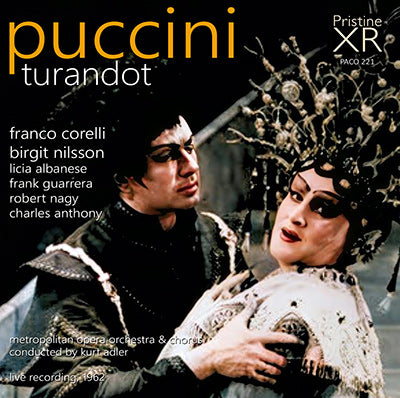
PUCCINI Turandot
disc one (77:36)
1. RADIO Opening announcement (0:21)
ACT ONE, SCENE ONE
2. Popolo di Pekino! (4:05)
3. Perduta la battaglia (1:20)
4. Gira la cote, gira, gira! (2:52)
5. Perché tarda la luna? (4:00)
6. O giovinetto! (4:18)
7. Figlio, che fai? (3:55)
8. Silenzio! (3:54)
9. Signore, ascolta! (2:40)
10. Non piangere, Liù (2:22)
11. Ah! per l'ultima volta! (3:02)
12. RADIO End of Act 1 - Start of Act 2 (1:28)
ACT TWO, SCENE ONE
13. Olà, Pang! Olà, Pong (3:18)
14. Ho una casa nell'Honan (3:28)
15. O mondo, pieno di pazzi innamorati! (4:18)
16. Udite trombe! Altro che pace! (4:16)
ACT TWO, SCENE TWO
17. Un giuramente atroce mi costringe (4:07)
18. Popolo di Pekino! (1:35)
19. In questa Reggia (2:39)
20. O Principi, che a lunghe caravane (3:29)
21. Straniero, ascolta! (4:32)
22. Gelo che ti dà foco (3:04)
23. Figlio del cielo! (2:54)
24. Tre engmi m'hai proposto (4:06)
25. RADIO End of Act 2 (1:32)
disc two (40:57)
ACT THREE, SCENE ONE
1. RADIO Start of Act 3 (0:34)
2. Cosi comanda Turandot (3:10)
3. Nessun dorma! (3:24)
4. Tu che guardi le stelle (4:17)
5. Principessa divina (2:48)
6. Quel nome! (1:30)
7. Tanto amore segreto (3:24)
8. Tu, che di gel sei cinta (3:06)
9. Liù...Liù...sorgi! (4:31)
10. Principessa di morte! (3:27)
11. O mio fio mattutino (4:22)
ACT THREE, SCENE TWO
12. Diecimila anni al nostro Imperatore! (3:51)
13. RADIO Closing announcement (2:31)
CAST
La principessa Turandot - Birgit Nilsson
Calaf - Franco Corelli
Liù - Licia Albanese
Ping - Frank Guarrera
Pang - Robert Nagy
Pong - Charles Anthony
Timur - Ezio Flagello
L'imperatore Altoum - Alessio De Paolis
Un mandarino - Calvin Marsh
Chorus and Orchestra of the Metropolitan Opera
conducted by Kurt Adler
Broadcast live on 24 February 1962 from the Metroplitan Opera House, New York City
Radio announcer: Milton Cross
XR remastered by: Andrew Rose
Cover artwork: Franco Corelli & Birgit Nilsson
Total duration: 1hr 58:33
Review
Pristine’s is the edition I will turn to
From 1961 to 1967 the Metropolitan Opera’s production of Puccini’s Turandot starred Birgit Nilsson and Franco Corelli, as ideal a bit of casting as is possible for that opera. The new production was supposed to be conducted by Dimitri Mitropoulos, but he died in 1960 and Rudolf Bing decided on another celebrity conductor, Leopold Stokowski. That did not work out too well, and for a few seasons the opera was conducted competently by Fausto Cleva and somewhat less so by chorus master Kurt Adler. In 1966 Bing engaged the young Zubin Mehta, who brought to the podium the same musical glamor and excitement that the two leads brought to the stage. That performance, with Mirella Freni as Liù, deserves but has not received the level of sonic restoration bestowed on this 1962 broadcast, first from Immortal Performances a year ago and now from Pristine. I entered the Living Stage release of the 1966 Mehta broadcast (LS 4035158) into Fanfare ’s Hall of Fame.
A direct comparison between Mehta’s reading and Adler’s vividly demonstrates the difference between committed, imaginative conducting and time-beating. Mehta knows how to lean into phrases, how to shape the ebb and flow of the music over both short spans and full acts. He clearly understands the importance of orchestral balance and color. He maintains intensity at soft dynamic levels rather than letting the tension go limp. Under Adler, particularly when Nilsson, Corelli, and Albanese are not singing, the music just moves along until the next vocal highlight. To give one example, the scene with Ping, Pang, and Pong that opens act II has impetus and an appropriately macabre quality under Mehta; under Adler, the scene is so ordinary that we want it to get out of the way so we can hear the Riddle Scene.
Even so, this remains a thrilling performance. I reviewed Immortal Performances’ release, which has some fine bonus material as well, in Fanfare 47:5. I was very positive about the quality of sound on that version, but I must admit that Andrew Rose’s XR remastering here is an improvement. Perhaps Pristine had access to a superior source, because the range of color from both the orchestra and singers is wider and more vividly presented, and the added XR stereo hall ambience provides a convincing sense of space around the performers.
Nilsson and Corelli made a studio recording of Turandot for EMI, and if there were no live recordings, it would certainly do. However, because of Francesco Molinari-Pradelli’s pedestrian conducting and an overall studio-bound flatness, the EMI set is frankly less desirable than any of the live performances with these two singers. Nilsson and Corelli exhibit a wider range of dynamic shading than one might have expected. Nilsson’s ability to color her voice in “In questa reggia” to convey Turandot’s anguish over the torment her ancestor suffered, and the added warmth in her tone in the final scene when the Ice Princess melts, will surprise those who think of Nilsson only in terms of her steely power and brilliant high notes. As for Corelli, he too displays both power and sensitivity; some of his soft singing is exquisitely beautiful. There is a reason that for the decade of the 1960s, in Italy as well as at the Met, these two dominated productions of Turandot .
Uniquely, this particular broadcast is the only example we have of Licia Albanese as Liù. She was known for her affinity with Puccini’s heroines and her uncanny ability to reflect the combination of strength and fragility that almost all of them exhibit, particularly Liù. There are sopranos who sang this music with a more classically beautiful timbre, but none with the specificity of inflection and phrasing that matches Albanese.
The rest of the cast is superb. Ezio Flagello is almost luxury casting as Timur, and long-time Met stalwarts Frank Guarrera, Robert Nagy, and Charles Anthony are distinguished as Ping, Pang, and Pong. The same goes for Alessio De Paolis as the Emperor.
For collectors who own the Immortal Performances issue, the question is whether Pristine’s is different enough to warrant replacement. That has to be a personal decision, aided by listening to the sample excerpt provided at its website, pristineclassical.com. As much as I admire the work of Immortal Performances, and appreciate the added bonus material, when I want to hear this performance, Pristine’s is the edition I will turn to. Now, would somebody please lavish as much attention on the 1966 Mehta broadcast?
Purchasing this recording from the website includes a download package with three PDF files: the full orchestral score, the vocal score with piano accompaniment, and the original Italian libretto.
Henry Fogel
