

This album is included in the following sets:
This set contains the following albums:
- Producer's Note
- Full Track Listing
- Cover Art
On 6 April 1962, London heard Herbert von Karajan conduct the Vienna Philharmonic Orchestra in Mozart’s “Jupiter” Symphony and Bruckner’s Seventh at the Royal Festival Hall, in a concert broadcast by the BBC and remembered at once as an occasion of uncommon weight. More than sixty years later, what survives on this recording is not simply a performance of Bruckner’s Seventh, but the sound of a major musical encounter: Karajan, already one of Europe’s defining conductors, leading an orchestra whose authority in Austro-German repertoire seemed almost hereditary.
The atmosphere in the hall was vividly caught by Neville Cardus in The Guardian, who described “a packed raving audience” assembled for Karajan and the Viennese. Cardus, never one to miss the theatrical element in musical performance, saw Karajan as an imposing presence, apparently immovable before the massed players, able by force of personality alone to command total attention. Even that may have understated the sense of anticipation. The Vienna Philharmonic was not merely admired in London. It was heard as a carrier of tradition, a unique sound-world in itself.
That sound made an immediate impression. Writing in The Observer, Peter Heyworth called the orchestra “once more incomparable among the great orchestras of the world”, praising above all the individuality of its tone and manner of playing. He pointed to its capacity not “to glitter but to blend”, and to the sumptuous, rounded sonority that gave the performance its special character. Donald Mitchell in The Daily Telegraph responded in similar fashion, marvelling at the “warmth of the lower strings” and the thrilling vibrancy of the brass, while Richard Last in the Daily Herald wrote of the brass section’s “Day of Judgment sound”. Again and again, contemporary responses return to the same thing: not merely brilliance, but colour, weight, blend and grandeur.
If the first half of the concert drew more qualified admiration, the second seems to have carried the evening to another level. Mozart’s “Jupiter” Symphony was widely respected for its finish and beauty of line, but several critics found it too upholstered, too soft-grained, too little touched by classical tension or vitality. In Bruckner, however, conductor and orchestra appeared to meet on native ground. Here the long line, the breadth of phrasing and the patient accumulation of sonority all became virtues of the highest order.
Mitchell’s verdict was unequivocal: this was “a consistently brilliant and often noble performance”, and “London has not heard a Bruckner performance of this quality for years.” He singled out Karajan as “a master of the long phrase”, able to shape Bruckner’s huge spans with continuity and purpose, and described the great Adagio as “the crown of the interpretation”. Heyworth, too, was deeply impressed, writing that in the Seventh “the orchestra covered itself with glory”, and that “the splendour of its playing in the Bruckner was prodigious”. Most tellingly of all, he judged Karajan “a master not merely of sound but of architecture”, a phrase that goes to the heart of what this performance still communicates. For Bruckner’s Seventh depends not only upon sonority, however magnificent, but upon the shaping of great musical paragraphs, the balancing of immense spans and the controlled release of cumulative power.
Cardus, characteristically, heard both the splendour and a hint of artifice. He admired the way Karajan could make phrases seem to levitate, and called the Adagio “truly feierlich”, with its coda lamenting Wagner’s passing rendered with particular eloquence. Yet he also wondered whether the performance might be “a little self-consciously presented”, and detected in places a certain heaviness of tension and tempo. Heyworth likewise felt that the Scherzo lacked something in elemental force, and that the Trio was slightly sentimentalised. Such reservations are revealing, and valuable. They remind us that this was no neutral, objective traversal, but a distinctly profiled interpretation: grand, moulded, richly expressive, and unmistakably Karajan.
That, finally, is what gives this 1962 performance its documentary and musical fascination. Here is Karajan before a London audience, leading the Vienna Philharmonic in music central to its identity, and doing so with a command of line, texture and climax that contemporary critics recognised at once as exceptional. If there were qualms about polish, self-awareness or softness at the edges, they were voiced in the presence of something larger: a reading of Bruckner’s Seventh that struck London as a major event. The decades have not diminished that impression. If anything, they have allowed us to hear more clearly what those first listeners heard: noble breadth, sovereign orchestral playing, and Bruckner spoken in a voice of immense authority.
```
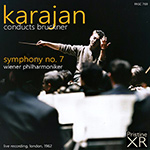
KARAJAN conducts Bruckner
1. RADIO Introduction (1:22)
BRUCKNER Symphony No. 7 in E major, WAB 107
2. 1st mvt. - Allegro moderato (18:54)
3. 2nd mvt. - Adagio: Sehr feierlich und sehr langsam (22:15)
4. 3rd mvt. - Scherzo: Sehr schnell - Trio: Etwas langsamer (10:01)
5. 4th mvt. - Finale: Bewegt, doch nicht schnell (11:43)
Vienna Philharmonic Orchestra
conducted by Herbert von Karajan
XR remastered by Andrew Rose
Live concert broadcast recording, 6 April 1962, Royal Festival Hall, London
Total duration: 64:14
Reviews
Fanfare — James A. Altena
Issue 50:1 (Sept/Oct 2026) · Read the original review
This performance previously was released by ICA in 2013, along with the Mozart “Jupiter” Symphony that preceded it on the concert. Gavin Dixon gave that set the back of his hand in 37:2: “The sound of the orchestra is clear but not particularly involving…. The thinness of the orchestral sound, especially the strings, compromises Karajan’s reading throughout…. Some of the playing is a bit scrappy too, at least by this orchestra’s standards…. An interesting historical release then, but hardly an essential one…. separated from his studio versions only by the smallest of interpretive details.”
My verdict is very different. It doubtless helps that Andrew Rose, with his trademark XR remastering, has given the sound fullness, spaciousness, warmth, and extra elucidation of detail over the ICA release. Also, I cannot claim to be fully au fait with most of Karajan’s Bruckner discography. Concerning the Seventh, I have heard his three studio and live versions for EMI and DG, plus the performance in the recently released Berlin Philharmonic box of live Karajan recordings; but those comprise only four of the 13 Bruckner Sevenths that colleague Huntley Dent mentioned in a review of another live performance in 44:6. I was not impressed by any of those four performances, finding them glassy in texture and emotionally sterile. This account is quite another matter; it is stunning in its electricity and passion. Although the tempos are quicker than in any of Karajan’s other performances, there is no sense of anything being hurried; everything unfolds with a sense of monumental grandeur, yet without ever flagging in energy or momentum. All four movements come off as perfectly proportioned, both within themselves and to one another (for once the finale does not seem too short); but of course the Adagio properly forms the work’s heart, and the sheer intensity of this rendition left me at its end feeling quite wrung out. As for the playing, the strings, woodwinds, and brass all are luminous; if occasionally there is a momentary rough edge due to fatigue, that is a very small price to pay, and most live historic performances should have instrumental execution at this level of excellence. As usual, Pristine offers the disc in a cardboard digipak, with the score provided online; the original preceding BBC radio broadcast announcement is included in the release. This is a serious candidate for my 2026 Want List; emphatically, urgently recommended. James A. Altena