

This album is included in the following sets:
This set contains the following albums:
- Producer's Note
- Full Track Listing
- Cover Art
By the late 1930s the National Broadcasting Company had created something unprecedented in American musical life: a full-time symphony orchestra assembled specifically for radio. The NBC Symphony Orchestra was formed in 1937 primarily for the broadcasts of Arturo Toscanini, but before Toscanini’s first appearance on Christmas Day of that year the orchestra needed to be tested, disciplined and moulded into a working ensemble. That crucial preparatory work fell largely to the Polish conductor Artur Rodziński.
Rodziński had already established a formidable reputation in the United States through his transformative leadership of the Cleveland Orchestra. NBC engaged him first for a trial broadcast in November 1937, followed by three concerts in December that effectively served as the orchestra’s public dress rehearsal before Toscanini assumed the podium. Rodziński returned to conduct further NBC Symphony broadcasts in April 1938 and again in December of the same year. The present recordings preserve the last two of four concerts he conducted on consecutive weekends that December.
These broadcasts therefore represent the closing chapter of Rodziński’s brief but significant association with the NBC Symphony Orchestra. The New Year’s Eve programme heard here would prove to be the final concert he conducted with the ensemble.
The Christmas Eve broadcast opens atmospherically with the Prelude to Humperdinck’s Hänsel und Gretel, music whose luminous orchestral writing made it a favourite seasonal curtain-raiser. From there Rodziński turns to Johann Sebastian Bach as orchestrated by Ottorino Respighi. Respighi’s Bach transcriptions were widely admired in the early twentieth century for their rich orchestral palette, and here two chorales from the set of Three Chorales were performed: Nun komm, der Heiden Heiland and Wachet auf, ruft uns die Stimme.
The central work of the programme is Beethoven’s First Symphony, music that bridges the Classical world of Haydn and Mozart with the emerging individuality that would soon transform the symphonic form. Rodziński follows it with one of the most striking orchestral transformations of the twentieth century: Arnold Schoenberg’s orchestration of Brahms’s Piano Quartet in G minor. Schoenberg explained that one reason for making the arrangement was that he wanted to hear everything in Brahms’s densely written score more clearly than was possible in the original chamber version. The result is a dazzling re-imagining of the work in which Brahmsian architecture is expanded into a vibrant orchestral showpiece.
The New Year’s Eve broadcast presents an equally colourful programme. It begins with Alexander Siloti’s orchestral arrangement of a concerto from Antonio Vivaldi’s L’estro armonico. Siloti’s late-Romantic treatment of the Baroque original reflects the era’s fascination with adapting earlier music to the modern symphony orchestra.
From there Rodziński launches into Alexander Scriabin’s Third Symphony, Le Divin Poème, a vast mystical canvas whose ecstatic climaxes and shimmering orchestration stand at the threshold of musical modernism. Scriabin’s ecstatic vision is followed by a sequence of orchestral miniatures: Ravel’s nostalgic Pavane pour une infante défunte and two movements from Debussy’s Nocturnes, Nuages and the exuberant Fêtes.
The concert concludes in celebratory fashion with the first waltz sequence from Richard Strauss’s Der Rosenkavalier, music whose swirling Viennese rhythms provided a fitting close to a New Year’s Eve broadcast.
The original transmissions were introduced by NBC announcer Gene Hamilton. His commentary survives in full on the source recordings, but because the complete broadcasts run slightly longer than a standard compact disc allows, much of this material has been edited here in order to accommodate the music within a single CD. Short excerpts of Hamilton’s introductions to the Christmas Eve concert and his closing remarks at the end of the New Year’s Eve broadcast have been retained.
Despite their broadcast origins the surviving recordings are remarkable for their warmth, dynamic range and clarity. In these new XR remasterings the sound reveals impressive orchestral colour, with quiet surfaces and extended frequency range that allow Rodziński’s incisive conducting and the NBC Symphony Orchestra’s brilliance to emerge with striking immediacy.
These final NBC broadcasts not only complete Rodziński’s recorded association with the orchestra but also offer a vivid glimpse of American orchestral broadcasting at the end of the 1930s.
RODZINSKI NBC 1938, Volume 4
disc one (79:45)
1. RADIO Introduction to Christmas Eve Program (0:28)
2. HUMPERDINCK Hänsel und Gretel - Prelude (8:00)
BACH (arr. Respighi) Chorales from the Orgelbüchlein
3. Nun komm, der Heiden Heiland, BWV 659 (5:38)
4. Wachet auf, ruft uns die Stimme, BWV 645 (4:10)
BEETHOVEN Symphony No. 1 in C major, Op. 21
5. 1st mvt. - Adagio molto - Allegro con brio (6:46)
6. 2nd mvt. - Andante cantabile con moto (6:56)
7. 3rd mvt. - Menuetto: Allegro molto e vivace (3:27)
8. 4th mvt. - Finale: Adagio - Allegro molto e vivace (5:43)
BRAHMS (arr. Schoenberg) Piano Quartet No. 1 in G minor, Op. 25
9. 1st mvt. - Allegro (13:44)
10. 2nd mvt. - Intermezzo: Allegro ma non troppo - Trio: Animato (8:51)
11. 3rd mvt. - Andante con moto (8:35)
12. 4th mvt. - Rondo alla zingarese: Presto (7:26)
disc two (78:01)
VIVALDI (arr. Siloti) Concerto in D minor
from L’estro armonico, Op. 3 No. 11, RV 565
1. 1st mvt. - Allegro (5:33)
2. 2nd mvt. - Adagio e spiccato (4:37)
3. 3rd mvt. - Allegro (3:22)
SCRIABIN Symphony No. 3 in C minor, Op. 43 - Le Divin Poème
4. 1st mvt. - Lutte (17:05)
5. 2nd mvt. - Voluptés (8:11)
6. 3rd mvt. - Jeu divin (9:47)
7. RAVEL Pavane pour une infante défunte (6:17)
DEBUSSY Nocturnes
8. Nuages (8:35)
9. Fêtes (6:01)
10. R. STRAUSSDer Rosenkavalier Waltzes - First sequence (7:55)
11. RADIO Conclusion to New Year's Eve Program (0:38)
NBC Symphony Orchestra
conducted by Artur Rodziński
XR remastering by: Andrew Rose
Live broadcast recordings, 24 & 31 December 1938
Studio 8H, NBC Radio City, New York
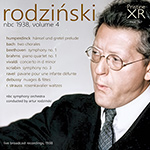
Cover artwork based on a photograph of Artur Rodziński
Total duration: 2hr 37:46
Reviews
Gramophone Review
Pristine Classical continues to dazzle us with astoundingly vivid broadcast recordings from the NBC Symphony in 1938.
Pristine Classical continues to dazzle us with astoundingly vivid broadcast recordings from the NBC Symphony in 1938 under the direction of the orchestra’s principal trainer prior to the arrival of Toscanini, Polish-born Artur Rodziński. Volume 4 features concerts from Christmas Eve and New Year’s Eve with a host of significant works. Vivaldi’s Concerto grosso in D minor, Op. 3 No. 11, is broadly paced and very emphatically played - ‘old style’ Baroque with cast-iron biceps and steel-capped boots, very ‘physical’ you might say, but with little in the way of period awareness. Beethoven’s First Symphony is lean and virile, swift too, and although Rodziński drops the first movement’s exposition repeat (and the repeat in the second movement), he includes the repeat of the Scherzo’s Trio and the finale. The playing is mostly deft and well drilled, but some might find the orchestra’s tense delivery just a little uncomfortable. By way of a contrast, I turned to Eugene Ormandy’s Sony recording from early 1965 (reissued in Sony’s box-set ‘Eugene Ormandy and the Philadelphia Orchestra: The Columbia Stereo Collection 1964-1983’) - the first movement in particular - and sat back to relish afresh the music’s poise, classical composure and keenness of attack. Energy and precise pointing are in plentiful supply there too, but ‘tenseness’ doesn’t really come into it. Here Rodziński is thrilling but breathless.
The set’s opening number is a lively and musically sympathetic account of the Prelude to Humperdinck’s fairy-tale opera Hänsel und Gretel, where Rodziński appreciates both the music’s lyrical flow and its affectionately up-beat faster music. Two Bach chorales orchestrated by Respighi draw a generous sonority from the NBC strings (parallels with Stokowski spring to mind) and there’s a rare showing (certainly in terms of this orchestra) where Brahms’s First Piano Quartet in G minor, Op. 25, is presented in Schoenberg’s affectionately OTT orchestration. Rodziński indulges the Andante con moto slow movement with considerable warmth then makes an enthusiastic beeline for Schoenberg’s colourful take on the Rondo alla zingarese finale, with its brittle xylophone and varied perspectives (at times returning to solo strings from Brahms’s original). An appreciative audience signals a definite ‘thumbs up’ and the orchestra acquits itself brilliantly.
Rob Cowan
Gramophone, July 2026
Fanfare — Jerry Dubins
Issue 50:1 (Sept/Oct 2026) · Read the original review
Artur Rodziński (1892–1958) is a bit before my time, and these live radio broadcasts went out over the airwaves well before I was born. I do see from the Fanfare Archive, however, that I reviewed another Pristine album in 43:3, containing performances of Beethoven’s Piano Concerto No. 3 and Brahms’s Piano Concerto No. 1 with Rudolf Serkin and Rodziński leading the New York Philharmonic in “live” recordings dating from 1945 and 1946. My review was generally positive, if somewhat less enthusiastic about the Brahms than the Beethoven, though my critical remarks had more to do with the pianist’s cursory reading of the score than they did with the conductor’s leading of it. Serkin can be heard in at least six recordings of Brahms’s D-Minor Concerto, and the “live” air check with Rodziński is probably not the best of them.
Having just submitted for this same Fanfare issue a 10-disc Eloquence set devoted to George Szell, a conductor despised for making the lives of his musicians miserable, and by more than one account a horrible, deplorable human being, I now take up the case of Artur Rodziński, a conductor who, by all accounts, was not much more likable than Szell, but at the outset at least, was well received by audiences, critics, and the musicians who played under him.
That said, not all was sweetness and light backstage in the concert halls and at meetings in the board rooms of orchestras’ trustees, where stabbings in the back not infrequently escalated into stabbings in the front. Rodziński’s public persona may have been more that of a mild-mannered, soft-spoken gentleman than that of Szell, but out of the public eye, he was not the go-along-to-get-along sort of guy he appeared to be.
From what I’ve read, I suspect that a large part of the problems Rodziński confronted in New York, Philadelphia, and Chicago was jealousy—not his, but that of the big-ego, and in the case of Stokowski, big-hair, conductors that Rodziński was hired to assist in rehearsals and preparation of the musicians for the interpretations their regular, permanent conductors would bring to their concerts. Rodziński’s podium demeanor and obvious talent led to his being kept in the wings, so to speak, by the insecurities of those who had originally “brung him to the dance.”
His first dance partner was Stokowski, who “discovered” the Polish Rodziński shortly after WWI and invited him to be his assistant with the Philadelphia Orchestra. From there, in fairly rapid succession, he found himself leading the Los Angeles Philharmonic, the Cleveland Orchestra, the New York Philharmonic, and the Chicago Symphony Orchestra. Rodziński was also instrumental—no pun intended—in grooming the NBC Symphony Orchestra for the arrival of the royal from Italy, Arturo Toscanini. Having done all the prep work, he received little credit for it beyond a “thank you and you can go now.” Which he did, resigning his post in Cleveland at the time and accepting an offer to lead the New York Philharmonic as music director in 1943.
That lasted only four seasons. Rodziński’s tenure was not without its controversies and head-butting, primarily with the orchestra’s manager, Arthur Judson. Rodziński wanted more control over personnel hiring and firing, as well as over concert repertoire and programming, areas over which Judson was not willing to cede much territory. So, Rodziński resigned from his position in New York, his job-hopping next taking him to Chicago, where he was appointed music director of the orchestra there. From the kettle into the fire: he lasted in Chicago for only a single season. The Windy City’s orchestra management was even more tone-deaf to Rodziński’s ideas than Judson had been in New York.
What were some of the suggestions Rodziński put forth that were so controversial? Well, for starters, he felt that programming ought to include more modern works by Debussy, Ravel, Berg, Shostakovich, and even American composers—this was the late 1930s and early 1940s. He was also of a mind that opera should be part of the orchestra’s and audience’s diet. To that end, he had secured the American rights to Shostakovich’s opera Lady Macbeth of Mtsensk, beating Stokowski, his onetime mentor, to the punch, and giving the American premiere of the opera with the Cleveland Orchestra in 1935, only a year after it debuted in the Soviet Union. Contrary to management’s misgivings, the performance was a success, well received by critics and audience alike.
But perhaps the most shocking of Rodziński’s controversial notions (considering the culture’s male chauvinism) was actually quite practical and down to earth. Noting how the ranks of male musicians had been decimated by the military draft during WWII, Rodziński proposed a quite logical solution: hire women to fill the shortage, saying that they would be “an excellent addition to any first class symphony orchestra” [Donald Rosenberg, The Cleveland Orchestra Story: Second to None]. Rodziński championed equal treatment for women in all fields of classical music from early in his career: “It makes no difference,” he’s quoted as saying, “there are no rules, women surely can be just as great artists as men ... if they have talent or genius, they are all the same.”
Needless to say, orchestra managers recoiled at the thought, but Rodziński’s idea would eventually come to fruition, and in a big way. Almost every major American orchestra today is well supplied with women players, often in first-desk, principal positions.
After the debacle in Chicago—Rodziński didn’t resign, his contract was terminated—he soured on the behind-the-scenes politics of the American classical music scene and returned to Europe, settling in Italy. I’m not sure things were any different there than there were in the States. Petty rivalries, jealousies, and competing for power and control seem to be universal human curses. In any event, suffering from heart failure, Rodziński made his way back to the U.S. for the last time in November of 1958 to conduct performances by Chicago’s Lyric Opera of Wagner’s Tristan und Isolde, dying shortly thereafter in a Boston hospital.
It’s easy to say that Rodziński was a larger and more important figure in the world of conductors than his reputation and recorded legacy would lead one to believe, and that his career was hindered by authoritarian orchestra managers, bean-counting boards of directors, and professional rivals who resented his talent. But as I said earlier, backstage and behind the scenes, Rodziński was not a go-along-to-get-along kind of guy. He was, to some extent, a victim of his own uncompromising demands. Some might call it integrity, but he was not entirely innocent of the furors and feuds that were of his own making.
The NBC Symphony Orchestra was born in 1937, its mission in life predestined to be the first of its kind in America—a full-time symphony orchestra assembled specifically for the radio broadcasts that would be led by Toscanini. But according to the album note, “Before Toscanini’s appearance on Christmas Day of that year, players needed to be hired, and the orchestra needed to be tested, disciplined, and molded into a working ensemble. The crucial preparatory work fell largely to the Polish conductor Artur Rodziński.” In other words, he’d been recruited essentially as a répétiteur to whip the players into shape for the real maestro to come. If I sound somewhat cynical saying that, it’s because it strikes me that a conductor of lesser stature than Rodziński would have sufficed for the job. I don’t know how Rodziński himself felt about it. But the question must have crossed his mind: Why wasn’t he chosen instead of Toscanini to lead the newly formed NBC Symphony Orchestra he had been charged with putting together?
Anyhow, just prior to Toscanini’s arrival, Rodziński gave three actual concerts with the orchestra as trial runs—dress rehearsals, if you will—to ensure that all was ready for the hand-off of batons. Toscanini approved of Rodziński’s work and held him in high enough esteem that Rodziński was engaged to conduct the orchestra in four additional concerts over the course of 1938.
Reviewing the contents of this two-disc set is a fairly straightforward exercise. The two-disc set documents the last two of those four concerts, given successively on the two last Saturdays of 1938—Christmas Eve, 12/24, and New Year’s Eve, 12/31, the latter being the conductor’s final appearance with the NBC Symphony Orchestra.
Disc one opens with a spoken introduction to the Christmas Eve concert, which, oddly perhaps, doesn’t seem very Christmasy, unless the two Bach chorales, arranged for orchestra by Respighi (another oddity in itself) are meant to serve that purpose.
Next comes the Prelude to Humperdinck’s opera, Hansel and Gretel, followed by Beethoven’s Symphony No. 1, and Schoenberg’s orchestration of Brahms’s Piano Quartet No. 1
Disc two kicks off with the Siloti arrangement of Vivaldi’s D-Minor Concerto, RV 565, No. 11 of the 12 concertos from the composer’s L’estro armonico. Just put out of your mind why it needed arranging, and accept the fact that Siloti gave it the full treatment—“a lush orchestration, including woodwinds and organ, expanding Vivaldi’s chamber work into a grand, late-Romantic style suitable for modern symphony orchestras.” The point to performing it was to showcase the well-oiled, magnificent machine that the NBC SO had become.
Next on disc two is a real shocker: the Symphony No. 3 in C Minor, “The Divine Poem,” by Scriabin. This had to have been a very daring programming choice. It doesn’t appear that Toscanini ever conducted a single note of Scriabin’s music, and in 1938, I wonder who had. AI is unaware of this performance by Rodziński, citing the date of the first recording as 1946 or 1947 by Nikolai Golovanov with the USSR State Radio Orchestra. I haven’t verified that one way or another, but if it’s true, then Rodziński was a decade ahead of the times. One wonders what the orchestra members, radio listeners, and critics must have thought of this strange, modernist music.
It’s symbolic in a way—New Year’s Eve, ushering in a new era. Out with the old, in with the new. And Rodziński didn’t stop there. It’s like he finally got his revenge on all of those reactionary orchestra managers and board members. He followed up the Scriabin with Ravel’s Pavane for a dead Princess (another work Toscanini is said never to have recorded) and pressed on with two of Debussy’s Nocturnes: Nuages and Fêtes (which Toscanini did record, but only the first two movements, like Rodziński, because the third calls for a wordless female chorus).
Nor, as far as I know, did Toscanini perform and/or record the waltz sequence from Richard Strauss’s Der Rosenkavalier, with which Rodziński ends his New Year’s Eve program. There’s little doubt that it was this concert, Rodziński’s act of defiance and declaration of independence for what he always wanted to do, that ended his relationship with Toscanini and his association with the NBC Symphony Orchestra, the orchestra he had helped to create and would never lead in concert again. A 38-second, abbreviated spoken conclusion to the New Year’s Eve broadcast is heard on track 11 of the second disc.
It’s worth noting that two of the works in this two-CD set will be found in the Fanfare Archive being led by Rodziński, but not in these same performances. A Pristine release (569), reviewed in 43:3 by Ken Meltzer and Huntley Dent, contains a 1952 performance of Beethoven’s Symphony No. 1, but with the Tonkünstler Orchestra, originally recorded by the Remington label. It’s not this 1938 version with the NBC SO. The 1952 recording is an oddity because in some way and somehow, it got itself included in Pristine’s set titled ARTUR RODZIŃSKI: Complete Chicago Symphony Recordings. Was Vienna’s Tonkünstler Orchestra on tour in Chicago at the time? I think not.
The second item being led here by Rodziński that shows up in the Fanfare Archive, but in a different performance, is buried deep in a 6-CD set titled ARTUR RODZINSKI—NEW YORK PHILHARMONIC. The Complete Columbia Album Collection. And it’s the second movement only, Fêtes, from Debussy’s Nocturnes. It was reviewed by James Miller in 45:2.
This one is a bit more complicated, however, for in the same issue, Huntley Dent reviewed a single disc titled RODZINSKI AT THE NBC, Vol. 1, which included the first two movements, Nuages and Fêtes from the Debussy that are included, as here, in the present set. Are these the same performances Pristine duplicated from Volume 1 in this Volume 4 of its Rodziński survey? The answer, at least according to Pristine’s documentation, is “no.” The Dent-reviewed album (Pristine 633) comes from a broadcast performance in 1937. The set at hand (Pristine 767) of the same two Debussy numbers comes from a broadcast performance in 1938.
Having made a special effort to restore Rodziński’s recordings, which are many, Pristine has adopted a fairly rational means of presentation: separate them out by orchestra—Cleveland, New York Philharmonic, Chicago Symphony Orchestra, and the NBC Symphony Orchestra. There were also one-offs here and there with the Royal Philharmonic, the Vienna Symphony Orchestra, the RAI-Radio Italiana Orchestra, and the Tonkünstler Orchestra.
The performances, insofar as technical execution goes, speak volumes to the high standards the NBC Symphony Orchestra’s players had been expected to meet when first vetted, and then to the level of perfection to which they had been drilled. Stylistically, the performances are another story, or, I should say, from a different era. The gait in the Beethoven Symphony No. 1 is ungainly, despite its Allegros not being as sluggish as I might have expected. But it’s not the tempos, per se, that drag the thing down, it’s the thickened textures and pompous, regimental reading of the score that prevents it from taking flight. As I listened to it, I couldn’t help but wonder if Rodziński thought he was conducting Beethoven’s “Emperor” Concerto; I’ve never heard a performance of this symphony that bangs out accented notes and cadences with such aggressive authoritarianism. Needless to say, the first-movement exposition repeat is skipped.
The opening to the overture to Hansel and Gretel is instructive in just how remarkable such a newborn orchestra as the NBC SO could be. Not even Chicago’s fabled brass section could surpass the brass players heard here, and it’s a testament to Rodziński’s love of that Wagnerian sound.
The less said about the Bach and Vivaldi items the better.
As far as execution and interpretation go, Rodziński’s performance of Scriabin’s “Divine Poem” Symphony is in want only of a modern-day, state-of-the-art SACD recording, like that by Valéry Gergiev leading the London Symphony Orchestra on an LSO Live disc to make it competitive with the top contenders—Muti with the Philadelphia Orchestra (EMI), though not on SACD, one that has consistently earned critical plaudits.
Rodziński may have had a special liking for the music of Debussy and Ravel, but listening to his readings of Ravel’s Pavane and two of Debussy’s three Nocturnes, I’m not sure his affection translated into a stylish French flair for their Impressionist works. They’re by no means poorly played; they just sound more generic that idiomatic.
With the concluding sequence of waltzes from Strauss’s Der Rosenkavalier, Rodziński seems back in his element. They’re very nicely done, with that characteristic Viennese lilting Schwung perfectly projected.
Andrew Rose, who has rescued these 1938 recordings and remastered them using his proprietary “XR” process, has done an amazing job, as usual, of extracting information from the original aircheck tapes. But for an occasional rumble in the low-range regions, which is easily tamed by a slight reduction in volume level, the sound is superb. Definitely recommended to those with an interest in the work of Artur Rodziński with the NBC Symphony Orchestra in its first year of existence, just after Toscanini had arrived, and just before the outbreak of WWII. Jerry Dubins