This album is included in the following sets:
This set contains the following albums:
- Producer's Note
- Full Track Listing
- Cover Art
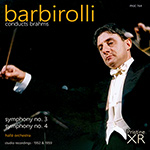
Sir John Barbirolli’s relationship with Brahms was one of instinctive sympathy rather than doctrinal alignment. He did not approach these symphonies as architectural monuments to be surveyed from a distance, nor as exercises in classical restraint, but as living musical organisms, shaped by long melodic spans, subtle internal balance, and a constant concern for expressive continuity. These two recordings, made seven years apart with the Hallé Orchestra, offer a revealing portrait of that approach at different stages of both conductor and orchestra.
The Third Symphony, recorded in May 1952, comes from a period when the Hallé was still emerging from the privations of the war years. Technical polish was not yet its defining quality, but what Barbirolli drew from the players was something arguably more important: rhythmic alertness, clarity of articulation, and an unforced warmth of tone. Contemporary criticism recognised the performance as one of real distinction, praising the natural flow of the opening movement, the care taken over internal balance, and the rhythmic precision achieved without any sense of rigidity. Brahms can tempt conductors to “sag” in the finale, yet the contemporary view was that Barbirolli avoids this, sustaining the music’s momentum and keeping the argument taut.
What stands out most strongly today is the performance’s lyric inwardness. The Andante unfolds with a calm, songful inevitability, while the famous Poco allegretto avoids sentimentality entirely, its melancholy voiced with restraint and poise. Barbirolli’s Brahms is neither austere nor over-emphatic; instead, he allows the music to speak in paragraphs rather than gestures, trusting the score’s emotional logic. The mono sound, far from being a limitation, reinforces the sense of concentration and intimacy.
By the time of the Fourth Symphony recording in September 1959, circumstances had changed markedly. The Hallé was a more secure, technically assured ensemble, and the recording was made in stereo, allowing a fuller realisation of Brahms’s orchestral weight and colour. This is a darker, more uncompromising Brahms than the Third, and Barbirolli responds accordingly. Tempi are broader, textures denser, and the music’s tragic undercurrent is allowed to surface without mitigation.
The opening movement is notable for its sense of inevitability. Barbirolli does not press the drama, but neither does he relax it; the tension is cumulative, sustained across long spans rather than driven bar by bar. The Andante moderato is noble rather than consolatory, its archaic colouring given space to resonate. In the Allegro giocoso, Barbirolli avoids brilliance for its own sake, favouring weight and momentum over sparkle, while the great passacaglia finale is projected with stern grandeur. This is not a reading concerned with analytical clarity above all else; it is concerned with emotional truth and structural coherence, and it achieves both through patience and long-range vision.
The Fourth Symphony was later issued in the UK on the Pye Golden Guinea label (catalogue GSGC 14037, commonly dated to 1965), and it appears to have attracted little in the way of prominent contemporary reviewing in the major specialist press. Heard now, the recording stands comfortably alongside Barbirolli’s finest late work, and reveals a conductor fully at ease with Brahms’s tragic voice.
Taken together, these performances chart both continuity and growth. Barbirolli’s essential musical personality remains constant: lyrical, humane, and deeply responsive to Brahms’s inner life. What changes is the scale of expression and the sonic canvas on which it is realised. This pairing offers not only two distinguished interpretations of Brahms’s symphonic masterpieces, but also a compelling insight into one of the twentieth century’s most individual Brahmsians at work.
Heard today, these recordings also illuminate an approach to Brahms that differs markedly from many later traditions. Barbirolli belonged to a generation of conductors formed before the widespread influence of historically informed performance and before orchestral style became increasingly standardised across Europe and America. His Brahms is characterised by flexible tempo relationships, a strong emphasis on lyrical continuity, and a readiness to allow phrases to expand or yield in response to expressive need. Rather than treating rhythmic firmness or structural clarity as ends in themselves, Barbirolli places the music’s long melodic line and emotional trajectory at the centre of his interpretations. For listeners accustomed to tighter, more objective modern readings, these performances offer a contrasting perspective, one that prioritises warmth, elasticity and sustained musical thought as central elements of Brahms’s expressive language.
BARBIROLLI Brahms: Symphonies 3 & 4
BRAHMS Symphony No. 3 in F major, Op. 90
1. 1st mvt. – Allegro con brio (9:16)
2. 2nd mvt. – Andante (8:21)
3. 3rd mvt. – Poco allegretto (5:24)
4. 4th mvt. – Allegro – Un poco sostenuto (8:39)
Recorded in mono, 7–10 May 1952, Free Trade Hall, Manchester
BRAHMS Symphony No. 4 in E minor, Op. 98
5. 1st mvt. – Allegro non troppo (12:04)
6. 2nd mvt. – Andante moderato (11:31)
7. 3rd mvt. – Allegro giocoso (6:25)
8. 4th mvt. – Allegro energico e passionato (10:19)
Recorded in stereo, 18–19 September 1959, Free Trade Hall, Manchester
Hallé Orchestra
conducted by Sir John Barbirolli
XR remastered by Andrew Rose
Total duration: 71:59