This album is included in the following sets:
This set contains the following albums:
- Producer's Note
- Full Track Listing
- Cover Art
When Albert Herring received its first performance at Glyndebourne on 20 June 1947, Benjamin Britten appeared to have turned from tragedy to comedy with almost disarming ease. After Peter Grimes and The Rape of Lucretia, here was a chamber opera of lightness, wit and affectionate satire, freely adapted by Eric Crozier from Guy de Maupassant’s Le Rosier de Madame Husson. Yet beneath its surface sparkle lies one of Britten’s most persistent themes: the individual negotiating the pressures of a watchful, censorious community. The premiere was given by the English Opera Group, conducted by Britten himself, with Peter Pears in the title role.
The action takes place in the fictional Suffolk market town of Loxford at the turn of the twentieth century. The annual May Day celebrations have reached a moral impasse. Lady Billows and her committee wish to crown a May Queen, but no local girl can satisfy their standards of virtue. Their solution is ingenious and absurd: they will crown a May King instead. The chosen emblem of innocence is Albert Herring, the shy greengrocer’s son, dutiful, repressed and watched over by a formidable mother. During the festivities, Sid spikes Albert’s lemonade with rum. Albert disappears overnight, panic ensues, and when he returns, rather more worldly than before, he has discovered the beginnings of independence.
The first American performances followed remarkably quickly, at Tanglewood on 8 and 9 August 1949, mounted by the Opera Department of the Berkshire Music Center under Boris Goldovsky. The original programme announced the work “For the First Time in This Country,” and the production formed part of the post-war Tanglewood culture in which new opera, young singers and adventurous theatrical training were closely entwined.
Robert A. Simon, reviewing the first night in The New Yorker, was immediately won over, praising the opera’s “believable story, involving believable people” and writing that “words and music are as one.” His review makes clear that he heard the 8 August cast, not the present recording of 9 August, but his enthusiasm for the production as a whole is unmistakable: Goldovsky conducted and, with Sarah Caldwell, directed the enterprise, earning, in Simon’s phrase, “several echoing cheers.” A further contemporary verdict, quoted from Warren Storey Smith in the Boston Post, described the first American performances as “a triumph” both for the opera and for Goldovsky’s production.
Today Boris Goldovsky is remembered as one of the great champions of opera in America. Born in Moscow in 1908 into a distinguished musical family, he studied in Europe with Artur Schnabel and Ernő Dohnányi before settling in the United States, where he became a conducting student of Fritz Reiner at the Curtis Institute. By the 1940s he was shaping opera departments at both the New England Conservatory and the Berkshire Music Center, later becoming nationally known through touring opera, English-language productions, teaching, broadcasting and his Metropolitan Opera radio commentaries.
This production also preserves an early glimpse of Sarah Caldwell, then still in her twenties and working as Goldovsky’s assistant. She would later found the Boston Opera Group, subsequently the Opera Company of Boston, and become one of the most audacious figures in American opera, renowned for ambitious repertory and theatrical daring.
The cast heard here is that of the second Tanglewood performance: David Lloyd as Albert, Ellen Faull as Lady Billows and Lise Sorrell as Mrs Herring, alongside Elinor Warren, Beverly Hunziker, James Pease, Howard Fried, Joseph Contreras, Nora Riggs, Frances G. Cammuso, Bennett Eppes, Irvin Nordquist and Helen Spaeth. Lloyd later recalled that he had been “the first American Albert,” and his subsequent career embraced both singing and opera administration.
The survival of this recording is itself remarkable. Professional tape recording was still a very new technology in the United States in 1949, with the first commercial Ampex machines having entered service only the previous year. The surviving source exhibits pronounced and continuously varying speed instability, with the pitch rising progressively and unevenly over the course of individual reels. Whether this behaviour was introduced during the original recording or during a later playback transfer cannot now be known with certainty, but it is consistent with the mechanical characteristics of early tape transports, particularly changing reel tension and load as the tape pack moved from one spool to the other. Each reel has therefore been carefully analysed and continuously re-pitched in order to restore stable musical pitch throughout the performance.
Seventy-seven years later, this Tanglewood Albert Herring still speaks with freshness and charm. It is a document of Britten’s early American reception, of Goldovsky’s missionary zeal, of young singers meeting a new work at close quarters, and of a moment when opera and recording technology were both opening new doors. A May King had crossed the Atlantic, lemonade and all.
BRITTEN Albert Herring, Op. 39
Comic opera in three acts
Libretto by Eric Crozier, after Guy de Maupassant's Le Rosier de Madame Husson
Disc One: Act One and Act Two, Scene One (65:27)
01. Act One, Scene One - The morning room at Lady Billows' house in Loxford (1:49)
02. Doctor Jessop's midwife... (2:21)
03. I hope we're not too early (2:25)
04. Stuff! Tobacco stink! (2:23)
05. Now then! Notebook, Florence! (2:21)
06. The first suggestion on my list (3:58)
07. Is this all you can bring? (2:28)
08. Begging your pardon (3:21)
09. Virtue, says Holy Writ (1:39)
10. Right! We'll have him! (2:49)
11. Interlude (3:11)
12. Act One, Scene Two - Bounce me high (2:27)
13. Shop! Hi! Albert! (1:31)
14. Did you ever have a pint at the local? (1:45)
15. Sid I'm sorry but... (2:39)
16. We'll walk to the spinney (2:02)
17. He's much too busy (1:55)
18. Mum wants two penn'oth of potherbs (1:30)
19. Good morning, young man! (1:25)
20. We bring great news to you (2:38)
21. Well, think of that, my lad (2:24)
22. Act Two, Scene One - Inside a marquee... (2:04)
23. For three precious weeks (0:50)
24. That's a fine sight for sore eyes! (2:07)
25. Quickly, quickly (2:52)
26. I don't think you ought! (0:44)
27. Quick, here they are! (2:11)
28. Husssh!... Harold Wood! (1:31)
29. Come, let's sit down (1:00)
30. I'm full of happiness (3:07)
Disc Two: Act Two, Scene One continued, Scene Two and Act Three (57:37)
01. As representing our local Council (1:50)
02. My heart leaps up with joy to see (1:44)
03. Erhumph... (1:04)
04. Go on, Albert! (1:47)
05. Albert the Good! (2:07)
06. Bring the plates! Quickly now! (5:57)
07. Albert the Good! (4:09)
08. Act Two, Scene Two - Why did she stare...? (2:25)
09. You oughtn't to whistle (1:18)
10. Come along, darling, come follow me quick! (1:59)
11. Heaven helps those who help themselves (4:36)
12. Albert! Albert? Fast asleep, poor kid! (2:13)
13. Act Three - The following afternoon... (2:04)
14. Is she asleep? (2:39)
15. What the hell d'you think I am? (1:37)
16. How's the manhunt? (1:05)
17. Have you found him? (1:58)
18. All that I did! (2:26)
19. Fools! (2:05)
20. In the midst of life is death (4:10)
21. Albert... (2:25)
22. I can't remember anything (4:31)
23. Hi! That's my girl (1:28)
Cast
Albert Herring - David Lloyd
Lady Billows - Ellen Faull
Mrs Herring - Lise Sorrell
Sid - Irvin Nordquist
Nancy - Helen Spaeth
Florence Pike - Elinor Warren
Miss Wordsworth - Beverly Hunziker
Mr Gedge - James Pease
Mr Upfold - Howard Fried
Police Superintendent Budd - Joseph Contreras
Emmie - Nora Riggs
Cis - Frances G. Cammuso
Harry - Bennett Eppes
Berkshire Music Center Opera Department
Boris Goldovsky, conductor
Boris Goldovsky and Sarah Caldwell, stage directors
Theatre-Concert Hall, Tanglewood, 9 August 1949
Recorded during the U.S. premiere production
XR Remastered by Andrew Rose
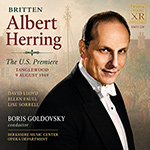
Cover artwork based on photographs of Boris Goldovsky
Total duration: 2hr 3:04