

This album is included in the following sets:
This set contains the following albums:
- Producer's Note
- Full Track Listing
- Cover Art
Among the many surviving post-war Ring cycles, the 1959 Covent Garden performances occupy a particularly fascinating place. They unite an almost ideal cast of Bayreuth veterans with one of the great Wagner conductors of the German tradition, all captured in vivid BBC broadcast sound from a house whose Wagner performances had, by this time, become annual landmarks for British listeners. Heard today, this Rheingold offers not merely a starry cast list but a revealing snapshot of Wagner performance practice at the close of the 1950s: a style rooted in textual clarity, dramatic momentum and vocal characterisation, with the orchestra driven less toward symphonic monumentality than toward theatrical urgency. It is precisely this combination of seasoned singers, sharply profiled conducting and live theatrical electricity that gives the performance its enduring fascination.
In the 1950s, the BBC broadcast Richard Wagner’s four-part Der Ring des Nibelungen every year, either from Covent Garden or from Bayreuth. By the time this Covent Garden cycle was broadcast in 1959, the radio audience would have been very familiar with the key principals: Astrid Varnay as Brünnhilde, Hans Hotter as Wotan, and Wolfgang Windgassen as Siegfried. But it is hard to imagine that any listener would have been disgruntled since they had the privilege of listening to some of the finest singers of the time in roles they had completely mastered. An added bonus in 1959 was that the singers came to Covent Garden in September 1959 comparatively fresh since there had been no Ring Cycle in Bayreuth that year.
Das Rheingold has a large ensemble cast but is led by Wotan and Alberich. Hans Hotter’s mastery of the role of Wotan is unquestioned, able to convey the nuances of text with utmost clarity. Hotter had been singing professionally for nearly thirty years by 1959, but his magnificent portrayal of the arrogant deity in the opening of the cycle remains utterly captivating. Otakar Kraus, incidentally the same age as Hotter, provides us with an absorbing and convincing Alberich, which one reviewer noted “was more than merely a nasty specimen of the power-maniac but a bully much wronged, so that his final curse had the ring of truth.” Critics also singled out the “singularly plausible” Loge of Richard Holm, the “radiant” Freia of Una Hale, and the “warm vibrant-voiced” Fricka of Ursula Böse - whom Opera magazine compared to Kathleen Ferrier. Singular praise indeed.
The newcomer to this production is the conductor Franz Konwitschny. Rudolf Kempe, the Royal Opera’s music director, elected not to conduct the Ring as he had done in 1957, and instead invited Konwitschny, General Music Director of the Deutsche Staatsoper in Berlin, to come to London. Konwitschny was particularly attentive to the needs of his cast, ensuring that the orchestra supported rather than overwhelmed the singers. Critics naturally compared the two conductors, believing that Kempe constructed an over-arching narrative that treated the four operas as one entity, while Konwitschny concentrated in on small sections providing “brilliance and surge” to create a true sense of excitement. The descent into Nibelheim is just one example of a thrilling Konwitschny “surge” that can be heard in this BBC broadcast of Das Rheingold.
Quite apart from the stature of the performance itself, what is especially striking today is the quality of the original BBC engineering. Despite the inevitable challenges of a live 1959 Covent Garden relay, the balance between stage and pit is remarkably natural, preserving both vocal presence and orchestral detail with impressive consistency. There is a tangible sense of the theatre in the air around the voices, the orchestra emerging with clarity and weight while still retaining the excitement of live performance. For this release, Pristine’s Ambient Stereo XR remastering has further opened out the original broadcast image, restoring depth, warmth and spatial realism to the soundstage. The result is a listening experience that brings this great Covent Garden Rheingold vividly into the present, allowing modern ears to appreciate not only the magnificence of the singing and conducting, but also just how expertly the BBC captured these landmark performances.
WAGNER Das Rheingold
DISC ONE (73:30)
SCENE 1
1. Prelude (4:54)
2. Weia! Waga! Woge, du Welle! (2:43)
3. Garstig glatter glitschiger Glimmer! (5:21)
4. Wallala! Lalaleia! (2:49)
5. Lugt, Schwestern! (6:37)
6. Der Welt Erbe gewann ich zu eigen durch dich! (4:26)
SCENE 2
7. Wotan! Gemahl! Erwache! (9:46)
8. Sanft schloß Schlaf dein Aug’ (7:10)
9. In ihrer Mitte sei sie entführt! (2:10)
10. Endlich Loge! (3:45)
11. Immer ist Undank Loges Lohn! (7:21)
12. Ein Runenzauber zwingt das Gold zum Reif (3:15)
13. Hör’, Wotan, der Harrenden Wort! (2:59)
14. Was sinnt nun Wotan so wild? (4:39)
15. Auf, Loge, hinab mit mir! (4:22)
SCENE 3
16. Hehe! Hehe! Hieher (1:13)
DISC TWO (77:18)
1. Dem Haupt fügt sich der Helm (1:20)
2. Nibelheims Nacht walzt mich umher. Heil! Wer dort? (5:29)
3. Nehmt euch in acht! Alberich naht! Sein harren wir! (8:13)
4. Vergeh, frevelnder Gauch! - Was sagt der! - Sei doch bei Sinnen! (4:34)
5. Ohe! Hahaha! Ohe! Hahaha! Schreckliche Schlange! (6:55)
SCENE 4
6. Da, Vetter, sitze du fest! (5:36)
7. Gezahlt hab' ich; nun laßt mich zieh'n! (6:23)
8. Bin ich nun frei! Wirklich frei! (4:12)
9. Fasolt und Fafner nahen von fern (5:11)
10. Gepflanzt sind die Pfähle (6:19)
11. Weiche, Wotan, weiche! (5:16)
12. Hort, ihr Riesen! Zurück, und harret! - Halt, du Gieriger! (6:27)
13. Schwules Gedunst - Zur Burg führt die Brücke (3:12)
14. Abendlich strahlt der Sonne Auge (4:19)
15. Rheingold! Rheingold! Reines Gold! Wie lauter und hell (3:52)
Chorus and Orchestra of the Royal Opera House, Covent Garden
Leader: Charles Taylor
conducted by Franz Konwitschny
CAST
Wotan - Hans Hotter
Donner - David Kelly
Froh - Edgar Evans
Loge - Richard Holm
Alberich - Otakar Kraus
Mime - Peter Klein
Fasolt - Kurt Böhme
Fafner - Michael Langdon
Fricka - Ursula Böse
Freia - Una Hale
Erda - Marga Höffgen
Woglinde - Joan Carlyle
Wellgunde - Josephine Veasey
Flosshilde - Marjorie Thomas
BBC radio broadcast from Royal Opera House, Covent Garden, London
18 September 1959
XR remastered by Andrew Rose
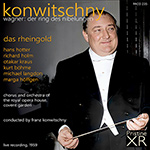
Cover artwork based on a photograph of Franz Konwitschny
Total duration: 2hr 30:46
Reviews
Fanfare — Dominic Hartley
Issue 50:1 (Sept/Oct 2026) · Read the original review
With the issue of this 1959 Covent Garden Rheingold under Franz Konwitschny, Pristine now has half a dozen complete or in-progress postwar Ring cycles: Furtwängler’s two (La Scala 1950, RAI Rome 1953); Krauss at Bayreuth in 1953; Knappertsbusch at Bayreuth in 1956; Leinsdorf at the Met in 1961–62; and now Konwitschny. What strikes me today—and what I think is the proper context in which to receive this release—is the cumulative picture. Pristine has begun to give us back not merely a set of classic individual performances but something approaching a topography of mid-century Wagner.
The point is not parochial. It would be easy enough to frame this Rheingold as the British area of that landscape. The BBC’s annual Ring broadcasts, alternating between Bayreuth and the Royal Opera, were a fixture of British musical life in the 1950s in a way that is hard to imagine now. The interest of this release is wider than that, though. We are increasingly in a position to triangulate. We can hear Hans Hotter’s Wotan under Krauss and Knappertsbusch at Bayreuth and now at Covent Garden under a different conductor and with a substantially different supporting cast. Three readings within six years. We can hear Konwitschny’s Rheingold against Krauss’s, Knappertsbusch’s, Leinsdorf’s, and the two Furtwängler’s, and notice, among many other things, how variously the orchestral writing was being realized in these years, how differently the descent into Nibelheim or the entry into Valhalla could be paced and weighted.
That’s the case I want to make for this release in its broader context, and it is a case I would make even if the recording itself was of merely documentary interest. As it happens, it’s rather better than that. Konwitschny is not Furtwängler, perhaps, but he is a Wagnerian of real distinction. Born in Moravia in 1901, he had a long association with the Leipzig Gewandhaus and with the Berlin Staatsoper. He was widely regarded in his lifetime as one of the leading German conductors of his generation, particularly in Wagner and Bruckner. He died in 1962, only three years after this Rheingold was broadcast, which gives the recording an additional retrospective interest. It catches him near the end of a career that ought to be much better known than it is.
What strikes me about his work here is the absence of any straining after grandeur and the corresponding presence of theatrical instinct. There is a sense throughout of a conductor thinking dramatically. Of the cast, Otakar Kraus’s Alberich is a particular pleasure. He’s not the snarling caricature one sometimes hears, but a wronged and resentful presence. Richard Holm makes a plausible Loge, sly and ambivalent. And then there’s Hotter. His intelligence here, his textual specificity, the way he weighs every phrase as if he were sounding out the line for the first time, is wonderful.
A word too on the engineering, which the liner notes describe as astonishingly good for 1959, a claim absolutely borne out on listening. The original BBC broadcast preserves the balance between stage and pit wonderfully well and Andrew Rose’s Ambient Stereo XR remastering has opened the sound out further. The remaining three operas are on their way. I’ll be waiting for them. Dominic Hartley
