
This album is included in the following sets:
This set contains the following albums:
- Producer's Note
- Full Track Listing
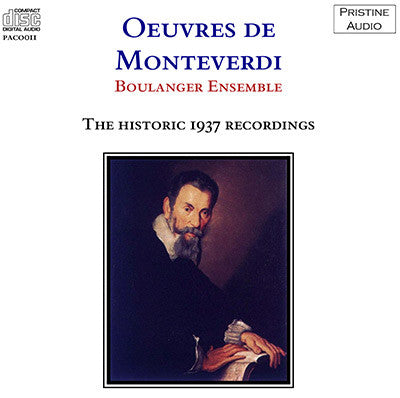
- Cover Art
"One of the purest treasures the gramophone has given us"
- The Record Guide, 1952
This collection of various madrigals and other works by Claudio Monteverdi (1567-1643) has often been regarded as one of the most important recordings of the twentieth century. Made in 1937 under the direction of Nadia Boulanger (who accompanies some of the pieces at the piano), it re-introduced to the world a composer who had been virtually forgotten for centuries; yet he was the musical genius who had practically invented opera with Orfeo in 1607, and whose marrying of musical techniques old and new set the stage for the entire Baroque movement.
Yet there is more to this recording than simply the merit of discovering lost musicians. In these ten 78rpm sides Boulanger conjured up musical perfection such that it has rarely been unavailable since, on a variety of transfers, good, bad and indifferent.
I am grateful to a long-time customer of Pristine Audio for suggesting this set. I had not listened to a note by Monteverdi since my school O-level music examinations in 1985, when I decided that his Beatus Vir would be the one work I had no intention of learning about, such was my lack of engagement with it at the time. (In the light of this recording perhaps I've achieved the maturity lacking all those years ago for that piece!)
Andrew Rose
BOULANGER ENSEMBLE Oeuvres de Monteverdi (1937)
MONTEVERDI Madrigals and other works
1. Hor ch'el ciel e la terra (5:43)
Madrigali guerrieri et amorosi...libro ottavo (pub. 1638)
Hor ch'el ciel e la terra (6 part madrigal)
2. Lamento d'Arianna — Lasciatemi morire (2:55)
Il sesto libro di madrigali (1614)
Lamento d'Arianna: Lasciatemi morire (5 part madrigal)
3. Zefiro torna, 'ciacona' (7:54)
Scherzi musicali (pub. 1632)
Zefiro torna, 'ciacona' (Chaconne for two tenors)
4. Ardo e scoprir (4:13)
Madrigali guerrieri et amorosi...libro ottavo (pub. 1638)
Ardo e scoprir (Duet for two tenors)
5. Ohimè, dovè il mio ben- (1:43)
Concerto — settimo libro di madrigali (1619)
Ohimè, dovè il mio ben? (Romanesca for two tenors)
6. Chiome d'oro, bel thesoro (2:34)
Concerto — settimo libro di madrigali (1619)
Chiome d'oro, bel thesoro (Canzonetta for two tenors)
7. Il ballo delle ingrate (8:51)
Ballet (1608)
Il ballo delle ingrate (Ballet extracts for solo voices & strings)
8. Non havea Febo ancora (lamento della ninfa) (4:21)
Madrigali guerrieri et amorosi...libro ottavo (pub. 1638)
Non havea Febo ancora (lamento della ninfa) (4 part madrigal)
9. Ecco mormorar l'onde (3:09)
Il secondo libro di madrigali (pub. 1590)
Ecco mormorar l'onde (5 part madrigal)
All nine tracks:
Recorded in 1937, issued as 5HMV 78s DB.5038-42
Matrix Numbers:2LA: 1525-6, 1520-21, 1519, 1532, 1535-4, 1518, 1533
Takes: All first except 2LA1518 ("Amor") - 3rd take
Fanfare Review
Writing
in Fanfare magazine in 2003, Raymond Tuttle states: "While it is not
difficult to find versions that surpass these on technical grounds—I
mean both the production of notes and the electronic reproduction of
sound—I can’t think of any that are more sincere, more heartfelt.
Boulanger guides these works with the bittersweet tenderness of a mother
guiding her infant child in his first steps."
He goes on:
"Boulanger’s small, handpicked ensemble of singers was a diverse group.
There were émigrés from Eastern Europe, a countess, and a tenor who was
equally at home in French art song and the music hall. For the most
part, these were not “great” singers, but they were dedicated to
Boulanger and to the composers that she in turn served. Hearing these
musicians, one senses that they were a family united by music.
The
age of these recordings probably works in their favor, giving them a
magical patina impossible in the clinical digital age. The feeling of
exploration, of Sleeping Beauties awakened with a kiss, is moving. Call
me a sentimentalist, but there it is."