

This album is included in the following sets:
This set contains the following albums:
- Producer's Note
- Full Track Listing
- Cover Art
Edvard Grieg’s three violin sonatas form one of the most personal and revealing strands of his output, spanning more than twenty years of creative life and charting a clear arc of artistic development. Written in 1865, 1867 and 1887 respectively, they are works to which Grieg attached unusual importance, later observing that each sonata reflected a distinct stage in his own musical growth: youthful abundance of ideas, an awakening national voice, and finally a broader, more inward-looking maturity.
The Violin Sonata No. 1 in F major, Op. 8, composed when Grieg was just twenty-two, is a strikingly assured work. Although its formal outlines reflect the German Romantic tradition in which he had been trained, the musical language is already recognisably individual. The opening movement combines rhythmic buoyancy with melodic generosity, the violin singing freely over an alert and characterful piano part. A lightly sprung Allegretto follows, its central episode hinting at the dance idioms that would become central to Grieg’s style, before a high-spirited finale rounds off the work with youthful confidence. Far from being apprentice music, the First Sonata announces a distinctive voice with remarkable clarity.
The Second Sonata in G major, Op. 13, written only two years later, marks a decisive step forward. Often nicknamed the “Dance Sonata”, it brings Grieg’s Norwegian identity into sharper focus, not through direct quotation but through the assimilation of folk rhythm and gesture into a refined chamber-music language. The opening movement unfolds with rhapsodic sweep and greater structural ambition than before, while the slow movement offers a long-breathed melody of touching simplicity. The finale, driven by energetic dance rhythms, confirms the growing equality of violin and piano, whose partnership here is fully integrated and dramatically purposeful.
With the Third Sonata in C minor, Op. 45, composed in 1887, Grieg reaches a level of expressive concentration and emotional depth unmatched in his earlier works. Darker in tone and more tightly argued, it belongs unmistakably to his mature period and was the last chamber work he completed. The opening movement is taut and intense, its thematic material closely worked, while the second movement, marked Allegretto espressivo alla Romanza, is among Grieg’s most inspired creations. Here the violin sings with an almost vocal intimacy over harmonies of subtle richness, creating a mood of restrained tenderness that lingers long after the music has faded. The finale draws once again on dance rhythms, but with an underlying gravity that prevents easy resolution, giving the work a cumulative emotional power of rare distinction.
Taken together, the three sonatas offer a remarkably complete portrait of Grieg as a chamber composer. They balance lyricism with rhythmic vitality, national colour with cosmopolitan craftsmanship, and intimate expression with formal clarity. While they may lack the overt drama of the piano concerto or the pictorial immediacy of the Lyric Pieces, they reward close listening with a depth and sincerity that place them among the most compelling violin sonatas of the Romantic era.
These performances were recorded in stereo at Abbey Road’s Studio 3 in October 1957 by Yehudi Menuhin and Robert Levin, though they were initially released in mono. Some later reissues appeared in stereo, but the sound has often remained muted by generational loss and conservative transfers. Heard today through XR remastering, the surviving stereo sources reveal a vivid soundstage, natural instrumental balance and an immediacy that belies the recordings’ age. Inner detail emerges with striking clarity, allowing Grieg’s finely wrought textures to speak with renewed freshness.
Menuhin’s playing is marked by a super-sweet tone, finely graded nuance and an instinctive lyrical generosity that suits this music perfectly. His phrasing brings out the vocal quality at the heart of Grieg’s writing, while Levin provides a sensitive and responsive partnership, shaping the piano’s often complex textures with rhythmic poise and tonal clarity. Together they offer interpretations of warmth, honesty and deep musical understanding, restoring these sonatas to their rightful place as major statements within Grieg’s chamber music.
MENUHIN plays Grieg Violin Sonatas
GRIEG Violin Sonata No. 1 in F major, Op. 8
1. 1st mvt. - Allegro con brio (7:55)
2. 2nd mvt. - Allegretto quasi andantino (4:59)
3. 3rd mvt. - Allegro molto vivace (7:04)
Recorded 9 October 1957
GRIEG Violin Sonata No. 2 in G major, Op. 13
4. 1st mvt. - Lento doloroso - Allegro vivace (8:38)
5. 2nd mvt. - Allegretto tranquillo (5:43)
6. 3rd mvt. - Allegro animato (5:32)
Recorded 10 October 1957
GRIEG Violin Sonata No. 3 in C minor, Op. 45
7. 1st mvt. - Allegro molto ed appassionato (9:54)
8. 2nd mvt. - Allegretto espressivo alla Romanza (6:36)
9. 3rd mvt. - Allegro animato (7:19)
Recorded 10 & 11 October 1957
Yehudi Menuhin, violin
Robert Levin, piano
XR remastering by Andrew Rose
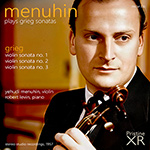
Cover artwork based on a photograph of Yehudi Menuhin
Recorded at EMI Abbey Road Studio 3, London
Total duration: 63:40
MusicWeb International Review
Menuhin commands all this with the ease and musicianship that one would expect
This is a valuable rediscovery: Menuhin in prime form plays Edvard Grieg’s three violin sonatas. It is sensible to start with the quality of the recording, in early but real stereo. Andrew Rose has put it through his XR remastering process, and the results are predictably impressive. Menuhin’s violin is rich and sweet, with only the merest trace of wiriness on the high notes. The piano is amazingly full and resonant, though isolated high notes can sound a bit tinny. But these marginal blemishes need not put off anyone who would like to hear Menuhin in these works.
Although they are not heard nearly as often as Brahms’s three violin sonatas, those by Grieg are of comparable quality. Indeed, the composer considered them to be among his best works. In fact, he wrote little chamber music. He also composed the String Quartet Op.27 and the Cello Sonata Op.36. There are several other unfinished chamber works, notably a second string quartet completed by Julius Röntgen.
Grieg wrote the first violin sonata when he was twenty-two, the second two years later while he was on his honeymoon. They show the influence of the Norwegian nationalist composer and violinist Ole Bull (1810-1880), who took the young Edvard Grieg under his wing and facilitated his musical education. Another influence was the folk music played on the Hardanger fiddle. It has sympathetic strings under those which are played, a flatter bridge, and often a very ornamental design.
The first sonata, in the same key as Beethoven’s Spring sonata for violin and piano, has a similar feeling to it. The first movement is in sonata form. In the second, you can hear the influence of the Hardanger fiddle repertoire. The cheerful finale is built from three melodies.
The second sonata is even more imbued with the folk spirit. The first movement is grander than in the first sonata, the second has a beautiful tune, and the finale is based on dance rhythms.
The third sonata, Grieg’s last chamber work, is rather different – much more serious and dramatic than its predecessors. It is rather similar in mood to Brahms’s D minor violin sonata, though that is a rather later work. The first movement is dark and powerful. The second movement has one of those themes you think you have known all your life. The finale is adventurous and vigorous.
Menuhin commands all this with the ease and musicianship that one would expect. He also has no difficulty with the occasional very fast and skittish passages, and his intonation is impeccable. His partner on the piano, who provides excellent support, is Norwegian Robert Levin (not to be confused with the American pianist and musicologist Robert Levin, who has made the best modern reconstructions of Mozart’s C Minor Mass and Requiem).
There are, of course, other recordings of this repertoire; I should put in a word for Hagai Sham and Arnon Erez on Hyperion. But if you collect Menuhin or simply want to hear some fine violin playing, this will do very nicely.
Stephen Barber
MusicWeb International, May 2026
