This album is included in the following sets:
This set contains the following albums:
- Producer's Note
- Full Track Listing
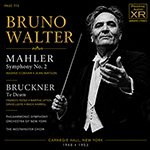
- Cover Art
On Sunday afternoon, 5 December 1948, Bruno Walter returned to Carnegie Hall to conduct the Philharmonic-Symphony Orchestra of New York in Mahler’s Symphony No. 2, the “Resurrection”. It was the third performance in a remarkable sequence of concerts given that week, following earlier performances on 2 and 3 December. Joined by soprano Nadine Conner, contralto Jean Watson and the Westminster Choir under Dr John Finley Williamson, Walter brought to Mahler’s vast symphonic fresco an authority rooted not merely in tradition, but in direct personal connection to the composer’s world.
Even in 1948 Mahler’s symphonies had not yet assumed the central place they occupy today. The Second Symphony, with its immense scale, philosophical ambition and choral finale, was still regarded in many quarters as an extraordinary undertaking rather than established repertoire. Walter, however, had long been recognised as one of Mahler’s supreme interpreters. As a young chorus director at the Hamburg Opera in the 1890s, he had worked closely with Mahler himself, absorbing both the practical discipline and expressive breadth that shaped these performances decades later.
The programme note distributed at Carnegie Hall traced the work’s origins through Mahler’s years in Hamburg and his struggle to find the key to the symphony’s final movement. Only after attending the funeral of Hans von Bülow in 1894, the note explained, did Mahler discover the solution he sought, hearing Klopstock’s “Resurrection” ode sung during the service: “This struck me like a flash of lightning. Everything was revealed clear and plain to my soul.”
Reviewing the first performance in The New York Times, Noel Straus recognised immediately the exceptional stature of Walter’s interpretation. The symphony, he wrote, was “bound together from first to last with the utmost logic”, praising Walter’s “keen understanding of its every measure” and performances of rare “sensitivity, searching imagination and conveyance of every fluctuating mood from the most lyric to the most dramatic.”
Such comments go to the heart of Walter’s Mahler style. There is grandeur here, certainly, but never heaviness for its own sake. Walter shapes the gigantic structure organically, allowing its immense paragraphs to unfold naturally rather than forcing them into rhetorical display. The opening movement retains its terrifying weight and tragic momentum, while the Andante offers fleeting consolation before the sardonic Scherzo unsettles the ground once more. Jean Watson’s deeply felt Urlicht leads into a finale whose vast choral peroration emerges not as theatrical effect, but as the inevitable fulfilment of all that has preceded it.
These Carnegie Hall performances captured Walter and the New York Philharmonic at a moment of exceptional mutual understanding. The orchestra responds with power, refinement and commitment throughout, while the Westminster Choir brings both clarity and weight to the climactic pages. Heard today, the performance still carries the electricity of live occasion: not a studio reconstruction, but a living musical event unfolding before a Carnegie Hall audience less than four decades after Mahler’s death.
This set is completed by Anton Bruckner’s Te Deum, recorded at Carnegie Hall on 7 March 1953 with the New York Philharmonic, Westminster Choir and a distinguished quartet of soloists: Frances Yeend, Martha Lipton, David Lloyd and Mack Harrell. Bruckner valued the work highly, and is said to have considered it as a possible substitute finale for his unfinished Ninth Symphony. Compact in scale beside Mahler’s monumental canvas but no less fervent in expression, the Te Deum combines exultant choral writing, blazing orchestral sonorities and moments of profound devotional stillness. Walter’s performance balances grandeur with humanity, bringing warmth and momentum to music that can sometimes become merely monumental.
Pristine Audio’s Ambient Stereo XR restorations present these historic performances with renewed depth, presence and transparency, preserving both the scale of the music and the profoundly human qualities at the centre of Walter’s interpretations.
WALTER conducts Mahler and Bruckner
Disc one (48:48)
MAHLER Symphony No. 2 in C minor, “Resurrection”
1. 1st mvt. - Allegro maestoso. Mit durchaus ernstem und feierlichem Ausdruck (21:57)
2. 2nd mvt. - Andante moderato. Sehr gemächlich (11:06)
3. 3rd mvt. - Scherzo. In ruhig fliessender Bewegung (10:42)
4. 4th mvt. - Urlicht. Sehr feierlich, aber schlicht (5:03)
Disc two (54:21)
1. 5th mvt. (part 1) - Im Tempo des Scherzos. Wild herausfahrend (13:43)
2. 5th mvt. (part 2) - Wieder zurückhaltend - Langsam. Misterioso (20:31)
Nadine Conner, soprano
Jean Watson, contralto
BRUCKNER Te Deum in C major, WAB 45
3. 1. Te Deum laudamus. Allegro (6:12)
4. 2. Te ergo quaesumus. Moderato (2:12)
5. 3. Aeterna fac. Allegro. Feierlich, mit Kraft (1:27)
6. 4. Salvum fac populum tuum. Moderato (5:17)
7. 5. In te, Domine, speravi. Mäßig bewegt (4:59)
Frances Yeend, soprano
Martha Lipton, contralto
David Lloyd, tenor
Mack Harrell, baritone
Philharmonic-Symphony Orchestra of New York
Westminster Choir (Dr John Finley Williamson, director)
conducted by Bruno Walter
Mahler: Recorded live at Carnegie Hall, New York, 5 December 1948
Bruckner: Recorded at Carnegie Hall, New York, 7 March 1953
XR remastered by Andrew Rose
Cover artwork based on a photograph of Bruno Walter
Total duration: 1hr 43:10