
This album is included in the following sets:
This set contains the following albums:
- Producer's Note
- Full Track Listing
- Cover Art
My initial thoughts when listening to this recording were mixed. For large parts of it the sound was adequate, though not wonderful But then I'd hear a nasty edit and a section of really poor quality audio which tempted me to abandon the whole exercise.
But what I discovered in the process of restoring this recording was far more interesting that I ever imagined. It's a perfect example of a new technology not being properly understood or handled - rather than recording the musical repeats, these were simply copied (badly) and spliced in (very badly) from the original material!
Now whilst we can't go back and re-record the poor-quality dubs used on the vinyl release, we can now remake those edits, splice in the originals without loss of quality, and do this to a degree of precision undreamed of in the 1950's.
That, coupled with the resolution of a number of major sonic flaws, especially with regard to tonal balance, mean that we can now present the record as it should have sounded 52 years ago, rather than the deeply flawed product put out originally.
Andrew Rose
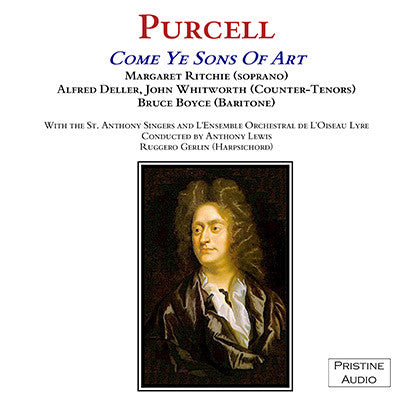
DELLER Purcell: Come Ye Sons of Art (1953)
PURCELL Come Ye Sons Of Art
1. Symphony Largo-Allegro-Adagio [Orchestra] (4:04)
2. Come Ye Sons Of Art, Away [Counter-Tenor Solo and Chorus] (2:07)
3. Sound The Trumpet, 'Til Around [Duet — Two Counter-Tenors — Chorus] (4:00)
4. Strike The Viol, Touch The Lute [Counter-Tenor Solo] (3:03)
5. The Day That Such A Blessing [Bass solo] (2:12)
6. Bid The Virtues, Bid The Graces [Soprano solo] (3:10)
7. These Are The Sacred Charms [Bass solo] (1:49)
8. See Nature, Rejoicing, Has Shown Us The Way [Soprano and bass soli — Chorus] (2:42)
Released in ~1953 as a L'Oiseau Lyre LP and on London LP DL 53004
Duration 23:06
Margaret Ritchie (soprano)
Alfred Deller, John Whitworth (Counter-Tenors)
Bruce Boyce (Baritone)
The St. Anthony Singers
L'Ensemble Orchestral de L'Oiseau Lyre -
Conductor: Anthony Lewis
Ruggero Gerlin (Harpsichord)
Bill Rosen's Review
I never got over how Deller and John Whitworth challenge each other with roulades over Purcell's ceaseless accompanying rhythm
When
I was young, I considered Purcell to be a rather feeble forerunner of
Handel. The recording that changed my mind and made me realize that
Purcell was great and original was a rather dullish-sounding 10" import
in an unattractive box featuring Alfred Deller, supposedly a man,
singing in a register I associated with women. I gradually got used to
him and his colleague by means of their magnificent duet "Sound the
Trumpet". I never got over how Deller and John Whitworth challenge each
other with roulades over Purcell's ceaseless accompanying rhythm. What
can one say about a set of singers that also includes Margaret Ritchie
and Bruce Boyce? The orchestra and chorus perform with tremendous vigor.
In
order to be sure that I was not just suffering from nostalgic dementia,
I played a 1992 recording of the same work with Robert King conducting
the Oxford New College Choir and the King's Consort. It was BORING!
Everybody seemed to be just singing the notes, whereas in the Deller
recording everybody seemed to mean the notes. Although it was in stereo,
even the sound was boring. The singers were very good, but the whole
affair seemed listless after the Deller recording under review. I
noticed that the King recording said, "Complete Odes and Welcome Songs -
Volume 8". Maybe they were really yearning to do "West Side Story".
To
me, the Pristine Audio Restoration has made the Ancient L'Oiseau Lyre
recording equal or even superior to the 1992 Hyperion in terms of
musical punch, freedom from noise and detail. It means that I can listen
to an historical recording and forget the historical part. It
potentially opens up for me what is perhaps the greatest period of
classical performance practice: 1926-1957.
Reviewer: Bill Rosen
