
This album is included in the following sets:
This set contains the following albums:
- Producer's Note
- Full Track Listing
- Cover Art
The faults noted in the three other recordings of Fauré’s beautiful work, foggy choral tone in soft passages, dynamics out of perspective, and so forth, are all avoided here and in almost every respect this is an ideal performance.
This chorus is superior to those used in the previous recordings and the choice of Gérard Souzay gives special distinction to the baritone solo. He sings most beautifully throughout.
Alec Robertson, The Gramophone, April 1956 (Requiem, original mono-only issue)
I wrote of this recording of Fauré’s Requiem Mass, when it was issued four years ago, as in almost every respect an ideal performance. The qualification was called for by some minor faults of balance and by the rather too vibrant singing, as I felt it to be, of that fine artist Suzanne Danco in “Pie Jesu”. Gérard Souzay sings most beautifully throughout and stereo gives a better perspective to the recording, softening also the somewhat obtrusive bass figure for the organ in “In Paradisum”, and altogether providing more musical sound, good though the mono disc was.
Alec Robertson, The Gramophone, July 1960 (Requiem, stereo issue)
Connoisseurs of record collecting will pounce on the unfamiliar item here—the prelude to Fauré’s opera Pénélope, never before available on record in this country and scarcely ever heard in the concert-hall, but lauded by all writers on Fauré for its nobility of thought. It is indeed a moving and intensely emotional piece, suggesting Penelope’s long agonised waiting, the thoughts which fill her mind, and her steadfast faith in Ulysses’ eventual return. Ansermet and his orchestra play it eloquently, as they do the Pelléas et Mélisande music (the Fileuses is charmingly done, and the Sicilienne is neither too fast nor sentimentalised); and the recording is excellent. The performance of Masques et Bergamasques (which does not often show up in its complete form) is lively enough but a shade matter-of-fact in total effect—not that this is very profound music, in any case.
Lionel Salter, The Gramophone, March 1962 (Other works)
These recordings, made six years apart, find Ansermet as a master of the orchestral music of Gabriel Fauré, in commemoration of whose 100 th anniversary this album is released. The Requiem comes relatively early in the history of Decca’s pioneering foray into the world of stereo music recordings – and yet for their Swiss production team stereo would have already been business as usual. Decca had made their first stereo recordings with Ansermet and the Suisse Romande Orchestra at Geneva’s Victoria Hall some seventeen months earlier, and in the intervening months, of twenty-six recordings made there, all but one were recorded both in mono and stereo. It would be several years before Decca dispensed with two teams of engineers and recording equipment for both formats, at around the time that the second set of recordings presented here: of the four Geneva recording sessions held in February and March of 1961, only the Fauré (and Debussy) session was a stereo-only affair, though by June separate mono taping had ceased. This would suggest that the Fauré session may have served to convince the company that it no longer needed a specially-made mono tape recording as a distinct entity in the recording process.
Naturally, this being Decca, both recording sessions resulted in excellent recordings for their day. As can been seen in the two Gramophone reviews, the advent of stereo was heard to improve the already highly lauded production of the Requiem. The further sonic advances brought to bear on these recordings by Pristine’s XR remastering only serves to further enhance the listener’s experience and get ever closer to the sound that would have been heard in Geneva’s Victoria Hall all those years ago.
Andrew Rose
ANSERMET conducts Fauré
1. FAURÉ Pénélope - Prélude (8:07)
FAURÉ Requiem, Op. 48
2. Introitus Requiem aeternam - Kyrie (7:02)
3. Offertorium Domine Jesu Christe (9:11)
4. Sanctus (3:16)
5. Pie Jesu (3:12)
6. Agnus Dei (5:17)
7. Libera me (5:24)
8. In paradisum (4:20)
Suzanne Danco (soprano)
Gérard Souzay (baritone)
L’Union Chorale de la Tour de Peilz
(chorus master: Robert Mermoud)
FAURÉ Pelléas et Mélisande, Op. 80: Suite
9. Prélude (5:51)
10. La Fileuse (Andantino quasi Allegretto) (3:09)
11. Mort de Mélisande (Molto Adagio) (4:11)
12. Sicilienne (4:02)
FAURÉ Masques et Bergamasques, Op. 112: Suite
13. Ouverture (3:30)
14. Menuet (2:42)
15. Gavotte (3:12)
16. Pastorale (4:12)
Recorded 16 October 1955
Producer: James Walker
Other works
Recorded 22-24 February 1961
Producer: Michael Brenner
Recorded at Victoria Hall, Geneva
Engineered by Roy Wallace
Orchestre de la Suisse Romande
conducted by Ernest Ansermet
XR remastering by: Andrew Rose
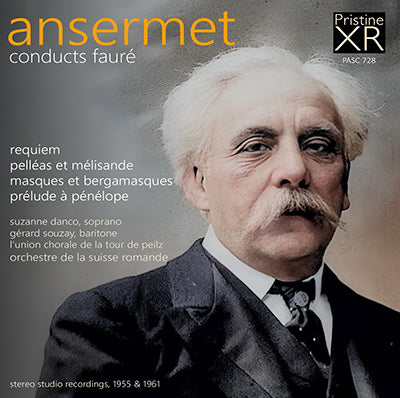
Cover artwork based on a photograph of Fauré
Requiem
Total duration: 76:38
Review
Admirers of Fauré, Ansermet, and the Suisse Romande need not hesitate. Recommended.
A new release from Pristine Audio (PA) features Decca stereo recordings of music by Gabriel Fauré, performed by the Orchestre de la Suisse Romande and conductor Ernest Ansermet. The Requiem was recorded in 1955. All the other pieces on the disc were recorded in 1961. This same collection of recordings was previously issued on the Decca Eloquence label (480 4763), and reviewed by James Miller in the May/June 2012 Fanfare (35:5). Miller praised the disc as “an excellent collection.” Miller found Ansermet’s interpretation of the Requiem “plainspoken, even on the austere side, and all the more effective for it. His two soloists, close to their vocal primes, live up to their reputation.” The Suite from Fauré’s incidental music to Pelléas et Mélisande receives a “straightforward performance,” while the Masques et Bergamasques Suite “is right up Ansermet’s alley and he delivers a performance combining energy and refinement.”
I agree with James Miller that this is a splendid collection of Fauré recordings. To the extent that one might find sentimentality in Fauré’s music, such elements are absent here. Ansermet draws a refined, transparent, and marvelously blended sonority from his orchestra. The brooding Prélude from the opera Pénélope maintains a controlled tension throughout. Fauré described his Requiem as “a happy deliverance, as a yearning for joy that lies beyond, rather than as a sorrowful passing.” Ansermet fashions a rendition that maintains a lightness of touch. The sonority favors the middle and upper registers of both chorus and orchestra. Tempos never flag, and the application of rubato is subtle and elegant. Both soprano Suzanne Danco and baritone Gérard Souzay are marvelous in their solos, and very much in accord with Ansermet’s overall concept. The L’Union Chorale de la Tour de Peilz is likewise both restrained in approach and pleasing in sonority. Both the Pelléas et Mélisande and Masques et Bergamasques orchestral suites are performed with precision, elegance, and gratifyingly focused wind and brass. All told, these are excellent performances by an orchestra and conductor celebrated for their mastery of French repertoire.
I have not heard the Eloquence reissue of these Decca stereo recordings. In PA’s XR remastering by Andrew Rose, they sound fresh, lifelike, and of a far more recent vintage than 1955 and 1961. The acoustic has ample dynamic range, color, detail, and attractive depth of perspective. Tape hiss is minimal. PA inserts ample runoff between each of the pieces, so that the CD’s total time is 76:38, compared with 76:14 for the Eloquence release. PA includes early Gramophone reviews of the featured recordings and brief comments by Andrew Rose, but not texts or translations for the Requiem . Admirers of Fauré, Ansermet, and the Suisse Romande need not hesitate. Recommended.
Ken Meltzer