

This album is included in the following sets:
This set contains the following albums:
- Producer's Note
- Full Track Listing
- Cover Art
While Albert Coates has long been associated with Wagner and Russian music of the Romantic era, his championing of contemporary music has been less recognized, particularly in the area of recording reissues. The current release addresses this by presenting all of his recordings of Stravinsky and Ravel which have not already appeared on Pristine along with his complete recordings of works by Scriabin, Prokofiev, Holst, Bax and Respighi. Some of the works were last reissued nearly half a century ago on LP, while others are being revived here for the first time.
At a time when Columbia did not have a single Beethoven symphony in its catalog, it is remarkable that the label brought out a complete recording on three discs of a then-challenging contemporary work by Scriabin, The Poem of Ecstasy. In the event, it was not quite complete. At the break between Sides 4 and 5 (15:44 in the track), 19 bars totaling around a minute of music from Figure 30 to 32 in the score are missing. It was less likely an intentional cut than an oversight, as the music could have fit on either side. Sides 3 and 4 were first recorded a week after the others, and it is likely that Coates and the session producer forgot where Side 5 had begun and inadvertently left the bars out. Although one gets a general idea of Coates’ approach, the acoustic process could not really do justice to this colorful score, and it is a shame that he never got to re-record it electrically.
Coates had previously recorded the 1911 version of Stravinsky’s Firebird Suite acoustically in 1924 (reissued on Pristine PASC 303). This electric remake of two of the numbers generates a great deal of excitement, although the orchestral choirs in the “Infernal Dance” are noticeably out-of-sync at some points. Coates’ single disc of The Song of the Nightingale is labeled “Chinese March”, although here this section appears between the opening “Celebration” music and the last minute or so of the final segment, the “Funeral March”. Those following the score will note that Coates takes a repeat starting around 2:20 in the first section, incorporating music which does not appear elsewhere; and in the last section, the flute phrase two bars before Figure 96 is transposed upward by a full tone.
Coates’ disc of music from The Love for Three Oranges was the first recording of any Prokofiev orchestral music ever made, predating Koussevitzky’s more famous first Boston version by two years. The composer’s Le pas d’acier (most helpfully translated as The Dance of Steel) was a ballet containing descriptive scenes in a Soviet foundry. One of Coates’ last recordings for HMV, it was taken down complete; but the two sides containing numbers 7 through 9 of the score were never released.
Sir Adrian Boult’s long association with Holst’s The Planets has obscured the work’s connection to Coates; but while Boult conducted the first (incomplete) performance to a privately-invited audience in 1918, Coates presented the first public performance with the LSO in 1920. Six years later, he recorded the four movements presented here with essentially the same ensemble. Coates’ “Mars” is taken at a much faster clip than most performances, while the central section of his “Jupiter” is, by contrast, broadly paced, with an affectionate nobility that Elgar might have envied.
While Coates made several discs of operatic choruses by Wagner, Mussorgsky and others, Bax’s Mater ora Filium was his only recording as director of an a cappella choir. It was one of the earliest electrical recordings HMV made outside their studios. The Fountains of Rome was the first recording of any of Respighi’s “Roman Trilogy”, besting Molajoli’s version by nine months.
Coates had previously recorded Ravel’s Ma mère l’Oye Suite acoustically (PASC 303) before making the première recording of his La valse (which, oddly, was not released in the UK). It showcases a brilliant performance of great energy and detail, in sound that utterly belies its one hundred years.
Mark Obert-Thorn
COATES conducts 20th Century Music
CD 1 (57:21)
1. SCRIABIN The Poem of Ecstasy, Op. 54 (1905–08) (19:10)
Recorded 27 April & 7 May 1920, Columbia Clerkenwell Road Studio, London · Matrices: 74060-2, 74061-2, 74081-1, 74082-2 & 74062-1 · First issued on Columbia L 1380/2
STRAVINSKY The Firebird (1910)
2. The Princesses’ Game with the Golden Apples (2:38)
3. Infernal Dance of All Kashchei’s Subjects (4:15)
Recorded 15 February 1928, Kingsway Hall, London · Matrices: CR 1693-1 & 1692-2A · First issued on HMV D 1510
STRAVINSKY Song of the Nightingale (excerpts) (1914–21)
4. Celebration at the Palace of the Emperor of China (3:41)
5. Chinese March (3:16)
6. Funeral March (conclusion) (1:21)
Recorded 14 October 1930, Kingsway Hall, London · Matrices: Cc 20615-2 & 20614-2 · First issued on HMV D 1932
PROKOFIEV The Love for Three Oranges, Op. 33 (1921)
7. Infernal Scene (2:47)
8. March (1:42)
9. Scherzo (1:20)
Recorded 6 January 1927, Kingsway Hall, London · Matrices: CR 904-2 & 905-2A · First issued on HMV D 1259
PROKOFIEV Le pas d’acier, Op. 41 (1926)
10. Entrance of the characters (2:08)
11. The train of trading peasants (2:12)
12. The commissars (1:52)
13. The little street vendors (1:54)
14. The orator (1:54)
15. The sailor with bracelets and the working girl (2:19)
16. The hammers (1:34)
17. Finale (3:08)
Recorded 18 February 1932, Abbey Road Studio No. 1, London · Matrices: 2B 2199-2, 2200-2, 2801-2 & 2804-1 · First issued on HMV DB 1680/1
CD 2 (64:21)
HOLST The Planets, Op. 32 (1914–17)
1. Mars, the Bringer of War (6:02)
2. Mercury, the Winged Messenger (3:34)
3. Jupiter, the Bringer of Jollity (7:24)
4. Uranus, the Magician (5:24)
Recorded 20 September 1926, Kingsway Hall, London · Matrices: CR 694-1 & 695-1 (Mars), 693-2 (Mercury), 689-1A & 690-1 (Jupiter), 691-2 & 692-1 (Uranus) · First issued on HMV D 2006 (Mars), D 1308 (Mercury), D 1129 (Jupiter), D 1384 (Uranus)
HOLST The Perfect Fool – Ballet Music, Op. 39 (1918–22)
5. Introduction – Dance of Spirits of Earth (3:31)
Recorded 20 September 1926, Kingsway Hall, London · Matrix: CR 699-2 · First issued on HMV D 1308
Recorded 28 October 1925, St John’s Church, St John’s Wood, London · Matrices: CR 4-1, 5-2 & 6-1 · First issued on HMV D 1044/5
6. BAX Mater ora Filium (1921) (11:04)
RESPIGHI The Fountains of Rome (1916)
7. The Fountain of Valle Giulia at Dawn (4:07)
8. The Triton Fountain in the Morning (2:30)
9. The Trevi Fountain at Noon (3:24)
10. The Villa Medici Fountain at Sunset (5:56)
Recorded 4 January 1927 & 5 January 1928 · Matrices: CR 894-1, 895-1A, 896-2 & 897-2A · First issued on HMV D 1429/30
Recorded 26 March 1926, Queen’s Hall, London · Matrices: CR 214-1, 215-1 & 216-1 · First issued on Victor 9130/1
11. RAVEL La valse (1919–20) (11:20)
London Symphony Orchestra (CD 1; CD 2, tracks 7–10)
Symphony Orchestra (CD 2, tracks 1–5 & 11)
Leeds Festival Choir (CD 2, track 6)
Albert Coates, conductor
Producer and Audio Restoration Engineer: Mark Obert-Thorn
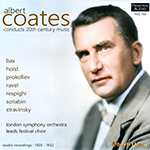
Cover artwork based on a photograph of Albert Coates
Special thanks to the late Don Tait for records from his collection
Total duration: 2hr 1:42
Gramophone Review
Whichever way you look at it you won’t find a more vivid introduction to Coates’s art anywhere.
The second CD includes an expressive account of Ravel’s Pavane pour une infante défunte and vivid performances of Debussy’s first two Nocturnes, ‘Fêtes’ taken at one hell of a lick - faster than I can remember hearing from anyone else in fact, with pin-sharp woodwind articulation and a lightning account of the central march-past, which wafts in from the near distance. Prior to Ravel, Debussy and an idiomatic-sounding account of Richard Strauss’s lilting Rosenkavalier Waltzes (the first sequence), we’re offered an electrifying rendition of Scriabin’s Third Symphony (Le divin poème), which sounds like the kind of music Tchaikovsky might have written had he lived long enough to do so.
Maybe that’s not true of Scriabin’s Fourth Symphony, The Poem of Ecstasy, a huge stylistic leap forwards after the Third, grounded as it is in the mystical sound world of the composer’s late maturity. Albert Coates’s 1920 recording (timing 19'11"), which for whatever reason isn’t quite complete, has a peculiar charm, the acoustical process bringing a unique intimacy to music that usually relies on a huge welter of sound to make its impact, especially at its close. Coates’s LSO recording, superbly transferred by Mark Obert-Thorn, pinpoints individual instruments, the lead violin promoting a degree of portamento that dates its provenance beyond reasonable doubt. The performance itself certainly pushes forwards, and if the final ecstatic surge lacks sonic substance, its enthusiastic interpretative thrust is beyond doubt.
Coates was the opposite of the disciplinarian Rodziński, more along the lines of his impulsive Russian conductor/composer contemporary Nikolay Golovanov (there’s an online mugshot of the two men sitting together), less concerned with fine detail than with the overall thrill and sweep of a work. The remainder of this double-pack devoted to Coates conducting 20th-century music includes a generous Suite from Prokofiev’s ballet Le pas d’acier, excerpts from The Love for Three Oranges (including a fiery ‘Infernal Scene’), extracts from Stravinsky’s Firebird and Song of the Nightingale, all electrically recorded, as are movements from Holst’s The Planets and The Perfect Fool. ‘Mars’ flies past with the speed of lightning. By contrast, Bax’s rather beautiful a cappella piece Mater ora filium comes off well and there are full-on performances of Respighi’s Fountains of Rome and Ravel’s La valse (the latter is a real stunner, exciting and some!). Various of these recordings have been reissued before, others not, but whichever way you look at it you won’t find a more vivid introduction to Coates’s art anywhere.
Rob Cowan
Gramophone, July 2026